History
In 1874, Treaty 4, which brokered the sale of Indigenous land to the British Crown, was established between Queen Victoria and the Cree and Saulteaux First Nations. On September 15 of the same year, Kaneonuskatew (or, in his English name of George Gordon) was among the first of the Indigenous leaders to make the agreement, signing as Chief of the George Gordon First Nation. [1] By 1884, half of the families belonging to the nation were farming, a development which had commenced in 1876, and would continue for many years. [1] Although both George Gordon and his son, Moses Gordon, were originally hereditary chiefs, the people have since adopted the practice of democratically voting their chiefs and councillors into office. [2]

Treaty 4 is a treaty established between Queen Victoria and the Cree and Saulteaux First Nation band governments. The area covered by Treaty 4 represents most of current day southern Saskatchewan, plus small portions of what are today western Manitoba and southeastern Alberta. This treaty is also called the "Qu'Appelle Treaty," as its first signings were conducted at Fort Qu'Appelle, North-West Territories, on 15 September 1874. Additional signings or adhesions continued until September 1877. This treaty is the only indigenous treaty in Canada that has a corresponding indigenous interpretation.
The Cree are one of the largest groups of First Nations in North America.

The Saulteaux are a First Nations band government in Ontario, Manitoba, Saskatchewan, Alberta and British Columbia, Canada. They are a branch of the Ojibwe when they pushed west forming into a mixed culture of woodlands and plains Indians customs and traditions.
The George Gordon First Nation was the location of Gordon Indian Residential School, the longest-running residential school in Canada. The Anglican Church of Canada established a day school on Gordon’s Reserve in 1876. It was expanded in 1888 to provide housing to students attending the school. In 1929 the school was destroyed by fire and eventually rebuilt. Problems with water supply and maintenance led to its being closed for much of the time between 1947 and 1953. The school was closed in 1996. [3] Children attending Gordon Indian Residential School were reported to have suffered various forms of abuse, inflicting severe damage to the Gordon community. [4] The schools have been proven to have facilitated the abuse of children under their care. The federal government knew of these abuses, and has since apologized and paid compensation to the victims. The extent of the damage done to these communities is still yet known. [5] [6] The residential school system is widely regarded as cultural genocide, due to the action of destroying Indigenous culture, language, and religion, as well as the intent to do so. [7] On the reserve, the Gordon Recovery and Wellness Centre provides services and support to the victims of the abuse that occurred during the Residential School System. [8]

In Canada, the Indian residential school system was a network of boarding schools for Indigenous peoples. The network was funded by the Canadian government's Department of Indian Affairs and administered by Christian churches. The school system was created for the purpose of removing Indigenous children from the influence of their own culture and assimilating them into the dominant Canadian culture. Over the course of the system's more than hundred-year existence, about 30 per cent of Indigenous children were placed in residential schools nationally. The number of school-related deaths remains unknown due to an incomplete historical record, though estimates range from 3,200 upwards of 6,000.
Programs and services
The George Gordon First Nation boasts a modern medical clinic, an education centre, a computer centre, an arena and a day care, as well as the Gordon Retail Centre and the Buffalo Ranch Project. Programs that are offered to band members include the Residential School Recovery and Wellness Centre, Brighter Futures, and Gordon Social Development. Other community infrastructures involve band office, pre-fab plant, fire hall, teachers center, gymnasium, warehouse, water treatment plant, and machine shed. [1] [2]
In Canada, the First Nations are the predominant indigenous peoples in Canada south of the Arctic Circle. Those in the Arctic area are distinct and known as Inuit. The Métis, another distinct ethnicity, developed after European contact and relations primarily between First Nations people and Europeans. There are 634 recognized First Nations governments or bands spread across Canada, roughly half of which are in the provinces of Ontario and British Columbia.

The Assembly of First Nations (AFN) is an assembly, modelled on the United Nations General Assembly, of First Nations represented by their chiefs. It emerged from and replaced the Canadian National Indian Brotherhood in the early 1980s. The aims of the organization are to protect and advance the aboriginal and treaty rights and interests of First Nations in Canada, including health, education, culture and language.
Treaty Five is a treaty that was first established in September, 1875, between Queen Victoria and Saulteaux and Swampy Cree non-treaty band governments and peoples around Lake Winnipeg in the District of Keewatin. Much of what is today central and northern Manitoba was covered by the treaty, as were a few small adjoining portions of the present-day provinces of Saskatchewan and Ontario. The Treaty was completed in two rounds. The first was from September 1875 to September 1876. The Crown intended in 1875 to include only "the Indians [east and west] of Lake Winnipeg for the surrender of the Territory uncovered by previous treaties" including "the proposed migration of the Norway House band". Pimicikamak territory was north of the lake. It was included by accident or design of Tepastenam attending the Norway House signing. Additional peoples and groups signed on between 1908 and 1910.
Gordon 86 is a Cree First Nation reserve in Saskatchewan, Canada located 61 kilometres (38 mi) northwest of Fort Qu'Appelle. It is one of three territories of the George Gordon First Nation, as arranged by the signing of Treaty 4. The reserve has an area of 14,438.3 hectares. It is also known as the George Gordon Reserve.
John Baptiste Tootoosis was a prominent Cree First Nations leader in Canada. He is the grandson of Yellow Mud Blanket, the brother of legendary Cree leader Pitikwahanapiwiyin, also known as Poundmaker.
Frederick "Chief Running Deer" Sasakamoose, is a former Canadian professional ice hockey player. He is the first Canadian indigenous player in the National Hockey League, and the first First Nations player with treaty status.
In Canada, an Indian band or band, sometimes referred to as a First Nation band or simply a First Nation, is the basic unit of government for those peoples subject to the Indian Act. Bands are typically small groups of people: the largest in the country, the Six Nations of the Grand River First Nation had 22,294 members in September 2005, and many have a membership below 100 people. Each First Nation is typically represented by a band council chaired by an elected chief, and sometimes also a hereditary chief. As of 2013, there were 614 bands in Canada. Membership in a band is controlled in one of two ways: for most bands, membership is obtained by becoming listed on the Indian Register maintained by the government. As of 2013, there were 253 First Nations which had their own membership criteria, so that not all Status Indians are members of a band.
Noel Starblanket is a First Nations leader in Canada. For two terms from 1976 to 1980 he was chief of the National Indian Brotherhood.

Ahtahkakoop First Nation is a Cree First Nation band government in Shell Lake, Saskatchewan, Canada. The Ahtahkakoop First Nation government and community is located on Ahtahkakoop 104, 72 kilometers northwest of Prince Albert and is 17,347 hectares in size.
Muskowekwan First Nation is a Saulteaux (Ojibway) First Nation who inhabit approximately 100 km northwest of Melville, Saskatchewan, Canada. As of May, 2008, the First Nation has 1,517 registered people, of which their on-Reserve population was 400.
The Cold Lake First Nations is a First Nations band government. This band is the governing body for people descended from several different historic groups, hence the plural, nations, used in the band's name. In August 2016, there were 2,858 members of this band, of which 1,382 lived within five reserves, about 220 square kilometres (85 sq mi) large within the province of Alberta.
The following is an alphabetical list of topics related to Indigenous peoples in Canada, comprising the First Nations, Inuit and Métis peoples.

The Okanese First Nation is a Cree-Saulteaux First Nation band government in Balcarres, Saskatchewan, Canada.
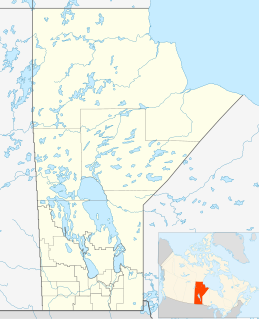
The Mathias Colomb First Nation, Mathias Colomb Cree Nation (MCCN), Mathias Colomb (Cree) First Nation, Pukatawagan/Mathias Colomb Cree Nation is a remote northern Manitoba First Nations, located 210 km (130 mi) north of The Pas and 819 km (509 mi) northwest of Winnipeg, Manitoba, which had two reserves under its jurisdiction, Indian Rreserve (IR) 198 and IR No. 199. They are part of the Treaty 6 and the main community is at Pukatawagan and consists of 1,536.6 ha on the shore of Pukatawagan Lake and lies about 210 km (130 mi) north of The Pas. Their second reserve was the Highrock reserve (CSD) located on Highrock Lake, 30 km (19 mi) downstream from Pukatawagan, which was dissolved by 2006.
Saulteaux First Nation is an Anishinaabe First Nation band government, whose reserves are located near Cochin, Saskatchewan. In February 2012, the First Nation had a total of 1,225 registered members, of which 604 lived on their own reserve.
Treaty Four Reserve Grounds Indian Reserve No. 77 is an Indian Reserve in Saskatchewan, Canada, shared by 33 band governments from Saskatchewan and Manitoba. The Reserve Grounds are located adjacent to and west of Fort Qu'Appelle, Saskatchewan. All bands are signatories to Treaty 4. This Reserve may belong to Assiniboine Chief Long Lodge #77. Who was a treaty signatory chief to treaty 4 in 1877 at Cypress Hills
George Lawrence Poitras, Paskwaw-Mostos-Kapimotet was a teacher and later Chief of the Peepeekisis Cree Nation.