
Parantica aglea, the glassy tiger, is a butterfly found in Indomalayan realm that belongs to the crows and tigers, that is, the danaid group of the brush-footed butterflies family.
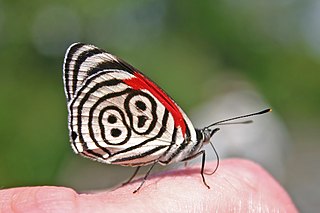
Diaethria anna, also known as Anna's eighty-eight, is a butterfly in wet tropical forests in Middle America. On rare occasions, it can be found as a stray in south Texas. Its upperside is dark brown with a metallic bluish-green band on the forewings. The underside of the forewings are red, which is followed by a wide, black band and then white tips; the underside of the hindwings is white, with lines that approximate a black-outlined "88", giving the species its common name.
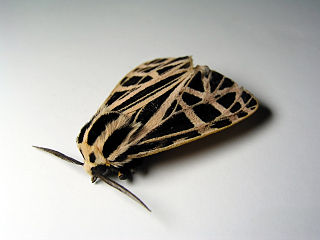
Grammia is a genus of tiger moths in the family Erebidae. The genus was described by Rambur in 1866.

Heliothis peltigera, the bordered straw, is a species of moth of the family Noctuidae.
Leptarctia is a monotypic tiger moth genus in the family Erebidae described by Stretch in 1872. Its only species, Leptarctia californiae, was described by Francis Walker in 1855. It is found in western North America, from New Mexico and Colorado to California and north to British Columbia. The habitat consists of open forests, meadows and clearings in the mountains.

Chytolita is a monotypic litter moth genus of the family Erebidae erected by Augustus Radcliffe Grote in 1873. Its only species, Chytolita morbidalis, the morbid owlet moth or morbid owlet, was first described by Achille Guenée in 1854. It is found in large parts of North America, from coast to coast in the north and south to North Carolina, Texas and Florida in the west. The habitat consists of deciduous woods and edges.

Catocala piatrix, the penitent underwing, is a moth from North America. The species was first described by Augustus Radcliffe Grote in 1864. It is placed in subfamily Catocalinae, either of the family Noctuidae, or – if the Noctuidae are circumscribed more strictly – of family Erebidae. Within the Catocalinae, it belongs to tribe Catocalini and – if the Noctuidae are circumscribed widely – subtribe Catocalina.

Euparthenos is a monotypic moth genus in the family Erebidae erected by Augustus Radcliffe Grote in 1876. Its only species, Euparthenos nubilis, the locust underwing, was first described by Jacob Hübner in 1823. The adults resemble some of the underwing moths of genus Catocala, which are fairly close relatives, in color, pattern, and the habit of resting on tree trunks. But E. nubilis can usually be immediately recognized by the four concentric black bands per hindwing, as opposed to one or two in Catocala. Color morphs of E. nubilis with altered pattern are known, however, and these may be hard to recognize without detailed examination.
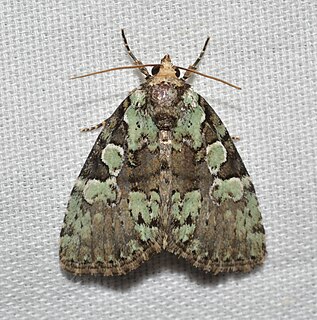
Leuconycta lepidula, the marbled-green leuconycta moth, marbled-green jaspidia or dark leuconycta, is a moth of the family Noctuidae. The species was first described by Augustus Radcliffe Grote in 1874. It is found in North America from Nova Scotia to North Carolina, west to Texas and north to Alberta.

Orthodes majuscula, the rustic Quaker, is a moth of the family Noctuidae. The species was first described by Gottlieb August Wilhelm Herrich-Schäffer in 1868. It is widespread throughout the New World, including eastern North America, Cuba, Mexico, Costa Rica and Brazil.

Apantesis nais, the Nais tiger moth, is a moth of the family Erebidae. It was described by Dru Drury in 1773.

Drasteria parallela is a moth in the family Erebidae. It is found in the Cascade Mountains of Washington, the Klamath and Siskiyou Mountains of south-western Oregon and the northern Sierra Nevada in California. The habitat consists of exposed ridges in forests at middle elevations.
Grammia blakei, or Blake's tiger moth, is a moth of the family Erebidae. It was described by Augustus Radcliffe Grote in 1864. It is found on the North American Great Plains, from the southern prairie provinces of Canada south to US states of Texas and western Colorado. The habitat consists of sandy prairie, including overgrazed native pastures.
Grammia nevadensis, the Nevada tiger moth, is a moth of the family Erebidae. It was described by Augustus Radcliffe Grote and Coleman Townsend Robinson in 1866. It is found in the Pacific Northwest of North America, as well as the inter mountain region and the Rocky Mountain states. In Canada, it is found in Alberta and southern Saskatchewan and Manitoba. The habitat consists of deserts, juniper woodlands and open sagebrush range-lands, as well as open forests.
Elophila ekthlipsis, the nymphula moth, is a moth in the family Crambidae. It was described by Augustus Radcliffe Grote in 1876. It is found in North America, where it has been recorded from the Great Lakes area, including Indiana, Maine, Michigan, Minnesota, New Brunswick, New Hampshire, Ohio, Ontario, Quebec and Wisconsin. The habitat consists of ponds and marshes.
Colomychus talis, the distinguished colymychus moth, is a moth in the family Crambidae. It was described by Augustus Radcliffe Grote in 1878. It is found in Mexico and the south-eastern United States, where it has been recorded from Alabama, Arkansas, Florida, Georgia, Maryland, North Carolina, Oklahoma, South Carolina and Virginia.

Olceclostera angelica, the angel moth, is a moth in the family Bombycidae. The species was first described by Augustus Radcliffe Grote in 1864. It is found in North America, where it has been recorded from Quebec and Maine to Florida, west to Texas and north to Wisconsin and Ontario. The habitat consists of deciduous forests.
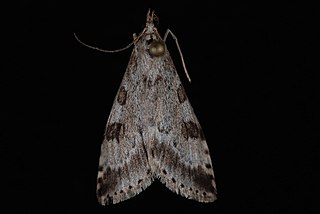
Udea washingtonalis, the Washington udea moth, is a moth in the family Crambidae. It was described by Augustus Radcliffe Grote in 1882. It is found in North America, where it has been recorded from Alaska, British Columbia, California, Montana and Washington.
Parabagrotis cupidissima is a species of moth in the family Noctuidae. It was described by Augustus Radcliffe Grote in 1875 and is found in North America, where it ranges from southern Vancouver Island, along the Pacific Coast states, to southern California. The habitat consists of grasslands and oak woodlands.
Parabagrotis insularis is a species of moth in the family Noctuidae. It is found in North America, where it has been recorded from southern Vancouver Island, along the Pacific Coast through California to near the border with Mexico. The species was described by Augustus Radcliffe Grote in 1876.


