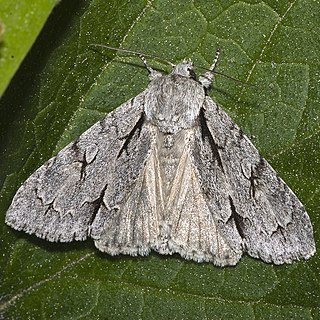
Acronicta is a genus of noctuid moths containing about 150 species distributed mainly in the temperate Holarctic, with some in adjacent subtropical regions. Caterpillars of most Acronicta species are unmistakable, with brightly colored hairy spikes, and often feed quite visibly on common foliate trees. The larva of the smeared dagger moth is unusually hairy even for this genus. Acronicta species are generally known as dagger moths, as most have one or more black dagger-shaped markings on their forewing uppersides. But some species have a conspicuous dark ring marking instead.

Euchaetes is a genus of moths in the family Erebidae. It was described by Thaddeus William Harris in 1841.

Lophocampa is a genus of moths in the family Erebidae. The genus was erected by Thaddeus William Harris in 1841. It contains around 75 species.

Grammia quenseli, the Labrador tiger moth, is a moth of the family Erebidae. In Central Europe the species is found in the Central Alps at altitudes of 2,000–2,700 metres (6,600–8,900 ft). They are also present in Northern Scandinavia. It is widely distributed in Polar Eurasia, mountains of Siberia, Mongolia, North China, Japan, Polar North America.
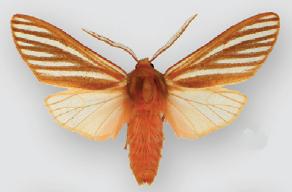
Pseudohemihyalea is a genus of moths in the family Erebidae described by Régo Barros in 1956. While the caterpillars of most species of Pseudohemihyalea feed on broad-leaved trees, the P. ambigua group has larvae that feed on conifers. Their forewing coloration has accordingly evolved to light-and-dark lengthwise striping, giving better camouflage among the slim needles of the host plants. In this, they seem to be convergent to certain geometer moths, such as Caripeta piniata or Sabulodes niveostriata.

Virbia is a genus of tiger moths in the family Erebidae. The genus was erected by Francis Walker in 1854.

Euxoa is a genus of moths of the family Noctuidae.

Dasychira is a genus of tussock moths in the family Erebidae described by Jacob Hübner in 1809. They are well distributed all over Africa, Europe, Madagascar, Japan, China, India, Sri Lanka, Myanmar, Java and Australia.

Hemileuca is a genus of moths in the family Saturniidae first described by Francis Walker in 1855.
Grammia blakei, or Blake's tiger moth, is a moth of the family Erebidae. It was described by Augustus Radcliffe Grote in 1864. It is found on the North American Great Plains, from the southern prairie provinces of Canada south to US states of Texas and western Colorado. The habitat consists of sandy prairie, including overgrazed native pastures.

Grammia figurata, the figured tiger moth, is a moth of the family Erebidae. It was described by Dru Drury in 1773. It is found in North America from southern Ontario and New Hampshire south to Georgia and west to Colorado and Texas.
Grammia nevadensis, the Nevada tiger moth, is a moth of the family Erebidae. It was described by Augustus Radcliffe Grote and Coleman Townsend Robinson in 1866. It is found in the Pacific Northwest of North America, as well as the inter mountain region and the Rocky Mountain states. In Canada, it is found in Alberta and southern Saskatchewan and Manitoba. The habitat consists of deserts, juniper woodlands and open sagebrush range-lands, as well as open forests.
Grammia speciosa is a moth of the family Erebidae. It was described by Möschler in 1864. It is found from Labrador west to British Columbia and Alaska. The habitat consists of wetlands, bogs and sub-Arctic tundra. The species is listed as endangered in Connecticut.
Grammia williamsii, or Williams' tiger moth, is a moth of the family Erebidae. It was described by Charles R. Dodge in 1871. It is found in North America from the Northwest Territories east to the northern Great Lakes region, New Brunswick and New England. It also occurs throughout the northern Great Plains, south at higher elevations to Arizona and New Mexico, west to south-eastern British Columbia and eastern California.

