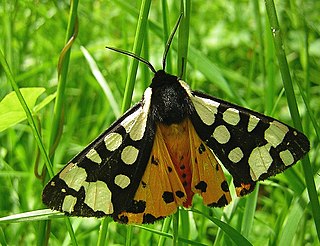
The Arctiina are a subtribe of moths in the family Erebidae.

Palearctia is a genus of tiger moths in the family Erebidae.
Grammia blakei, or Blake's tiger moth, is a moth of the family Erebidae. It was described by Augustus Radcliffe Grote in 1864. It is found on the North American Great Plains, from the southern prairie provinces of Canada south to US states of Texas and western Colorado. The habitat consists of sandy prairie, including overgrazed native pastures.
Grammia bowmani is a moth of the family Erebidae. It was described by Douglas C. Ferguson and B. Christian Schmidt in 2007. It is found in the United States in western Colorado and southeastern Utah. It occurs at elevations between 1,520 and 2,130 meters.
Grammia complicata is a moth of the family Erebidae. It was described by Francis Walker in 1865. It is found on south-eastern Vancouver Island and several Gulf Islands of British Columbia and Washington. The habitat consists of dry Garry oak meadows and sandy beaches.
Grammia edwardsii is a moth of the family Erebidae. It was described by Stretch in 1872. It is known only from the San Francisco area in California and Klamath County in Oregon.
Grammia eureka is a moth of the family Erebidae. It was described by Douglas C. Ferguson and B. Christian Schmidt in 2007. It has been found in the United States along the edges of the Great Basin in central Utah and in southwestern Idaho.
Grammia favorita is a moth of the family Erebidae. It was described by Neumögen in 1890. It is found in the Sand Hills of Nebraska, Nevada and north-eastern Colorado. The habitat consists of prairie sand dunes.
Grammia fergusoni is a moth of the family Erebidae. It was described by Schmidt in 2009. It is found in the central Sierra Nevada and White Mountains of California. The habitat consists of subalpine and alpine areas.

Grammia figurata, the figured tiger moth, is a moth of the family Erebidae. It was described by Dru Drury in 1773. It is found in North America from southern Ontario and New Hampshire south to Georgia and west to Colorado and Texas.
Grammia franconia is a moth of the family Erebidae. It was described by Henry Edwards in 1888. It is found in northeastern North America. The habitat consists of dry, rocky, or sandy areas, including pine barrens.
Grammia incorrupta is an arctiine moth in the family Erebidae, described by Henry Edwards in 1881. It is found from southern Colorado and south-eastern Kansas south through Arizona, New Mexico and western Texas into Mexico and west to south-eastern California. The habitat consists of grasslands and open woodlands.
Grammia hewletti is a moth of the family Erebidae. It was described by William Barnes and James Halliday McDunnough in 1918. It is found in the United States in south-western California.
Grammia kodara is a moth of the family Erebidae. It was described by Vladimir Viktorovitch Dubatolov and B. Christian Schmidt in 2005. It is found in the Kodar Mountains in Chita Province, Russia.

Grammia ornata, the ornate tiger moth or achaia moth, is a moth of the family Erebidae. It was described by Alpheus Spring Packard in 1864. It is found in western North America from southern British Columbia through the Pacific Northwest to southern California, northern Utah, and western Wyoming and Montana. It is found in a wide range of habitats, including open woodland.
Grammia philipiana is a moth of the family Erebidae. It was described by Douglas C. Ferguson in 1985. It is found in the far northwest of North America from Wrangel Island west to Mackenzie Delta in the Northwest Territories and south to Denali National Park in Alaska.

Grammia phyllira, the phyllira tiger moth, is a moth of the family Erebidae. It was described by Dru Drury in 1773. It is found in North America from Quebec and New England south to Florida and west to Texas, Colorado and Alberta. The habitat consists of dry, open woodland and grassland. The species is listed as endangered in Connecticut.
Grammia placentia, the placentia tiger moth, is a moth of the family Erebidae. It was described by James Edward Smith in 1797. It is found in the south-eastern United States, from New Jersey to Florida. The habitat consists of dry, sandy open wooded areas, primarily pine barrens.
Grammia williamsii, or Williams' tiger moth, is a moth of the family Erebidae. It was described by Charles R. Dodge in 1871. It is found in North America from the Northwest Territories east to the northern Great Lakes region, New Brunswick and New England. It also occurs throughout the northern Great Plains, south at higher elevations to Arizona and New Mexico, west to south-eastern British Columbia and eastern California.
Grammia yavapai is a moth of the subfamily Arctiinae. It was described by Schmidt in 2009. It is only found in the San Francisco volcanic field in Coconino County, Arizona.
