| Blake's tiger moth | |
|---|---|
| Scientific classification | |
| Kingdom: | Animalia |
| Clade: | Euarthropoda |
| Class: | Insecta |
| Order: | Lepidoptera |
| Superfamily: | Noctuoidea |
| Family: | Erebidae |
| Genus: | Grammia |
| Species: | G. blakei |
| Binomial name | |
| Grammia blakei (Grote, 1864) | |
| Synonyms | |
| |
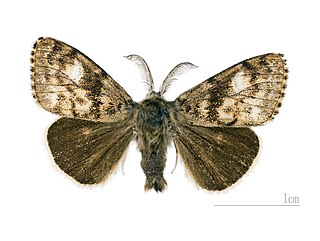
Grammia blakei, or Blake's tiger moth, is a moth of the family Erebidae. It was described by Augustus Radcliffe Grote in 1864. It is found on the North American Great Plains, from the southern prairie provinces of Canada south to US states of Texas and western Colorado. The habitat consists of sandy prairie, including overgrazed native pastures.
Moths comprise a group of insects related to butterflies, belonging to the order Lepidoptera. Most lepidopterans are moths, and there are thought to be approximately 160,000 species of moth, many of which have yet to be described. Most species of moth are nocturnal, but there are also crepuscular and diurnal species.
The Erebidae are a family of moths in the superfamily Noctuoidea. The family is among the largest families of moths by species count and contains a wide variety of well-known macromoth groups. The family includes the underwings (Catocala); litter moths (Herminiinae); tiger, lichen, and wasp moths (Arctiinae); tussock moths (Lymantriinae), including the arctic woolly bear moth ; piercing moths ; micronoctuoid moths (Micronoctuini); snout moths (Hypeninae); and zales, though many of these common names can also refer to moths outside the Erebidae. Some of the erebid moths are called owlets.
Augustus Radcliffe Grote was a British entomologist who worked mainly in America.
The length of the forewings is about 13.8 mm. The ground color of the forewings is dark chocolate brown to black with pale buff bands. The hindwings are pale yellow, but sometimes orange. There are dark brown to black markings. Adults are on wing from late May to early September, usually in one generation per year, although a partial second generation may occur in the southern parts of the range.
The larvae feed on Antennaria dimorpha , Koeleria cristata , Poa sandbergii , Stipa comata , Agropyron smithii , Eurotia lanata , Bouteloua gracilis and Carex species. [1]
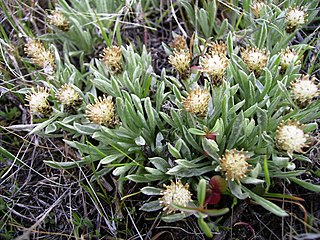
Antennaria dimorpha is a North American species of flowering plants in the daisy family known by the common name low pussytoes or gray cushion pussytoes. It is native to western Canada and the western United States as far south as Riverside County in California and Rio Arriba County in New Mexico. It is generally found in dry areas. There are historical records of the species formerly occurring in northwestern Nebraska, but these populations appear now to be gone.
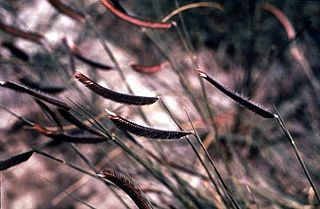
Bouteloua gracilis is a long-lived, warm-season (C4) perennial grass, native to North America.
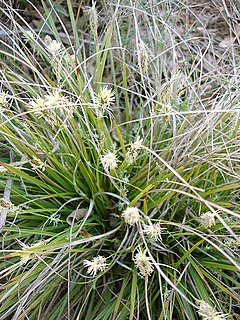
Carex is a vast genus of more than 2,000 species of grassy plants in the family Cyperaceae, commonly known as sedges. Other members of the Cyperaceae family are also called sedges, however those of genus Carex may be called true sedges, and it is the most species-rich genus in the family. The study of Carex is known as caricology.
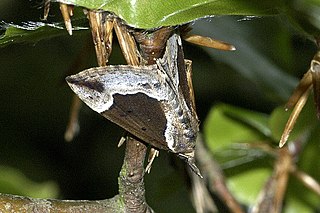
Hypena crassalis, the beautiful snout, is a moth of the family Noctuoidea. It is found in Europe.
Noctua fimbriata, the broad-bordered yellow underwing, is a moth of the family Noctuidae. It is found in Europe, North Africa, Anatolia, the Caucasus, Turkey, Caucasus, Transcaucasia, Armenia, Turkmenistan and Novosibirsk Oblast. The border of its southern range is unclear because of the similar looking species Noctua tirrenica.
Platynota flavedana, the black-shaded platynota moth, is a species of moth of the Tortricidae family. It is found in the United States from Minnesota to Maine, south to North Carolina and west to Arizona.
Grammia allectans is a moth of the family Erebidae. It was described by Douglas C. Ferguson in 1985. It is found in the Mexican states of Durango and Sonora and the Chiricahua Mountains of southern Arizona in the United States. The habitat consists of open montane pine forests.
Grammia bowmani is a moth of the family Erebidae. It was described by Douglas C. Ferguson and B. Christian Schmidt in 2007. It is found in the United States in western Colorado and southeastern Utah. It occurs at elevations between 1,520 and 2,130 meters.
Grammia cervinoides is a moth of the family Erebidae. It was described by Strecker in 1876. It is found above treeline in the Rocky Mountains of Colorado. The habitat consists of alpine areas, including rocky slopes.
Grammia doris, the Doris tiger moth, is a moth of the family Erebidae. It was described by Jean Baptiste Boisduval in 1869. It is found in British Columbia, northern Idaho, Alberta and western Montana. In the east, it is found in the Atlantic Coast provinces and from Nova Scotia to northern Florida and west to central Texas. The habitat consists of open willow/sedge fens and probably other open wetlands in the boreal forest.
Grammia edwardsii is a moth of the family Erebidae. It was described by Stretch in 1872. It is known only from the San Francisco area in California and Klamath County in Oregon.
Grammia favorita is a moth of the family Erebidae. It was described by Neumögen in 1890. It is found in the Sand Hills of Nebraska, Nevada and north-eastern Colorado. The habitat consists of prairie sand dunes.
Grammia figurata, the figured tiger moth, is a moth of the family Erebidae. It was described by Dru Drury in 1773. It is found in North America from southern Ontario and New Hampshire south to Georgia and west to Colorado and Texas.
Grammia f-pallida is a moth of the family Erebidae. It was described by Strecker in 1878. It is found from south-eastern Utah and Colorado south to eastern Arizona, New Mexico and eastern Texas. It has also been recorded from west-central Nevada, and probably also occurs in Mexico.
Grammia margo is a moth of the family Erebidae. It was described by Schmidt in 2009. It is found in grassland and transitional habitats on the northern Great Plains and Southern Rocky Mountain Front ranges, south to east-central Arizona.
Grammia nevadensis, the Nevada tiger moth, is a moth of the family Erebidae. It was described by Augustus Radcliffe Grote and Coleman Townsend Robinson in 1866. It is found in the Pacific Northwest of North America, as well as the inter mountain region and the Rocky Mountain states. In Canada, it is found in Alberta and southern Saskatchewan and Manitoba. The habitat consists of deserts, juniper woodlands and open sagebrush range-lands, as well as open forests.
Grammia ornata, the ornate tiger moth or achaia moth, is a moth of the family Erebidae. It was described by Alpheus Spring Packard in 1864. It is found in western North America from southern British Columbia through the Pacific Northwest to southern California, northern Utah, and western Wyoming and Montana. It is found in a wide range of habitats, including open woodland.
Grammia phyllira, the phyllira tiger moth, is a moth of the family Erebidae. It was described by Dru Drury in 1773. It is found in North America from Quebec and New England south to Florida and west to Texas, Colorado and Alberta. The habitat consists of dry, open woodland and grassland. The species is listed as endangered in Connecticut.
Grammia placentia, the placentia tiger moth, is a moth of the family Erebidae. It was described by James Edward Smith in 1797. It is found in the south-eastern United States, from New Jersey to Florida. The habitat consists of dry, sandy open wooded areas, primarily pine barrens.
Grammia speciosa is a moth of the family Erebidae. It was described by Möschler in 1864. It is found from Labrador west to British Columbia and Alaska. The habitat consists of wetlands, bogs and sub-Arctic tundra. The species is listed as endangered in Connecticut.
Grammia ursina is a moth of the family Erebidae. It was described by Schmidt in 2009. It is found on the Channel Islands off the coast of southern California and in mainland south-western California from Kern County south to San Diego County. It is probably also present in Baja California.
Grammia virguncula, the little virgin tiger moth, is a moth of the family Erebidae. It was described by W. Kirby in 1837. It is found across most of southern Canada and the United States, from the Rocky Mountains eastward. In the north, the range extends to northern Alberta and Newfoundland. In the south, it occurs along the Rocky Mountain to Apache County in Arizona and New Jersey in the east. It occurs in a variety of open wooded habitats, ranging from marshes, fens and bogs to transition parkland and prairie.
Grammia williamsii, Williams' tiger moth, is a moth of the family Erebidae. It was described by Dodge in 1871. It is found from the Northwest Territories east to the northern Great Lakes region, New Brunswick and New England. It also occurs throughout the northern Great Plains, south at higher elevations to Arizona and New Mexico, west to south-eastern British Columbia and eastern California.
| This Arctiina-related article is a stub. You can help Wikipedia by expanding it. |