
The Drosophilidae are a diverse, cosmopolitan family of flies, which includes species called fruit flies, although they are more accurately referred to as vinegar or pomace flies. Another distantly related family of flies, Tephritidae, are true fruit flies because they are frugivorous, and include apple maggot flies and many pests. The best known species of the Drosophilidae is Drosophila melanogaster, within the genus Drosophila, also called the "fruit fly." Drosophila melanogaster is used extensively for studies concerning genetics, development, physiology, ecology and behaviour. Many fundamental biological mechanisms were discovered first in D. melanogaster. The fruit fly is mostly composed of post-mitotic cells, has a very short lifespan, and shows gradual aging. As in other species, temperature influences the life history of the animal. Several genes have been identified that can be manipulated to extend the lifespan of these insects. Additionally, Drosophila subobscura, also within the genus Drosophila, has been reputed as a model organism for evolutionary-biological studies, along with D. sechellia for the evolution of host specialization on the toxic noni fruit and Scaptomyza flava for the evolution of herbivory and specialist on toxic mustard leaves.

The Ulidiidae or picture-winged flies are a large and diverse cosmopolitan family of flies (Diptera), and as in related families, most species are herbivorous or detritivorous. They are often known as picture-winged flies, along with members of other families in the superfamily Tephritoidea that have patterns of bands or spots on the wings. Some species share with the Tephritidae an unusual elongated posteroapical projection of the anal cell in the wing, but can be differentiated by the smoothly curving subcostal vein. Two species, Tetanops myopaeformis and Euxesta stigmatias, are agricultural pests.
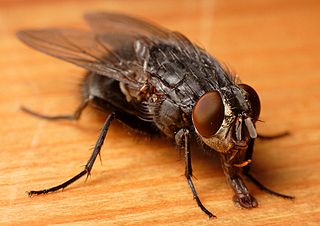
Calliphora is a genus of blow flies, also known as bottle flies, found in most parts of the world, with the highest diversity in Australia. The most widespread species in North America area Calliphora livida, C. vicina, and C. vomitoria.

The Lauxaniidae are a family of acalyptrate flies. They generally are small flies with large compound eyes that often are brightly coloured in life, sometimes with characteristic horizontal stripes, such as in Cestrotus species. Many species have variegated patterns on their wings, but in contrast they generally do not have variegated bodies, except for genera such as Cestrotus, whose camouflage mimics lichens or the texture of granitic rocks.

The Chamaemyiidae are a small family of acalyptrate flies with less than 200 species described worldwide. The larvae of these small flies are active and predatory and are often used for biological control of aphids, scale insects, and similar pests. Chamaemyiid fossils are poorly represented in amber deposits, but a few examples are known from the Eocene epoch onwards.
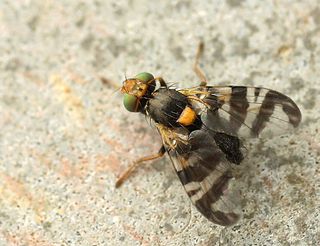
Rhagoletis is a genus of tephritid fruit flies with about 70 species.

Trupanea is a genus of tephritid or fruit flies in the family Tephritidae.
Apotropina is a genus of fruit flies in the family Chloropidae.

The Ulidiinae are a subfamily of flies in the family Ulidiidae. Like the Otitinae, most species are herbivorous or saprophagous. Most species share with the Tephritidae an unusual elongated projection of the anal cell in the wing but can be differentiated by the smoothly curving subcostal vein. Most are dull gray to shiny brown or black flies with vein R1 setulose or, in a few cases, bare.

Eutreta is a genus of the family Tephritidae, better known as fruit flies.
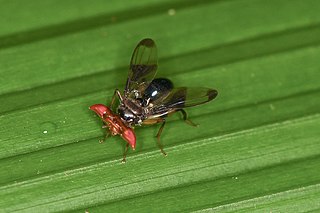
Richardia is a genus of flies in the family Richardiidae. It was first described by French entomologist Jean-Baptiste Robineau-Desvoid in 1830. It occurs from Mexico to Central and South America.

Xenochaetina is a genus of flies in the family Lauxaniidae. There are about 11 described species in Xenochaetina.
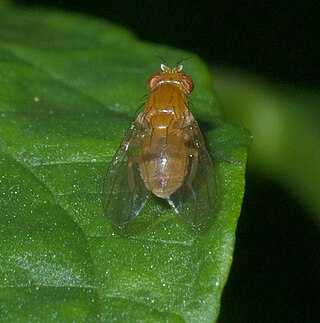
Neogriphoneura is a primarily neotropical genus of flies in the family Lauxaniidae. One species, N. sordida, ranges into the Nearctic. There are about 11 described species in Neogriphoneura.

Paralimna is a genus of shore flies.

Curtonotum is a genus of flies in the family Curtonotidae. There are more than 50 described species in Curtonotum.
Odontomera is a genus of flies in the family Richardiidae. There are about 19 described species in Odontomera.

Physegenua is a neotropical genus of flies in the family Lauxaniidae.


