
Tubers are enlarged structures in some plant species used as storage organs for nutrients. They are used for the plant's perennation, to provide energy and nutrients for regrowth during the next growing season, and as a means of asexual reproduction. Stem tubers form thickened rhizomes or stolons. Common plant species with stem tubers include the potato and yam. Some sources also treat modified lateral roots under the definition; these are found in sweet potatoes, cassava, and dahlias.
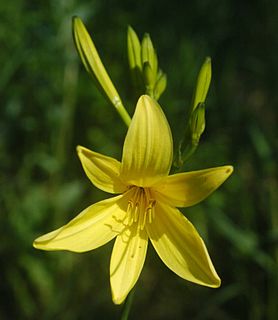
A daylily or day lily is a flowering plant in the genus Hemerocallis, a member of the family Asphodelaceae, subfamily Hemerocallidoideae. Despite the common name, it is not in fact a lily. Gardening enthusiasts and horticulturists have long bred daylily species for their attractive flowers. Thousands of cultivars have been registered by local and international Hemerocallis societies.

Hemerocallidoideae is the botanical name of a subfamily of flowering plants, part of the family Asphodelaceae sensu lato in the monocot order Asparagales according to the APG system of 2016. Earlier classification systems treated the group as a separate family, the Hemerocallidaceae. The name is derived from the generic name of the type genus, Hemerocallis. The largest genera in the group are Dianella, Hemerocallis (15), and Caesia (11).

Cornus walteri, also called Walter's dogwood, is a deciduous shrub or small tree 8–16 m tall, native to eastern Asia in Korea and much of China from Liaoning to Yunnan.
Tiger lily or Tiger Lily may refer to:

Hemerocallis fulva, the orange day-lily, tawny daylily, corn lily, tiger daylily, fulvous daylily or ditch lily, is a species of daylily native to Asia. It is very widely grown as an ornamental plant in temperate climates for its showy flowers and ease of cultivation. It is not a true lily in the genus Lilium, but gets its name from the superficial similarity of its flowers to Lilium and from the fact that each flower lasts only one day.

Oze Marshland is a high altitude marshland in the Oze National Park, Japan.

Hemerocallis middendorffii, known as Amur daylily, is a plant species in the subfamily Hemerocallidoideae of the family Asphodelaceae of the order Asparagales. It is native to the Russian Far East, northwest China, Korea, and Japan. It grows in meadows, mountain slopes, open woods, and scrub. It is cultivated in Asia for its edible flowers.

Korean immigration to Mexico began in 1905. The first Korean migrant workers settled in Yucatán, while more recent migrants from South Korea often choose Mexico City as their destination.
Hemerocallis lilioasphodelus is a plant of the genus Hemerocallis. It is found across China, in Europe in N.E. Italy and Slovenia and is one of the first daylilies used for breeding new daylily cultivars.

Hemerocallis minor, is also known as dwarf daylily, grassleaf lily and small daylily. It is native to northern Asia. The plant grows up through 0.5 m high. Its wide yellow flowers are scentless. It is a hermaphroditic species, pollinated by insects such as honey bees.
Hemerocallis hongdoensis, common name Hongdo Island day-lily or hongdo-wonch'uri, is a plant species native to a group of small islands in the Yellow Sea, off the southwest coast of South Korea. The species is named for Hongdo Island, where the type specimen was collected, about 115 km SW of Mokpo. The region is part of Dadohaehaesang National Park.
George Yeld (1845–1938) was a schoolmaster, climber, explorer and hybridiser of daylilies and irises. He was a member of the Alpine Club and editor of the Alpine Journal. Much of his climbing and exploration was conducted with volcanologist Tempest Anderson and he published reports of his exploits and produced introductory books on Latin for scholars. Yeld received the Victoria Medal of Honour from the Royal Horticultural Society in 1925.

Contarinia quinquenotata is a small midge which infests the flower buds of Hemerocallis, causing the buds to swell, remain closed and rot. It is a pest in several parts of the world. It is known by the common names of daylily gall midge and hemerocallis gall midge.

Hemerocallis citrina, common names citron daylily and long yellow daylily, is a species of herbaceous perennial plant in the family Asphodelaceae.

Hemerocallis middendorffii var. esculenta known as nikkōkisuge or zenteika is a perennial plant belonging to the family Asphodelaceae. It is native to Japan. Its yellow flower blooms in early summer, especially in the highlands of Japan in large groups.

Hemerocallis dumortieri is a species of plant in the family Asphodelaceae. It is native to Korea and possibly parts of China, and has been introduced into Japan. Hemerocallis dumortieri var. esculenta is native to Hokkaidō.
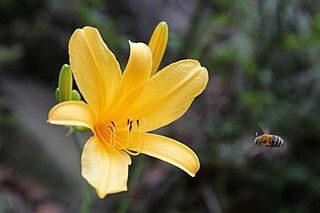
Hemerocallis hakuunensis, known as Baekunsan daylily, is a species in the family Asphodelaceae, native to Korea.

Paulownia coreana, also called Paulownia glabrata or Korean paulownia, is an indigenous species of South Korea. It is cultivated in South Pyongan and south of Gyeonggi.

Patis is a genus of grasses in the Stipeae tribe of the grass family, found in China, Korea, Japan, eastern Canada, and north central and eastern United States.
