
Halone is a genus of moths in the subfamily Arctiinae from southern Asia and Australia. The genus was erected by Francis Walker in 1854.
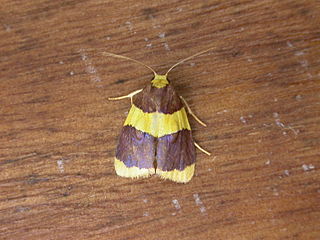
Heterallactis is a genus of moths in the family Erebidae erected by Edward Meyrick in 1886.
Heterotropa is a monotypic moth genus in the subfamily Arctiinae. Its single species, Heterotropa fastosa, is found in Australia's Northern Territory and Queensland. Both the genus and species were first described by Turner in 1940.
Oreopola is a monotypic moth genus in the subfamily Arctiinae. Its single species, Oreopola athola, is found in Australian island state ofTasmania. Both the genus and species were first described by Turner in 1940.
Sarobela is a monotypic moth genus of the family Erebidae described by Turner in 1936. Its only species, Sarobela litterata, was first described by Pagenstecher in 1888. It is found in Sri Lanka, Hong Kong, the Philippines, Taiwan, Myanmar, the Andaman Islands, Sumatra, Sulawesi, New Guinea, Borneo and Australia.
Eutane trimochla is a moth of the subfamily Arctiinae. It was described by Turner in 1940. It is known from Queensland, Australia.
Gymnasura prionosticha is a moth of the subfamily Arctiinae. It was described by Turner in 1940. It is found in Australia.
Gymnasura saginaea is a moth of the subfamily Arctiinae. It was described by Turner in 1899. It is found in Queensland, Australia.
Ameleta is a monotypic moth genus in the subfamily Arctiinae. Its only species, Ameleta panochra, is found in Queensland, Australia. Both the genus and species were first described by Turner in 1940. The habitat consists of wet tropical areas.
Heterallactis niphocephala is a moth of the family Erebidae. It was described by Alfred Jefferis Turner in 1940. It is found in Australia.
Heterallactis stenochrysa is a moth of the family Erebidae. It was described by Alfred Jefferis Turner in 1940. It is found in Queensland, Australia.
Heterallactis trigonochrysa is a moth of the family Erebidae. It was described by Alfred Jefferis Turner in 1940. It is found in Australia.
Lambula pleuroptycha is a moth of the family Erebidae. It was described by Alfred Jefferis Turner in 1940. It is found in Australia, where it has been recorded from the Northern Territory, Queensland and New South Wales.
Scaphidriotis camptopleura is a moth of the subfamily Arctiinae. It was described by Turner in 1940. It is found in the Australian state of Queensland.
Spilarctia nobilis is a moth in the family Erebidae. It was described by Alfred Jefferis Turner in 1940. It is found in Australia, where it has been recorded from Queensland.
Thallarcha epileuca is a moth in the subfamily Arctiinae. It was described by Turner in 1922. It is found in Australia, where it has been recorded from Queensland.
Thallarcha epiostola is a moth in the subfamily Arctiinae. It was described by Turner in 1926. It is found in Australia, where it has been recorded from Tasmania, New South Wales and Victoria.
Scoliacma adrasta is a moth in the family Erebidae. It was described by Alfred Jefferis Turner in 1940. It is found in Australia, where it has been recorded from Tasmania.
Threnosia hypopolia, the dull footman, is a moth in the subfamily Arctiinae. It was described by Turner in 1940. It is found in Australia, where it has been recorded from Victoria.
Threnosia myochroa, the heath footman, is a moth in the subfamily Arctiinae. It was described by Turner in 1940. It is found in Australia, where it has been recorded from New South Wales and Victoria.
