
Porpolomopsis lewelliniae, commonly known as the mauve splitting wax-cap, is a gilled fungus of the waxcap family found in wet forests of eastern Australia and New Zealand. The small mauve- or lilac-coloured mushrooms are fairly common and appear in moss or leaf litter on the forest floor in autumn, and are biotrophic. The key distinguishing feature is the splitting of the cap dividing down the middle of the individual gills.
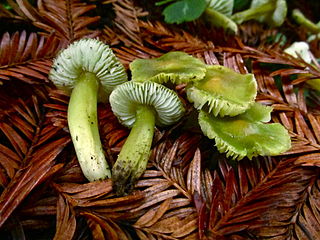
Hygrocybe virescens, commonly known as the lime-green waxy cap, is a species of agaric mushroom in the family Hygrophoraceae. The lime-green colored mushroom has a limited geographical distribution, having been reported only from California, Washington, and Mexico.

Hygrophorus subalpinus, commonly known as the subalpine waxycap, is a species of white snowbank fungus in the family Hygrophoraceae. Found in the mountains of western North America, it is found growing on the ground under conifers, usually near snowbanks.

Hygrophorus agathosmus, commonly known as the gray almond waxy cap or the almond woodwax, is a species of fungus in the family Hygrophoraceae. It was first described by Elias Magnus Fries in 1815; Fries gave it its current name in 1838. A widespread species, it is distributed in the United States, Europe, Africa, and India, and is found growing under spruce and pine in mixed forests. The fruit bodies are characterized by a light grayish cap that measures up to 8 cm (3.1 in) in diameter, waxy gills, a dry stem, and the distinct odor of bitter almonds. An edible but bland-tasting mushroom, extracts of the fruit bodies have been shown in laboratory tests to have antimicrobial activity against various bacteria that are pathogenic to humans.

Hygrophorus eburneus, commonly known as the ivory waxy cap or the cowboy's handkerchief, is a species of edible mushroom in the waxgill family of fungi. It is widespread in Europe and North America, and has also been collected in northern Africa. The fruit bodies are medium-sized, pure white, and when wet are covered in a layer of slime thick enough to make the mushroom difficult to pick up. The gills are broadly attached to the stem or running down it; as the family name suggests, they feel waxy when rubbed between the fingers. Like all Hygrophorus species, the fungus is mycorrhizal—a symbiotic association whereby the underground fungal mycelia penetrate and exchange nutrients with tree roots. They are common in a variety of forest types, where they grow on the ground in thickets or grassy areas. Hygrophorus eburneus is the type species of the genus Hygrophorus. A number of biologically active chemicals have been purified from the fruit bodies of the fungus, including fatty acids with bactericidal and fungicidal activity.
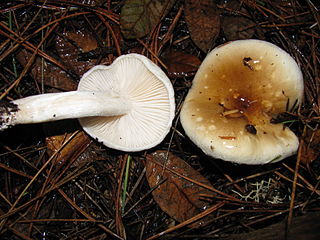
Hygrophorus bakerensis, commonly known as the Mt. Baker waxy cap, the brown almond waxy cap or the tawny almond waxy cap, is a species of fungus in the family Hygrophoraceae. It is characterized by its medium to large, relatively slender-statured fruit bodies with an almond odor, and growth often on or near rotting conifer wood. The slimy cap is brown in the center and cream to white near its curved edges. The gills and the stem are white, and in moist environments are often covered with droplets of a translucent liquid. The mushroom is known only from the United States, where it is common in coniferous forests throughout the Pacific Northwest. It was initially collected in Washington State on Mount Baker, a volcano. Although edible, the mushroom is not considered to be of high quality.

Hygrophorus latitabundus is a species of fungus in the genus Hygrophorus. It is distributed in European pine forests, and has a preference for calcareous soils. It fruits in autumn, producing large, edible mushrooms with slimy caps and stems.

Hygrophorus marzuolus, commonly known as the March mushroom, is a species of fungus in the family Hygrophoraceae. It is known from Asia, Europe, and North America, where it grows on the ground in mixed forests at high elevations.

Hygrophorus goetzii is a species of fungus in the family Hygrophoraceae. It is a snowbank mushroom with a rosy-pink cap that fades to cream color in maturity.

Hygrophorus purpurascens, commonly known as the purple-red waxy cap, is a species of agaric fungus in the family Hygrophoraceae. Its cap has a pink background color with streaks of purplish red overlaid, and mature gills have red spots.

Hygrophorus hypothejus, commonly known as the olive-brown waxy cap, or herald of the winter, is an edible species of fungus in the genus Hygrophorus native to Europe. It appears in late autumn in coniferous forests, often with the first frosts.

Humidicutis mavis is a gilled fungus of the waxcap family. It is found in Australia, Borneo, and New Zealand where the translucent white fungi grows from the ground to a height of 80 mm and a width of 50 mm.

Hygrophorus olivaceoalbus, commonly known as the olive wax cap or sheathed waxy cap, is a species of fungus in the genus Hygrophorus. The fruit bodies (mushrooms) appear from midsummer to late autumn under conifers in North American and Eurasian mountain forests. The mushrooms have olive-brown, slimy caps with dark streaks and a dark umbo; the caps measure 3 to 12 cm in diameter. Other characteristic features include a slimy stem up to 12 cm long that is spotted with ragged scales up to a ring-like zone. As its name implies, the mushroom has a waxy cap and gills. It is native to North America and across the northern regions of Europe. According to a publication by the Council of Europe, the fungus is nearly extinct in France.

Hygrophorus caeruleus is a rare species of agaric fungus in the family Hygrophoraceae. Found in the western United States, the mushroom is characterized by its stout fruit body including blue-tinted cap margin and stipe, blue-grey to bluish green gills, and odor of rancid meal.

Hygrophorus erubescens, commonly known as the blotched woodwax or pink waxcap, is an agaric fungus native to Scandinavia, Japan, Central Europe, Great Britain and North America.

Hygrophorus russula, commonly known as the pinkmottle woodwax, false russula, or russula-like waxy cap, is a fungus native to North America and Europe.
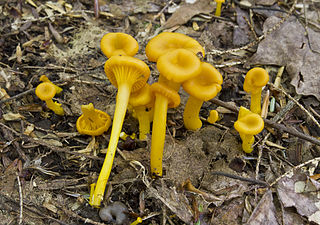
Gloioxanthomyces nitidus, commonly known as the shining waxcap, is a species of fungus in the family Hygrophoraceae.

Hygrophorus pudorinus, commonly known as the blushing waxycap, turpentine waxycap, or spruce waxy cap, is a species of fungus in the genus Hygrophorus.
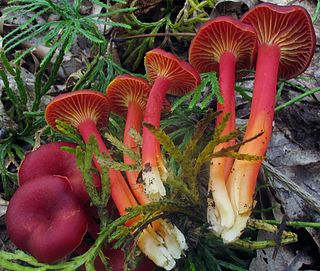
Hygrocybe appalachianensis, commonly known as the Appalachian waxy cap, is a gilled fungus of the waxcap family. It is found in the eastern United States, where it fruits singly, in groups, or clusters on the ground in deciduous and mixed forests. The species, described in 1963 from collections made in the Appalachian Mountains, was originally classified in the related genus Hygrophorus. It was transferred to Hygrocybe in 1998, in which it has been proposed as the type species of section Pseudofirmae.

Hygrocybe aurantiosplendens, commonly known as the orange waxcap, is a gilled fungus in the family Hygrophoraceae. It mainly occurs in Europe, but is also found in Siberia, and on both the East and West coasts of North America. It is uncertain if the continental ecotypes are in fact conspecific and are sometimes treated as distinct species.

