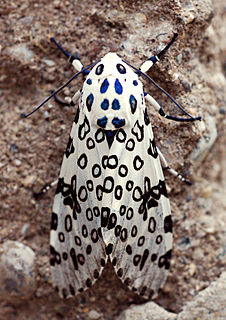
The giant leopard moth is a moth of the family Erebidae. They are distributed through North America from southern Ontario, and southern and eastern United States through New England, Mexico and down to Panama. The obsolete name Ecpantheria scribonia is still occasionally encountered.

Hypercompe is a genus of tiger moths in the family Erebidae erected by Jacob Hübner in 1819.

Hypercompe permaculata, the many-spotted tiger moth, is a tiger moth of the family Erebidae. It was first described by Alpheus Spring Packard in 1872. It is native to the western United States and parts of northern Mexico.

Hypercompe albicornis is a moth of the family Erebidae first described by Augustus Radcliffe Grote in 1865. It is found on Cuba.
Hypercompe bari is a moth of the family Erebidae first described by Charles Oberthür in 1881. It is found in French Guiana.
Hypercompe caudata is a moth of the family Erebidae. It was described by Francis Walker in 1855. It is found in Texas, southern Arizona, Mexico, Costa Rica, Honduras and Nicaragua.

Hypercompe mus is a moth of the family Erebidae first described by Charles Oberthür in 1881. It is found in Paraguay and Brazil.

Hypercompe cunigunda is a moth of the family Erebidae first described by Caspar Stoll in 1781. It is found in French Guiana, Suriname, Brazil, Venezuela, Ecuador and Bolivia.
Hypercompe deflorata is a moth of the family Erebidae first described by Johan Christian Fabricius in 1775. It is found in Ecuador.
Hypercompe detecta is a moth of the family Erebidae first described by Charles Oberthür in 1881. It is found in Brazil.
Hypercompe extrema is a moth of the family Erebidae. It was described by Francis Walker in 1855. It is found in Mexico, Costa Rica and possibly Chile.
Hypercompe flavopunctata is a moth of the family Erebidae first described by William Schaus in 1921. It is found in Paraguay.
Hypercompe hambletoni is a moth of the family Erebidae first described by William Schaus in 1938. It is found in Brazil.
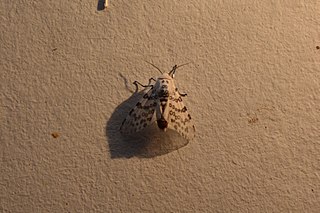
Hypercompe icasia is a moth of the family Erebidae first described by Pieter Cramer in 1777. It is widely distributed in South America and is also found on Martinique, Guadeloupe, Saint Martin, Dominica, St. Kitts, Nevis, St. Thomas and Puerto Rico.
Hypercompe indecisa is a moth of the family Erebidae first described by Francis Walker in 1855. It is found in Argentina and Uruguay.

Hypercompe laeta is a moth of the family Erebidae first described by Francis Walker in 1855. It is found in Panama and Venezuela.
Hypercompe ocularia, the ocularia leopard, is a moth of the family Erebidae. The species was first described by Johan Christian Fabricius in 1775.
Hypercompe simplex is a moth of the family Erebidae first described by Francis Walker in 1855. It is found in Puerto Rico, as well as on the Virgin Islands and the Lesser Antilles.
Hypercompe suffusa is a moth of the family Erebidae. It was described by William Schaus in 1889. It is found in southern Arizona, western Texas and Mexico.
