A myofibroblast is a cell phenotype that was first described as being in a state between a fibroblast and a smooth muscle cell.
CTGF, also known as CCN2 or connective tissue growth factor, is a matricellular protein of the CCN family of extracellular matrix-associated heparin-binding proteins. CTGF has important roles in many biological processes, including cell adhesion, migration, proliferation, angiogenesis, skeletal development, and tissue wound repair, and is critically involved in fibrotic disease and several forms of cancers.
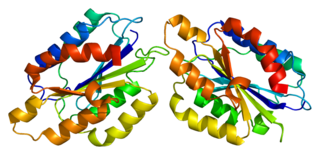
Integrin alpha-1 also CD49a is an integrin alpha subunit encoded in humans by the gene ITGA1. It makes up half of the α1β1 integrin duplex. Though CD49a can bind a number of ligands including collagen IV, collagen I, and others.

Collagen alpha-5(IV) chain is a protein that in humans is encoded by the COL4A5 gene.

Collagen alpha-1(XVIII) chain is a protein that in humans is encoded by the COL18A1 gene.

Collagen alpha-3(IV) chain is a protein that in humans is encoded by the COL4A3 gene.
Collagen alpha-4(IV) chain is a protein that in humans is encoded by the COL4A4 gene.

Laminin subunit alpha-5 is a protein that in humans is encoded by the LAMA5 gene.
Integrin beta-6 is a protein that in humans is encoded by the ITGB6 gene. It is the β6 subunit of the integrin αvβ6. Integrins are αβ heterodimeric glycoproteins which span the cell’s membrane, integrating the outside and inside of the cell. Integrins bind to specific extracellular proteins in the extracellular matrix or on other cells and subsequently transduce signals intracellularly to affect cell behaviour. One α and one β subunit associate non-covalently to form 24 unique integrins found in mammals. While some β integrin subunits partner with multiple α subunits, β6 associates exclusively with the αv subunit. Thus, the function of ITGB6 is entirely associated with the integrin αvβ6.

Laminin subunit beta-1 is a protein that in humans is encoded by the LAMB1 gene.
Collagen alpha-6(IV) chain is a protein that in humans is encoded by the COL4A6 gene.

Fibroblast activation protein alpha (FAP-alpha) also known as prolyl endopeptidase FAP is an enzyme that in humans is encoded by the FAP gene.

Periostin is a protein that in humans is encoded by the POSTN gene. Periostin functions as a ligand for alpha-V/beta-3 and alpha-V/beta-5 integrins to support adhesion and migration of epithelial cells.

Collagen alpha-1(XV) chain is a protein that in humans is encoded by the COL15A1 gene.

Collagen alpha-1(XIII) chain is a protein that in humans is encoded by the COL13A1 gene.
Collagen alpha-1(XXVI) chain is a protein that in humans is encoded by the EMID2 gene.

Integrin alpha-10 also known as ITGA10 is a protein that in humans is encoded by the ITGA10 gene.

In medicine, desmoplasia is the growth of fibrous connective tissue. It is also called a desmoplastic reaction to emphasize that it is secondary to an insult. Desmoplasia may occur around a neoplasm, causing dense fibrosis around the tumor, or scar tissue (adhesions) within the abdomen after abdominal surgery.
Pancreatic stellate cells (PaSCs) are classified as myofibroblast-like cells that are located in exocrine regions of the pancreas. PaSCs are mediated by paracrine and autocrine stimuli and share similarities with the hepatic stellate cell. Pancreatic stellate cell activation and expression of matrix molecules constitute the complex process that induces pancreatic fibrosis. Synthesis, deposition, maturation and remodelling of the fibrous connective tissue can be protective, however when persistent it impedes regular pancreatic function.

Collagen α-1 (XXIII) chain is a protein encoded by COL23A1 gene, which is located on chromosome 5q35 in humans, and on chromosome 11B1+2 in mice. The location of this gene was discovered by genomic sequence analysis.