


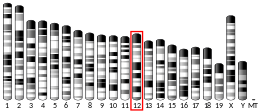


Integrin beta-8 is a protein that in humans is encoded by the ITGB8 gene. [5]
This gene is a member of the integrin beta chain family and encodes a single-pass type I membrane protein with a VWFA domain and four cysteine-rich repeats. This protein noncovalently binds to an alpha subunit to form a heterodimeric integrin complex. In general, integrin complexes mediate cell-cell and cell-extracellular matrix interactions and this complex plays a role in human airway epithelial proliferation. Alternatively spliced variants which encode different protein isoforms have been described; however, not all the variants have been fully characterized. [5] Additionally, it has been shown to interact with RhoGDI1 to alter the activation of Rho GTPases to promote Glioblastoma cell invasiveness. Uncoupling the αvβ8-RhoGDI1 interaction has been seen to block GBM cell invasion by hyperactivating Rho GTPases. [6]
High expression levels of ITGB8 are associated with high angiogenic and poorly invasive glioblastoma tumors. Conversely low expression of ITGB8 correlates with highly invasive but low angiogenic tumors. [7]

CD11c, also known as Integrin, alpha X (ITGAX), is a gene that encodes for CD11c.

Integrin beta-3 (β3) or CD61 is a protein that in humans is encoded by the ITGB3 gene. CD61 is a cluster of differentiation found on thrombocytes.

Integrin, alpha E (ITGAE) also known as CD103 is an integrin protein that in human is encoded by the ITGAE gene. CD103 binds integrin beta 7 to form the complete heterodimeric integrin molecule αEβ7, which has no distinct name. The αEβ7 complex is often referred to as "CD103" though this strictly refers only to the αE chain. Note that the β7 subunit can bind with other integrin α chains, such as α4 (CD49d).

Transforming protein RhoA, also known as Ras homolog family member A (RhoA), is a small GTPase protein in the Rho family of GTPases that in humans is encoded by the RHOA gene. While the effects of RhoA activity are not all well known, it is primarily associated with cytoskeleton regulation, mostly actin stress fibers formation and actomyosin contractility. It acts upon several effectors. Among them, ROCK1 and DIAPH1 are the best described. RhoA, and the other Rho GTPases, are part of a larger family of related proteins known as the Ras superfamily, a family of proteins involved in the regulation and timing of cell division. RhoA is one of the oldest Rho GTPases, with homologues present in the genomes since 1.5 billion years. As a consequence, RhoA is somehow involved in many cellular processes which emerged throughout evolution. RhoA specifically is regarded as a prominent regulatory factor in other functions such as the regulation of cytoskeletal dynamics, transcription, cell cycle progression and cell transformation.

Disintegrin and metalloproteinase domain-containing protein 15 is an enzyme that in humans is encoded by the ADAM15 gene.
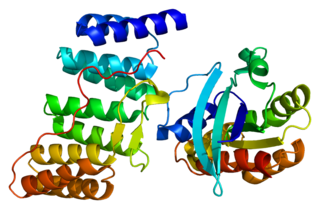
Ras-related C3 botulinum toxin substrate 3 (Rac3) is a G protein that in humans is encoded by the RAC3 gene. It is an important component of intracellular signalling pathways. Rac3 is a member of the Rac subfamily of the Rho family of small G proteins. Members of this superfamily appear to regulate a diverse array of cellular events, including the control of cell growth, cytoskeletal reorganization, and the activation of protein kinases.

Tenascin C (TN-C) is a glycoprotein that in humans is encoded by the TNC gene. It is expressed in the extracellular matrix of various tissues during development, disease or injury, and in restricted neurogenic areas of the central nervous system. Tenascin-C is the founding member of the tenascin protein family. In the embryo it is made by migrating cells like the neural crest; it is also abundant in developing tendons, bone and cartilage.

Integrin, beta 4 (ITGB4) also known as CD104, is a human gene.

Integrin beta-5 is a protein that in humans is encoded by the ITGB5 gene.

Integrin beta-6 is a protein that in humans is encoded by the ITGB6 gene. It is the β6 subunit of the integrin αvβ6. Integrins are αβ heterodimeric glycoproteins which span the cell’s membrane, integrating the outside and inside of the cell. Integrins bind to specific extracellular proteins in the extracellular matrix or on other cells and subsequently transduce signals intracellularly to affect cell behaviour. One α and one β subunit associate non-covalently to form 24 unique integrins found in mammals. While some β integrin subunits partner with multiple α subunits, β6 associates exclusively with the αv subunit. Thus, the function of ITGB6 is entirely associated with the integrin αvβ6.
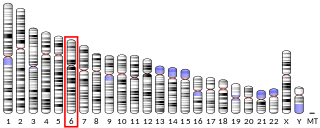
Neural precursor cell expressed developmentally down-regulated protein 9 (NEDD-9) is a protein that in humans is encoded by the NEDD9 gene. NEDD-9 is also known as enhancer of filamentation 1 (EF1), CRK-associated substrate-related protein (CAS-L), and Cas scaffolding protein family member 2 (CASS2). An important paralog of this gene is BCAR1.
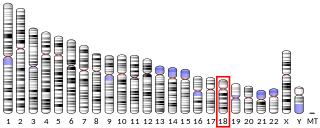
Laminin subunit alpha-1 is a protein that in humans is encoded by the LAMA1 gene.
Macrophage-stimulating protein receptor is a protein that in humans is encoded by the MST1R gene. MST1R is also known as RON kinase, named after the French city in which it was discovered. It is related to the c-MET receptor tyrosine kinase.

Integrin beta-7 is an integrin protein that in humans is encoded by the ITGB7 gene. It can pair with ITGA4 (CD49d) to form the heterodimeric integrin receptor α4β7, or with ITGAE (CD103) to form αEβ7.

Macrophage-stimulating protein (MSP), also known as hepatocyte growth factor-like protein, is a protein that in humans is encoded by the MST1 gene.
Integrin beta-1-binding protein 1 is a protein that in humans is encoded by the ITGB1BP1 gene.

Tetraspanin-4 is a protein that in humans is encoded by the TSPAN4 gene.
Integrin alpha-10 also known as ITGA10 is a protein that in humans is encoded by the ITGA10 gene.

Laminin subunit gamma-3 also known as LAMC3 is a protein that in humans is encoded by the LAMC3 gene.
Transforming growth factor beta (TGF-β) is a potent cell regulatory polypeptide homodimer of 25kD. It is a multifunctional signaling molecule with more than 40 related family members. TGF-β plays a role in a wide array of cellular processes including early embryonic development, cell growth, differentiation, motility, and apoptosis.
 | This article on a gene on human chromosome 7 is a stub. You can help Wikipedia by expanding it. |