The village was founded by Nadazovsky Greek settlers from Crimea,[2] in Demirci yayla and in the villages of Alushta, Generalske, Malorichenske and Sonjachnogorske in 1779. The village received its name from the Constantinople that was the capital of the Byzantine Empire at its founding,[2] which merited a great sacrifice known as a hecatomb (a sacrifice of two hundred bulls).
During the Soviet era, the village was home to the central estate of the Michurin collective farm. The artel has 2,115 hectares of arable land, including 200 hectares of irrigated land. The production area of the farm is meat and dairy farming and the cultivation of grain crops. The artel also engages in gardening and viticulture, which also includes the farming of melons. 5 workers of the collective farm have been awarded orders and medals.[citation needed]
The village had an eight-year school, a library, and a veterinary clinic. A children's factory was opened, and household workshops were operating. There were 6 branches of the regional association "Agricultural Machinery".[citation needed]
Russo-Ukrainian War
During the Russo-Ukrainian War, Kostyantynopil first came in proximity of hostilities between Russian and Ukrainian forces in February 2025. Russian forces first entered the village on February 27.[3] Russian forces captured the village by March 9.[4] On March 17, Ukrainian forces launched counterattack on the settlement, and have contested the village since.[5]
Population
According to data from 1859, the state village of Mariupol Greek District, Alexandrovsky Uyezd, Yekaterinoslav Governorate, had a population of 900 people (485 males and 415 females), 281 households, and an Orthodox church.[6]
As of 1886, the Greek colony of Bogatyrsk volost, Mariupol Uzyed, Ekaterinoslav province, had a population of 1,107 people, 189 households, an Orthodox church, a school, 2 shops and 2 brick factories.[7]
According to the 1897 census, the number of residents increased to 2,053 people (1,098 males and 955 females), of whom 2,034 were Eastern Orthodox.[8]
In 1908, the Greek settlement had a population of 2,423 (1,234 males and 1,189 females), and 360 households.[9]
According to the 2001 Ukrainian census, the village's population was 1,076 people. The main languages of the village were:[10]
↑ Ekaterinoslav province with Taganrog city council. List of populated places according to the data of 1859 . Published by the Central Statistical Committee of the Ministry of Internal Affairs. Edited by the editor I. Vilson. 1859. — IV + 452 p., (p. 2418)
↑ Volosts and the most important settlements of European Russia. According to the data of the survey conducted by the statistical institutions of the Ministry of Internal Affairs, on behalf of the Statistical Council. Edition of the Central Statistical Committee. Issue VIII. The provinces of the Novorossiya group. Saint Petersburg. 1886. — p. 30
↑ Populated places of the Russian Empire with 500 or more inhabitants with an indication of the total population available in them and the number of inhabitants of the predominant religion : according to the first universal census of 1897 / Ed. N. AND. Troynytskyi — S.-Pb.: Typography "Obshchestvennanaya polza": [steam typolitografiya NL Nyrkina], 1905. — S. 1-61. — X, 270, 120 p.
↑ Russian doref. List of populated places of Mariupol district of Ekaterinoslav province with attached map. Edition of Ekaterinoslavskaya Gubernay Zemskoy Upravy. Ekaterinoslav Typography of the Provincial Zemstvo. 1911 , (code 9-3)
History of cities and villages of the Ukrainian SSR . — K .: Main editorial office of the Ukrainian Academy of Sciences of the Ukrainian SSR . — 15,000 copies.
This page is based on this Wikipedia article Text is available under the CC BY-SA 4.0 license; additional terms may apply. Images, videos and audio are available under their respective licenses.


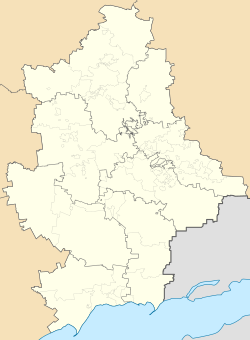


 Ukraine
  Donetsk Oblast

