The National Assembly, is the unicameral legislature of Kuwait. The National Assembly meets in Kuwait City. Members are chosen through direct election; the country is divided into five electoral districts with ten members representing each district. There are no official political parties in Kuwait, therefore candidates run as independents during elections; upon winning, members usually form informal parliamentary blocs. The National Assembly is made up of 50 elected members as well as up to 15 appointed government ministers who are ex officio members. On October 16, 2016, the Amir of Kuwait issued a decree dissolving the National Assembly citing security challenges, paving the way for early elections, which were held on November 26, 2016.

Elections in Kuwait are held for both the National Assembly and for the Municipality. Kuwait's constitution calls for elections to the unicameral National Assembly at a maximum interval of four years. Elections are held earlier if the Constitutional Court or Emir dissolve the parliament.
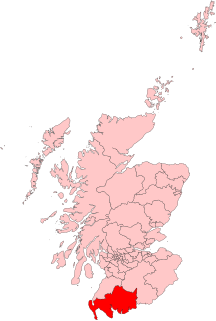
Dumfries and Galloway is a county constituency in the House of Commons of the Parliament of the United Kingdom. It was first used in the 2005 general election, and replaced Galloway and Upper Nithsdale and part of Dumfries. It elects one Member of Parliament (MP) by the first past the post system of election.

Al-Wefaq National Islamic Society, or Al-Wefaq for short, is a Bahraini political party. Although from 2006 to 2011 it was by far the single largest party in the Bahraini legislature, with 18 representatives in the 40-member Bahraini parliament, it was often outvoted by coalition blocs of opposition Sunni parties and independent MPs reflecting gerrymandering of electoral districts. On 27 February 2011, the 18 Al-Wefaq members of parliament submitted letters of resignation to protest regime violence against pro-reform Bahraini protestors.

Women's rights have been a cornerstone of the political reforms initiated by King Hamad, with women gaining the right to vote and stand as candidates in national elections for the first time after the constitution was amended in 2002. The extension of equal political rights has been accompanied by a conscious drive to promote women to positions of authority within government.
The 2002 Moroccan parliamentary election was held in Morocco on 27 September 2002. The election was the first since King Mohammed VI of Morocco had come to the throne in 1999 and international observers saw it as a test of his commitment to democracy. The election saw an Islamist party the Justice and Development Party make strong gains but the outgoing government kept a majority in the Assembly of Representatives.

General elections were held in Sudan between 11 and 15 April 2010, extended from the original end date of 13 April. The elections were held to elect the President and National Assembly of Sudan, as well as the President and Legislative Assembly of Southern Sudan. The election brought to the end the transitional period which began when the decades-long Second Sudanese Civil War ended in 2005.
An early parliamentary election was held in Kuwait on 17 May 2008 after the Emir Sabah Al-Sabah dissolved the National Assembly of Kuwait on 19 March 2008 over constant clashes between the government and the elected MPs. The last elections were held less than two years previously and saw a loose alliance of reformists and Islamists gain almost two thirds of the seats.
Kuwait is a constitutional emirate with a semi-democratic political system. The hybrid political system is divided between an elected parliament and appointed government.
Waleed Al-Tabatabaie was a member of the Kuwaiti National Assembly, who represented the third district. Born on 4 April 1964, Al-Tabtabaie obtained a PhD in Islamic studies from Al-Azhar and was an assistant professor at Kuwait University before being elected to the National Assembly in 1996. Al-Tabtabaie affiliated with the Islamist deputies.
Important political issues in the Kuwaiti National Assembly include rights for immigrant workers, gun control, and education reform.
The first bill which would have given women the right to vote in Kuwait was put to the parliament in 1973. It was ultimately overturned due to pressure from conservatives. Bills continued to be denied through 1985 and 1986. Kuwait then became heavily involved in the Iraq-Iran war, and women began demanding recognition for their efforts in keeping their families and society functional. The parliament agreed and the first woman was finally appointed as the ambassador of the Persian Gulf in 1993. In 1996, 500 women stopped working for an hour to show solidarity in their right for suffrage, and demonstrations continued throughout the next 6 years. In May 1999 a decree that allowed women the right to vote and run for office was issued by the emir, however it was overruled again by the parliament 6 months later.

The 2003 Djiboutian parliamentary election took place in Djibouti on 10 January 2003 to elect the National Assembly of Djibouti. The ruling coalition of President Ismail Omar Guelleh won all 65 seats in the election defeating an opposition coalition.

The 2010 Sri Lankan parliamentary election was held on April 8 and April 20, 2010, to elect 225 members to Sri Lanka's 14th Parliament. 14,088,500 Sri Lankans were eligible to vote in the election at 11,102 polling stations. It was the first general election held in Sri Lanka following the conclusion of the civil war which lasted 26 years.

The Afghan parliamentary election, 2010 to elect members of the House of the People took place on 18 September 2010. The Afghan Independent Election Commission - established in accordance with the article 156 of the Constitution of Afghanistan for the purpose of organizing and supervising all elections in the country - postponed the poll from its original date of 22 May to September 18.

Early general elections were held in Kuwait on 2 February 2012, the country's second general election in a three-year period. The election's turnout rate was 59%. However, in June 2012 Kuwait's Constitutional Court declared the elections invalid and reinstated the former parliament. The court said the dissolution of Parliament in December 2011 by Emir Sabah Al-Sabah was unconstitutional. In response, opposition MPs resigned from parliament and demanded a full parliamentary system.

Early general elections were held in Kuwait on 27 July 2013. The elections were required after the Constitutional Court dissolved Parliament and annulled the results of the December 2012 elections. Voter turnout was an estimated 52.5%, which was higher than expected despite an opposition boycott, and only 7% lower than the non-boycotted February 2012 elections.
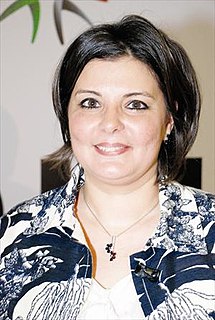
Aseel al-Awadhi is a former member of the National Assembly of Kuwait. She was a professor of philosophy at Kuwait University before moving into politics. Al-Awadhi first stood for a seat on the National Assembly in 2008, losing the election but gaining the highest number of votes for a female candidate since women were allowed to stand. She was elected representative of Kuwait's Third District in 2009; a post that she held until 2012.
Early general elections were held in Kuwait on 26 November 2016. They follow the dissolution of the parliament elected in 2013 by Emir Sabah Al-Ahmad Al-Jaber Al-Sabah in October 2016. Under the constitution, elections must be held within two months. Opposition candidates won 24 of the 50 seats in the National Assembly. Voter turnout was around 70 percent.