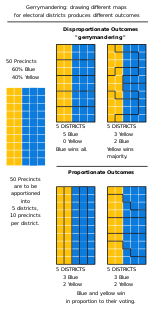
Plurality voting is an electoral system in which each voter is allowed to vote for only one candidate, and the candidate who polls the most among their counterparts is elected. In a system based on single-member districts, it may be called first-past-the-post (FPTP), single-choice voting, simple plurality or relative/simple majority. In a system based on multi-member districts, it may be referred to as winner-takes-all or bloc voting. The system is often used to elect members of a legislative assembly or executive officers. It is the most common form of the system, and is used in most elections in the United States, the lower house in India, most elections in the United Kingdom, and Canada.
Elections to determine the makeup of the legislative bodies on the three levels of administrative division in the Kingdom of Sweden are held once every four years. At the highest level, these elections determine the allocation of seats in the Riksdag, the national legislative body of Sweden. Elections to the 20 county councils (landsting) and 290 municipal assemblies (kommunfullmäktige) – all using roughly the same electoral system – are held concurrently with the legislative elections on the second Sunday in September.
The additional member system (AMS), also known as mixed-member proportional representation (MMP) outside the United Kingdom, is a mixed electoral system with one tier of single-member district representatives, and another tier of ‘additional members’ elected to make the overall election results more proportional.

Electoral systems for the legislatures of the individual Australian states and territories are broadly similar to the electoral system used in federal elections in Australia.
The Japanese political process has three types of elections: general elections to the House of Representatives held every four years, elections to the House of Councillors held every three years to choose one-half of its members, and local elections held every four years for offices in prefectures, cities, and villages. Elections are supervised by election committees at each administrative level under the general direction of the Central Election Administration Committee, an attached organization to the Ministry of Internal Affairs and Communications (MIC). The minimum voting age in Japan's non-compulsory electoral system was reduced from twenty to eighteen years in June 2016. Voters must satisfy a three-month residency requirement before being allowed to cast a ballot.

Elections in Angola take place within the framework of a multi-party democracy and a presidential system. The National Assembly is directly elected by voters, whilst the leader of the largest party or coalition in the National Assembly automatically becomes President. The country is currently a one-party dominant state, with the MPLA as the dominant party.
Elections in Botswana take place within the framework of a multi-party democracy and a parliamentary system. The National Assembly is mostly directly elected, and in turn elects the President and some of its own members. The Ntlo ya Dikgosi is a mixture of appointed, hereditary and indirectly elected members.
Elections in Malaysia exist at two levels: federal level and state level. Federal level elections are those for membership in the Dewan Rakyat, the lower house of Parliament, while state level elections are for membership in the various State Legislative Assemblies. The heads of executive branch at both the federal and state levels, the Prime Minister and Menteri Besar/Chief Ministers respectively, are indirectly elected, usually filled by a member of the majority party/coalition in the respective legislatures.
Elections in Jordan are for the lower house, known as the House of Representatives, of the bicameral parliament of Jordan, as well as for local elections. They take place within a political system where the King has extensive legislative and executive powers, retaining ultimate political control. The Prime Minister is selected by the King, the PM is then free to choose his own Cabinet. The parliament has quotas: three seats for Circassians and Chechens, nine for Christians and fifteen for women. The electoral system favours rural tribes and those of East Bank origin over urban areas that are primarily inhabited by those of Palestinian descent.

Elections in Kuwait are held for both the National Assembly and for the Municipality. Kuwait's constitution calls for elections to the unicameral National Assembly at a maximum interval of four years. Elections are held earlier if the Constitutional Court or Emir dissolve the parliament.

An Ontario electoral reform referendum was held on October 10, 2007, on the question of whether to establish a mixed member proportional representation (MMP) system for elections to the Legislative Assembly of Ontario. However, the resulting vote was strongly in favour of the existing plurality voting or "first-past-the-post" (FPTP) system.

The House of Representatives is the lower house of the National Assembly of Thailand, the legislative branch of the Thai government. The system of government of Thailand is that of a constitutional monarchy and a parliamentary democracy. The system of the Thai legislative branch is modelled after the Westminster system. The House of Representatives has 500 members, all of which are democratically elected: 375 members were directly elected through single constituency elections, while the other 125 are elected through party-list proportional representation. The roles and powers of the House of Representatives were enshrined in the Constitution of 2017.
An early parliamentary election was held in Kuwait on 17 May 2008 after the Emir Sabah Al-Sabah dissolved the National Assembly of Kuwait on 19 March 2008 over constant clashes between the government and the elected MPs. The last elections were held less than two years previously and saw a loose alliance of reformists and Islamists gain almost two thirds of the seats.
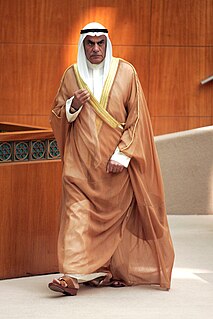
Abdulwahed Al-Awadhi is a member of the Kuwaiti National Assembly, representing the first district.
The first bill which would have given women the right to vote in Kuwait was put to the parliament in 1973. It was ultimately overturned due to pressure from conservatives. Bills continued to be denied through 1985 and 1986. Kuwait then became heavily involved in the Iraq-Iran war, and women began demanding recognition for their efforts in keeping their families and society functional. The parliament agreed and the first woman was finally appointed as the ambassador of the Persian Gulf in 1993. In 1996, 500 women stopped working for an hour to show solidarity in their right for suffrage, and demonstrations continued throughout the next 6 years. In May 1999 a decree that allowed women the right to vote and run for office was issued by the emir, however it was overruled again by the parliament 6 months later.
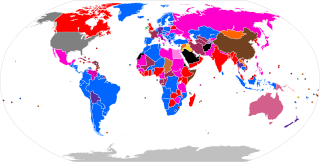
An electoral system is a set of rules that determine how elections and referendums are conducted and how their results are determined. Political electoral systems are organized by governments, while non-political elections may take place in business, non-profit organisations and informal organisations.

Early general elections were held in Kuwait on 2 February 2012, the country's second general election in a three-year period. The election's turnout rate was 59%. However, in June 2012 Kuwait's Constitutional Court declared the elections invalid and reinstated the former parliament. The court said the dissolution of Parliament in December 2011 by Emir Sabah Al-Sabah was unconstitutional. In response, opposition MPs resigned from parliament and demanded a full parliamentary system.
Early general elections were held in Kuwait on 1 December 2012 after early elections in February 2012 were declared invalid.

Early general elections were held in Kuwait on 27 July 2013. The elections were required after the Constitutional Court dissolved Parliament and annulled the results of the December 2012 elections. Voter turnout was an estimated 52.5%, which was higher than expected despite an opposition boycott, and only 7% lower than the non-boycotted February 2012 elections.
Early general elections were held in Kuwait on 26 November 2016. They follow the dissolution of the parliament elected in 2013 by Emir Sabah Al-Ahmad Al-Jaber Al-Sabah in October 2016. Under the constitution, elections must be held within two months. Opposition candidates won 24 of the 50 seats in the National Assembly. Voter turnout was around 70 percent.