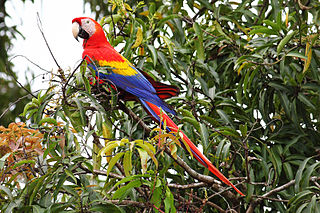
The scarlet macaw is a large red, yellow, and blue Central and South American parrot, a member of a large group of Neotropical parrots called macaws. It is native to humid evergreen forests of tropical Central and South America. Range extends from south-eastern Mexico to the Peruvian Amazon, Colombia, Bolivia, Venezuela and Brazil in lowlands of 500 m (1,640 ft) up to 1,000 m (3,281 ft). In some areas, it has suffered local extinction because of habitat destruction or capture for the parrot trade, but in other areas it remains fairly common. Formerly it ranged north to southern Tamaulipas. It can still be found on the island of Coiba. It is the national bird of Honduras. Like its relative the blue-and-yellow macaw, scarlet macaws are popular birds in aviculture as a result of their striking plumage.

Parrotlets are a group of the smallest New World parrot species, comprising several genera, namely Forpus, Nannopsittaca, and Touit. They have stocky builds and short tails and are endemic to Middle and South America.

The green-rumped parrotlet is a species of parrot in the family Psittacidae. It is the nominate species.

The blue-bellied parrot or purple-bellied parrot is the only species in its genus. It is generally considered endemic to the humid Atlantic Forest of southeastern Brazil, but there are two unconfirmed records from Misiones in Argentina. It occurs up to 1000 m. (3300 ft).

The golden-collared macaw or yellow-collared macaw is a small mostly green Central South American parrot, a member of a large group of Neotropical parrots known as macaws. It has a bright yellow patch on the back of its neck/upper shoulders that gives the species its name. In aviculture, it is one of a number of smaller macaws often called "mini-macaws".

The Pesquet's parrot, also known as the vulturine parrot, is the only member of its genus, and its genus is the only member of the subfamily Psittrichadinae. It is endemic to hill and montane rainforest in New Guinea.
The Manu parrotlet or Amazonian parrotlet is a species of parrotlet native to the western Amazon basin, from southern Peru to northwest Bolivia. It is found in lowland forests near bamboo and rivers. It has a stocky build akin to a small Amazon parrot. It has green plumage, with powder-blue lores and forehead, paler yellow-green cheeks and chin.

The maroon-bellied parakeet is a small parrot found from southeastern Brazil to north-eastern Argentina, including eastern Paraguay and Uruguay. It is also known as the reddish-bellied parakeet, and in aviculture it is usually referred to as the maroon-bellied conure, reddish-bellied conure or brown-eared conure.

The yellow-crowned amazon or yellow-crowned parrot is a species of parrot native to tropical South America and Panama. The taxonomy is highly complex and the yellow-headed and yellow-naped amazon are sometimes considered subspecies of the yellow-crowned amazon. Except in the taxonomic section, the following deals only with the nominate group .They are found in the Amazon basin.

The blue-winged parrotlet is a species of parrot in the family Psittacidae. It is the nominate species.

Kawall's amazon, also known as the white-faced amazon, white-cheeked amazon or Kawall's parrot, is a relatively large species of parrot in the family Psittacidae. It is endemic to the south-central Amazon. After not having been recorded in the wild for around 70 years, the species was rediscovered in the 1980s.

The Hispaniolan amazon or Hispaniolan parrot is a species of parrot in the family Psittacidae. It is found on Hispaniola, and has been introduced to Puerto Rico, and the U.S. Virgin Islands.

The Josephine's lorikeet is a species of parrot in the family Psittaculidae. It is found in the highlands of New Guinea . Its natural habitats are subtropical or tropical moist lowland forest and subtropical or tropical moist montane forest.

The Pacific parrotlet, also known as Lesson's parrotlet or the celestial parrotlet, is a species of small parrot in the family Psittacidae.

Forpus is a genus of neotropical parrots in the family Psittacidae.

The spectacled parrotlet is a species of parrot in the family Psittacidae. It is the nominate species.

The Mexican parrotlet, also known as the turquoise-rumped parrotlet or the Mexican blue-rumped parrotlet, is a species of parrot in the family Psittacidae. It is the nominate species.
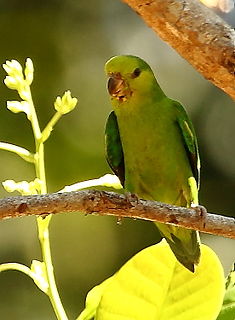
The dusky-billed parrotlet, also known as Sclater's parrotlet, is a small species of parrot in the family Psittacidae. It is the nominate species.

The yellow-faced parrotlet is a species of parrot in the family Psittacidae.
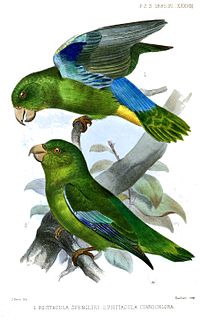
The turquoise-winged parrotlet is a species of parrot in the family Pscittacidae.

