Blue-winged parrotlet

Last updated

Blue-winged parrotlet
Forpus xanthopterygius -Goias, Brazil -male-8.jpg
Male in Goias, Brazil
Scientific classification Red Pencil Icon.png
Kingdom: Animalia
Phylum: Chordata
Class: Aves
Order: Psittaciformes
Family: Psittacidae
Genus: Forpus
Species:
F. xanthopterygius
Binomial name
Forpus xanthopterygius
(Spix, 1824)
Subspecies
  • F. x. xanthopterygius
  • F. x. flavescens
  • F. x. flavissimus

The blue-winged parrotlet (Forpus xanthopterygius) is a species of parrot in the family Psittacidae. It is the nominate species (F. x. xanthopterygius).

Contents

There are two subspecies: Salvadori's blue-winged parrotlet (F. x. flavescens) and Hellmayr's blue-winged parrotlet (F. x. flavissimus). [2]

Description

NameAppearanceRange
blue-winged parrotlet

(Forpus xanthopterygius xanthopterygius) (nominate species)

Typically around 12 centimetres (4.7 in) long and weigh about 28 grams (0.99 oz). Primarily green or olive green with light peach beaks and feet and dark brown eyes, which are surrounded by bright green. Blue-winged parrotlets are sexually dimorphic: males have purple-blue primary, secondary, and underwing coverts with bright blue patch on rump. Females have no blue markings and yellow-green foreheads. [2] Like all parrots, blue-winged parrotlets exhibit zygodactyly, meaning two toes face forward and two face backward.

Juveniles look like adults, except males have green feathers mixed in with their blue markings.

northeastern Argentina (Misiones, northeastern Corrientes, eastern Chaco, eastern Formosa), from Paraguay north through central/mideastern Brazil to northern Bahia [2]
Salvadori's blue-winged parrotlet

(F. x. flavescens)

Compared to the nominate species, both males and females are more yellow-green or paler in color. Males have paler blue markings on wings and more yellow-green foreheads, cheeks, and underparts. [2] mideastern Peru south to eastern Bolivia (Beni, Santa Cruz) [2]
Hellmayr's blue-winged parrotlet

(F. x. flavissimus)

Both males and females are more yellow-green or paler in color. Males have more yellow-green foreheads, cheeks, and throats. [2] northeastern Brazil from Maranhão, Ceará, Paraiba south to northern Bahia [2]

Distribution and habitat

A male blue-winged parrotlet looking out from a nest in the Vale do Ribeira, Brazil Forpus xanthopterygius -tree hole -Brazil-8.jpg
A male blue-winged parrotlet looking out from a nest in the Vale do Ribeira, Brazil

Blue-winged parrotlets are found in much of central and northern South America. Their range is split by each subspecies, as described above. It is generally common and widespread, though more localized in the Amazon Basin.

Blue-winged parrotlets are mainly found in lowlands. They occur in dry and riparian woodlands, cerrado, caatinga, palm groves, semi-arid scrubland, savanna, and pastures. [2] Blue-winged parrotlets tend to avoid densely forested areas. They are not found at altitudes above 1,200 metres (3,900 ft). [3]

Blue-winged parrotlets are generally non-migratory; however, populations in Argentina move locally according to the flowering seasons of various plant species in their diet. Populations in the Brazilian Atlantic Forest are altitudinal migrants. [4]

Conservation

The number of blue-winged parrotlets is unknown, but the population is stable. It is listed as Least Concern by the IUCN Red List. [1] The number of wild individuals is unknown.

Threats

The blue-winged parrotlet is not known to be affected by deforestation or the pet trade, unlike many of its close relatives in the genus Forpus . There are many areas across its range that are already protected. [5]

Behavior and ecology

A female blue-winged parrotlet in Goias, Brazil Forpus xanthopterygius -Goias, Brazil -female-8.jpg
A female blue-winged parrotlet in Goiás, Brazil
Pair of blue-winged parrotlets kept as pets Forpus xanthopterygius -pets-4.jpg
Pair of blue-winged parrotlets kept as pets

Social

Flocks are usually around 20 birds but can grow to over 50 around fruiting trees or seeding grasses. They are highly social and gregarious. [4] [6] Blue-winged parrotlets tend to feed in groups, usually between 2 and 12 individuals. [7]

Blue-winged parrotlets call while in flight and perched. Their calls are high-pitched "sheet" or "zeet" screeches or twittering. [6] [8] When feeding and socializing in large groups they make twittering and chattering noises. [2]

Reproduction

Blue-winged parrotlets' breeding season is May to August, but occupied nests have been observed in July, January, and March in different areas of the birds' range. [8] Females lay 3-7 small, white, roughly spherical eggs. [2] Some blue-winged parrotlets have been observed to scrape rufous hornero nests (made of clay) with their beaks. Though the reason for this is not entirely clear, nests created by rufous horneros have been used by blue-winged parrotlets to raise their broods, which has led to the suggestion that the parrotlets are "taste-testing" the nest material to determine whether it is suitable, according to unknown standards, for their needs. [9] However, similar studies of other Forpus species have concluded that clay-licking provides important minerals to the birds that otherwise would not be accessible.

Diet

Blue-winged parrotlets mostly feed on Cecropia sp. and Ficus sp. [10] fruits, Mikania sp. and Trema micrantha seeds, and Ambrosia sp., Handroanthus serratifolius , [7] and Marcgravia sp. flowers. However, they are known to occasionally feed on other plants such as grass. [2] Blue-winged parrotlets have been known to migrate locally based on the flowering and fruiting seasons of some of the main plants of their diet. [8]

Taxonomy

For many years, the blue-winged parrotlet was considered conspecific with the green-rumped parrotlet (Forpus passerinus), but today all authorities recognize the two as separate species. The turquoise-winged parrotlet (F. spengeli) and the large-billed parrotlet (F. crassirostris) were also considered conspecific with the blue-winged parrotlet until studies in 2015 pointed out the error in this classification based on morphological and geographical differences. [11] However, some taxonomic authorities, including the American Ornithological Society, still consider them so.

The blue-winged parrotlet is a rare case in which the common name has been more stable than the binomial. F. xanthopterygius initially referred to what are now considered two distinct species: the blue-winged parrotlet and the white-winged parakeet (Brotogeris versicolurus). In 1945, the Brazilian ornithologist Olivério Pinto discarded the name F. xanthopterygius for the blue-winged parrotlet and renamed it F. crassirostris (which now applies to the closely related large-billed parrotlet). During the same year, the blue-winged parrotlet was mistakenly recorded as F. xanthopterygius crassirostris and was again reverted to F. xanthopterygius. In 1978, Pinto mentioned the mistake in Novo Catálogo das Aves do Brazil and the name was changed to F. crassirostris. However, as was pointed out in 1999, the original name (F. xanthopterygius) remains valid per ICZN rules. Consequently, this name was re-applied to the blue-winged parrotlet. Additionally, the name of the nominate subspecies also changed: F. x. xanthopterygius is the subspecies formerly listed as F. crassirostris vividus.

Related Research Articles

Wilsons plover Species of bird

Wilson's plover is a small bird of the family Charadriidae.

Parrotlet Group of New World parrot species

Parrotlets are a group of the smallest New World parrot species, comprising several genera, namely Forpus, Nannopsittaca, and Touit. They have stocky builds and short tails and are endemic to Middle and South America.

Rufous-browed peppershrike Species of bird

The rufous-browed peppershrike is a passerine bird in the vireo family. It is widespread and often common in woodland, forest edge, and cultivation with some tall trees from Mexico and Trinidad south to Argentina and Uruguay.

Green-rumped parrotlet Species of bird

The green-rumped parrotlet is a species of parrot in the family Psittacidae.

The Manu parrotlet or Amazonian parrotlet is a species of parrotlet native to the western Amazon basin, from southern Peru to northwest Bolivia. It is found in lowland forests near bamboo and rivers.

Rufous hornero Species of bird

The rufous hornero is a medium-sized ovenbird in the family Furnariidae. It occurs in eastern South America, and is the national bird of Argentina and Uruguay. Also known as the red ovenbird, it is common in savannas, second-growth scrub, pastures and agricultural land and is synanthropic. Its range includes southeastern and southern Brazil, Bolivia, Paraguay, Uruguay and northern and central Argentina, extending as far south as northern Patagonia. The species is most closely related to the crested hornero of Paraguay and Argentina. There are four accepted subspecies.

Yellow-billed tern Species of bird

The yellow-billed tern is a small seabird found in South America. It is a species of tern in the family Laridae. It is found in Argentina, Bolivia, Brazil, Colombia, Ecuador, French Guiana, Guyana, Panama, Paraguay, Peru, Suriname, Trinidad and Tobago, Uruguay, and Venezuela. Its natural habitats are rivers, swamps, and freshwater lakes.

Kawalls amazon Species of bird

Kawall's amazon, also known as the white-faced amazon, white-cheeked amazon or Kawall's parrot, is a relatively large species of parrot in the family Psittacidae. It is endemic to the south-central Amazon. After not having been recorded in the wild for around 70 years, the species was rediscovered in the 1980s.

Red-browed amazon Species of bird

The red-browed amazon is a species of parrot in the family Psittacidae. It is endemic to Atlantic Forest in eastern Brazil. It has been considered a subspecies of the blue-cheeked amazon, but today all major authorities consider them separate species. It is threatened both by habitat loss and by being captured for the trade in wild parrots.

Pacific parrotlet Species of bird

The Pacific parrotlet, also known as Lesson's parrotlet or the celestial parrotlet, is a species of small parrot in the family Psittacidae.

<i>Forpus</i> Genus of birds

Forpus is a genus of neotropical parrots in the family Psittacidae.

Spectacled parrotlet Species of bird

The spectacled parrotlet is a species of parrot in the family Psittacidae.

Mexican parrotlet Species of bird

The Mexican parrotlet, also known as the turquoise-rumped parrotlet or the Mexican blue-rumped parrotlet, is a species of parrot in the family Psittacidae.
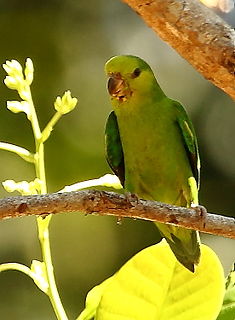
Dusky-billed parrotlet Species of bird

The dusky-billed parrotlet, also known as Sclater's parrotlet, is a small species of parrot in the family Psittacidae. It is the nominate species.

Yellow-faced parrotlet Species of bird

The yellow-faced parrotlet is a species of parrot in the family Psittacidae.

Santarem parakeet Species of bird

The Santarém parakeet, also known as Hellmayr's parakeet or in aviculture as Hellmayr's conure or the Santarém conure, is a species of parrot in the family Psittacidae. It is found in the eastern and central sections of the Amazon basin south of the Amazon River, only just extending onto the northern bank of this river.

Bonapartes parakeet Species of bird

Bonaparte's parakeet, also known as Deville's parakeet, or in aviculture as Deville's conure, is a species of parrot in the family Psittacidae. It is restricted to the Brazilian state of Amazonas south of the Solimões river.

Ceará gnateater Species of bird

The Ceará gnateater or Caatinga gnateater is a passerine bird of the gnateater family, Conopophagidae. It is found in forest understory and bushes in northeastern Brazil.
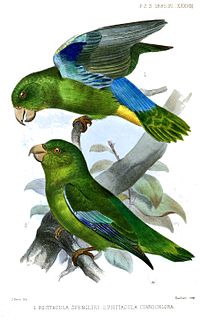
Turquoise-winged parrotlet Species of bird

The turquoise-winged parrotlet is a species of parrot in the family Pscittacidae.
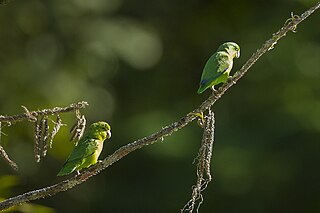
Large-billed parrotlet Species of bird

The large-billed parrotlet is a species of parrot in the family Psittacidae.

References

  1. 1 2 BirdLife International (2012). "Forpus xanthopterygius". IUCN Red List of Threatened Species . 2012. Retrieved 26 November 2013.CS1 maint: ref=harv (link)
  2. 1 2 3 4 5 6 7 8 9 10 11 "Blue-winged Parrotlet (Forpus xanthopterygius) | Parrot Encyclopedia". www.parrots.org. Retrieved 2019-03-17.
  3. Parr, M.; Juniper, T. (2010). Parrots: A Guide to Parrots of the World. A&C Black. p. 176. ISBN   978-1408135754.
  4. 1 2 "Blue-winged Parrotlet - Introduction | Neotropical Birds Online". neotropical.birds.cornell.edu. Retrieved 2019-03-17.
  5. "The IUCN Red List of Threatened Species". IUCN Red List of Threatened Species. Retrieved 2019-03-17.
  6. 1 2 "Blue-winged Parrotlet - eBird". ebird.org. Retrieved 2019-04-05.
  7. 1 2 Melo, C.; Oliveira, A.D.; Borges, C.A.; Ribeiro, G.; Tavares, J. (November 2009). "Impact of Forpus xanthopterygius (Spix, 1824) (Aves, Psittacidae) on flowers of Handroanthus serratifolius (Vahl.) S. O. Grose (Bignoniaceae)". Brazilian Journal of Biology. 69 (4): 1149–51. doi: 10.1590/S1519-69842009000500020 . PMID   19967187.
  8. 1 2 3 "Blue-winged Parrotlet (Forpus xanthopterygius)". www.hbw.com. Retrieved 2019-04-05.
  9. Sazima, I. (September 2008). "The parrotlet Forpus xanthopterygius scrapes at clay nests of the ovenbird Furnarius rufus: tasting or testing a new home?" (PDF). Revista Brasileira de Ornitologia. 16: 256–259.
  10. de Figueiredo, R.A. (1996). "Vertebrates at neotropical fig species in a forest fragment". Tropical Ecology. International Society for Tropical Ecology. 37 (1): 139–141 via ResearchGate.
  11. Bocalini, F.; Silveira, L.F. (May 2015). "Morphological variability and taxonomy of the Bluewinged Parrotlet Forpus xanthopterygius (Psittacidae)". Revista Brasileira de Ornitologia. 23: 64–75. doi: 10.1007/bf03544290 via ResearchGate.