
Allspice, also known as Jamaica pepper, myrtle pepper, pimenta, or pimento, is the dried unripe berry of Pimenta dioica, a midcanopy tree native to the Greater Antilles, southern Mexico, and Central America, now cultivated in many warm parts of the world. The name allspice was coined as early as 1621 by the English, who valued it as a spice that combined the flavours of cinnamon, nutmeg, and clove. Contrary to common knowledge, it is not a mixture of spices.

Urtica dioica, often known as common nettle, burn nettle, stinging nettle or nettle leaf, or just a nettle or stinger, is a herbaceous perennial flowering plant in the family Urticaceae. Originally native to Europe, much of temperate Asia and western North Africa, it is now found worldwide. The species is divided into six subspecies, five of which have many hollow stinging hairs called trichomes on the leaves and stems, which act like hypodermic needles, injecting histamine and other chemicals that produce a stinging sensation upon contact.

Lobelia chinensis, commonly known as Asian lobelia, Chinese lobelia, and Herba Lobellae Chinensis, is a species of flowering plant in the family Campanulaceae. It is one of the 50 fundamental herbs used in traditional Chinese medicine, where it has the name.

Lobelia purpurascens, commonly known as white root or purplish pratia, is a flowering plant in the family Campanulaceae of eastern Australia. It is a small herbaceous, scrambling plant with white to pale pink flowers.

Wurmbea dioica, commonly known as early Nancy, is a species of plant in the family Colchicaceae and is endemic to Australia. It is a herb with three linear to thread-like leaves and usually two to seven white flowers with a purple or greenish nectary band.

Lobelia dentata is a herb found in eastern Australia. The habitat is eucalyptus woodland and forest, often on sandy soils. It is an uncommon species, but may be locally abundant after bushfires.

Lobelia heterophylla is a blue to purple flowered herb found in Southern Australia. The specific epithet refers to the variety of leaf forms found on individual plants. The species was first described by Jacques Labillardière in his seminal work on Australian flora, Novae Hollandiae Plantarum Specimen. L. heterophylla has a wide distribution, due to its ability to inhabit a variety of soil types. The habit of the herbaceous plant is erect, up to 0.6 metres, with flowers appearing from August or October to December, or January to February. The flower whorl is deeply cleft, its colour range of blue, scarlet or purple is well known and it is considered to be a desirable specimen for use in gardens. The plant is commonly referred to as wing-seeded lobelia and Australian blue creeper. The species was featured and illustrated by Joseph Paxton in 1838.

Lobelia anceps, commonly known as angled lobelia, is a small herbaceous plant in the family Campanulaceae it grows in several states of Australia, New Zealand, South America and South Africa. It is a small, perennial herb with blue to purple flowers.
Lobelia archeri is a small herbaceous plant in the family Campanulaceae native to Western Australia, first described in 2010 by Neville Walsh.
Lobelia cleistogamoides is a small herbaceous plant in the family Campanulaceae native to Western Australia, and first described in 2007 by Neville Walsh and David Albrecht.

Lobelia douglasiana is a flowering plant in the family Campanulaceae and is endemic to northern Australia. It is a small, spreading herb with blue and white flowers.

Lobelia gibbosa, commonly known as tall lobelia, is a small herbaceous plant in the family Campanulaceae native to Western Australia.
Lobelia leucotos is a small herbaceous plant in the family Campanulaceae native to Western Australia.
Lobelia rarifolia is a small herbaceous plant in the family Campanulaceae native to Western Australia.
Lobelia rhytidosperma, commonly known as wrinkled-seeded lobelia, is a small herbaceous plant in the family Campanulaceae native to Western Australia.

Lobelia tenuior, commonly known as slender lobelia, is a small herbaceous plant in the family Campanulaceae native to Western Australia.

Lobelia winfridae, commonly known as little lobelia, is a small herbaceous plant in the family Campanulaceae native to Western Australia.

Lobelia trigonocaulis, the forest lobelia is a creeping or trailing herb, found in moist forest areas in New South Wales and Queensland in Australia. Blue to mauve flowers form between the months of December and May. Leaves are near circular or ovate in shape; ranging from about 4.0 to 5.5 cm long and 2.5 to 3.8 cm wide.

Lobelia browniana is a species of flowering plant in the family Campanulaceae and is endemic to eastern Australia. It is an erect, glabrous, annual plant with narrow leaves and one-sided racemes of blue flowers with long, soft hairs in the centre.
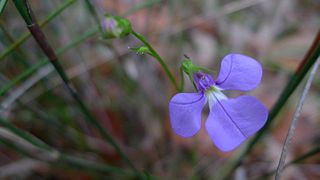
Lobelia anceps, commonly known as trailing lobelia, is a small herbaceous, flowering plant in the family Campanulaceae. It has dark blue or purple flowers and grows in New South Wales and Queensland.


