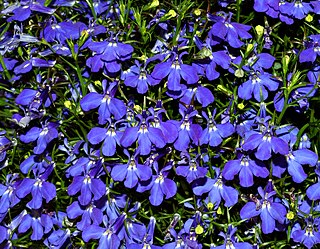
Lobelia is a genus of flowering plants comprising 415 species, with a subcosmopolitan distribution primarily in tropical to warm temperate regions of the world, a few species extending into cooler temperate regions. They are known generally as lobelias.

Pseudemys is a genus of large, herbivorous, freshwater turtles of the eastern United States and adjacent northeast Mexico. They are often referred to as cooters, which stems from kuta, the word for turtle in the Bambara and Malinké languages, brought to America by enslaved people from Africa.
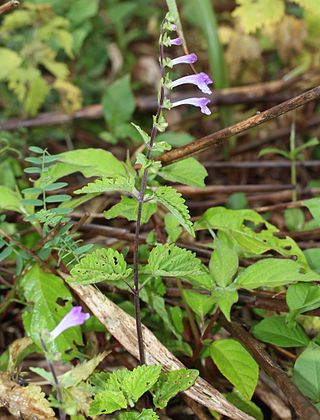
Scutellaria is a genus of flowering plants in the mint family, Lamiaceae. They are known commonly as skullcaps. The generic name is derived from the Latin scutella, meaning "a small dish, tray or platter", or "little dish", referring to the shape of the calyx. The common name alludes to the resemblance of the same structure to "miniature medieval helmets". The genus has a subcosmopolitan distribution, with species occurring nearly worldwide, mainly in temperate regions.

Uvularia is a genus of flowering plants in the family Colchicaceae, which is closely related to the lily family (Liliaceae). They are commonly called bellworts, bellflowers, or merrybells. The genus name is derived from the Latin ūvula meaning "little grape", likely because of the way the flowers hang downward. For the same reason Uvularia may also refer to the similarly derived palatine uvula, which hangs down from the soft palate in the mouth. The plants are often found growing on wooded slopes or in ravines and they spread by stolons, or stoloniferous rhizomes. The plants are usually 45–60 cm (18–24 in) in height and bear one or two flowers per stem in April and May, that hang downward from the axils of the leaves.

Lobelia cardinalis, the cardinal flower, is a species of flowering plant in the bellflower family Campanulaceae native to the Americas, from southeastern Canada south through the eastern and southwestern United States, Mexico and Central America to northern Colombia.
Ulmus americana var. floridana, the Florida elm, first described as Ulmus floridana by Alvan Wentworth Chapman in the 1860s, is smaller than the type, and occurs naturally in north and central Florida south to Lake Okeechobee.

Taxus floridana, the Florida yew, is a species of yew, endemic to a small area of under 10 km² on the eastern side of the Apalachicola River in mesophytic forests of northern Florida at altitudes of 15–40 m. It is listed as critically endangered. It is protected in reserves at the Torreya State Park and at the Nature Conservancy's Apalachicola Bluffs and Ravines Preserve, and has legal protection under the United States and Florida Endangered Species laws.

Sir Frederick Revans Chapman was a New Zealand judge and was the first New Zealand-born Supreme Court judge.
Utricularia floridana, the Florida yellow bladderwort, is a large affixed aquatic carnivorous plant in the bladderwort genus within the bladderwort family). It is a perennial plant that is endemic to southeastern United States.
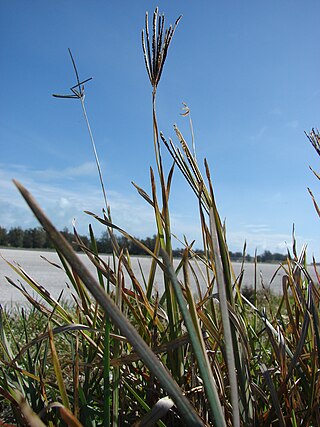
Eustachys is a genus of tropical and subtropical plants in the grass family. It is native primarily to warmer parts of the Americas, with a few species in Africa and Asia.

Chrysopsis floridana is a rare species of flowering plant in the family Asteraceae, known by its common name, Florida golden aster. It is endemic to Florida in the United States, where it is known from Hillsborough, Hardee, Manatee, and Pinellas Counties. It is considered an endemic of the west-central coast of the state in the general vicinity of Tampa Bay. There are 17 to 20 occurrences, many of which have few individuals, but one of which has over one million plants. In 1986 the plant was added to the US endangered species list because it was becoming increasingly rare, it was growing only on private property, and its habitat was unprotected and being destroyed and degraded by a number of forces. It is found at Bell Creek Nature Preserve in Riverview, Florida.

Stachys floridana is a species of betony in the mint family, Lamiaceae. It is native to the United States, where its true native range is probably limited to Florida, but today it is known throughout the Southeast as an introduced species and common weed. It occurs as far west as Texas, and it has been recorded in California. Its common names include Florida betony, Florida hedgenettle, and rattlesnake weed. It has been called wild artichoke, but it is not closely related to artichoke. The plant was the Florida Department of Agriculture's "Weed of the Month" for February 2010.
Stizocera floridana is a species of beetle in the family Cerambycidae. It was described by Linsley in 1949. It can grow to 13 mm. It is found in Lee County Florida.
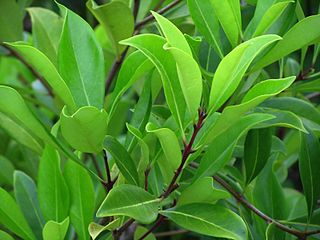
Cartrema is a genus of a few species of flowering plants in the family Oleaceae, native to southeastern Asia, southern China, and North America, formerly treated as section Leiolea of Osmanthus. Species of Cartrema may be distinguished from those of Osmanthus by the paniculate inflorescences of the former.
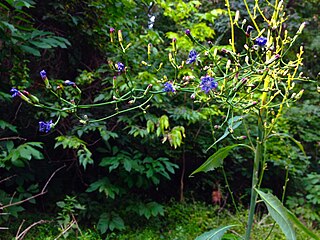
Lactuca floridana, commonly known as woodland lettuce, Florida lettuce, or false lettuce is a North American species of wild lettuce. It is native across much of central Canada and the eastern and central United States.
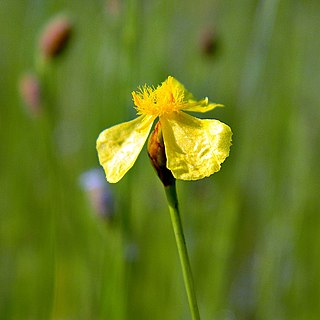
Xyris difformis, the bog yelloweyed grass, is a North American species of flowering plant in the yellow-eyed-grass family. It is native to the eastern and southern United States, eastern and central Canada, and Central America.

Zamia integrifolia, also known as coontie palm is a small, tough, woody cycad native to the southeastern United States, the Bahamas, Cuba, and the Cayman Islands.

Matelea floridana is a flowering plant within the Milkweed Subfamily. It is endemic to Florida and two counties in Georgia, and is listed as Endangered. It is a perennial dicot. Flowers are purplish black, 1–2 cm in diameter, borne on short pedicels that occur at mature nodes along the stem, from one to many flowers. Leaf pairs are opposite, cordate from 5–10 cm in length, lightly pubescent.

Froelichia floridana is a species of flowering plant in the genus Froelichia, in the amaranth family (Amaranthaceae). It is known as prairie cottonweed, Florida snakecotton, large cottonweed, field snakecotton, or plains snakecotton. An annual, it produces white woolly flowers on tall flowering stalks, growing up to 40 in (1,000 mm) in height. The narrowly oblanceolate to elliptic leaves are opposite, occurring on the lower third of the stem. It grows in central and eastern North America, from the Great Plains to Mexico, east to the Atlantic Coast. Its propensity to spread easily has resulted in it being considered an agricultural weed and it is an invasive species in Australia.


