
Asterales is an order of dicotyledonous flowering plants that includes the large family Asteraceae known for composite flowers made of florets, and ten families related to the Asteraceae. While asterids in general are characterized by fused petals, composite flowers consisting of many florets create the false appearance of separate petals.
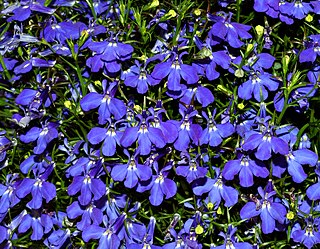
Lobelia is a genus of flowering plants comprising 415 species, with a subcosmopolitan distribution primarily in tropical to warm temperate regions of the world, a few species extending into cooler temperate regions. They are known generally as lobelias.

The family Campanulaceae, of the order Asterales, contains nearly 2400 species in 84 genera of herbaceous plants, shrubs, and rarely small trees, often with milky sap. Among them are several familiar garden plants belonging to the genera Campanula (bellflower), Lobelia, and Platycodon (balloonflower). Campanula rapunculus and Codonopsis lanceolata are eaten as vegetables. Lobelia inflata, L. siphilitica and L. tupa and others have been used as medicinal plants. Campanula rapunculoides may be a troublesome weed, particularly in gardens, while Legousia spp. may occur in arable fields.
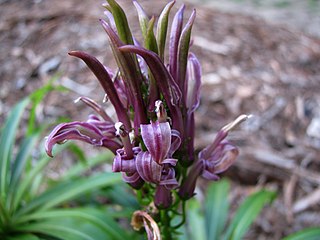
The Hawaiian lobelioids are a group of flowering plants in the bellflower family, Campanulaceae, subfamily Lobelioideae, all of which are endemic to the Hawaiian Islands. This is the largest plant radiation in the Hawaiian Islands, and indeed the largest on any island archipelago, with over 125 species. The six genera involved can be broadly separated based on growth habit: Clermontia are typically branched shrubs or small trees, up to 7 metres (23 ft) tall, with fleshy fruits; Cyanea and Delissea are typically unbranched or branching only at the base, with a cluster of relatively broad leaves at the apex and fleshy fruits; Lobelia and Trematolobelia have long thin leaves down a single, non-woody stem and capsular fruits with wind-dispersed seeds; and the peculiar Brighamia have a short, thick stem with a dense cluster of broad leaves, elongate white flowers, and capsular fruits. The relationships among the genera and sections remains unsettled as of April 2022.
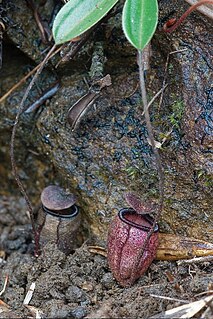
Nepenthes argentii is a highland Nepenthes pitcher plant native to Mount Guiting-Guiting on Sibuyan Island in the Philippines. It is possibly the smallest species in the genus and does not appear to have a climbing stage.
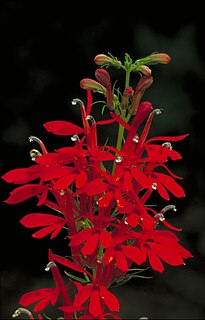
Lobelia cardinalis, the cardinal flower, is a species of flowering plant in the bellflower family Campanulaceae native to the Americas, from southeastern Canada south through the eastern and southwestern United States, Mexico and Central America to northern Colombia.

Lobelia scaevolifolia is a species of the plant family Campanulaceae. It is endemic to the island of Saint Helena in the South Atlantic Ocean. It was at one time placed as the only species, Trimeris scaevolifolia, in the genus Trimeris. Its common name is St. Helena lobelia.
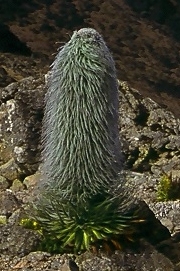
Lobelia telekii is a species of flowering plant in the family Campanulaceae, that is found only in the alpine zones of Mount Kenya, Mount Elgon, and the Aberdare Mountains of East Africa. It occurs at higher altitudes on well-drained sloped hillsides. It is a semelparous species, putting all its reproductive effort into producing single large inflorescence up to 3 metres (10 ft) tall, and then dying. Inflorescences of L. telekii also possesses a large pith-volume for internal water storage and marcescent foliage which could provide insulation. It secretes a polysaccharide into this reservoir, which may be useful for its survival in the cold climate. The plant is named after the Austro-Hungarian explorer, Count Sámuel Teleki.
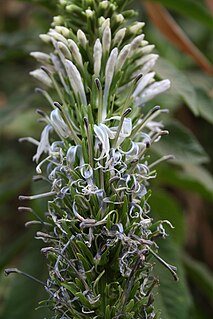
Lobelia columnaris is a species of plant in the family Campanulaceae. It is the only giant Lobelia occurring in West Africa and is found in Cameroon and Equatorial Guinea. Its natural habitat is subtropical or tropical dry forests.
Pratia is a formerly recognized genus of flowering plants in the family Campanulaceae, native to Asia, Australia and New Zealand. Along with other genera, such as Hypsela and Isotoma, it is now included in Lobelia.

Giant lobelia is a common name for several plants in the genus Lobelia and may refer to:

Lobelia rhynchopetalum, the giant lobelia, is a plant endemic to Ethiopia. Its habitat is the Afroalpine climate of the Semien Mountains and Bale Mountains National Park. Recent study show that it is under a threat of climate change.

Palmerella is a genus of plants in the family Campanulaceae. It has only one known species, Palmerella debilis, long known by the synonym Lobelia dunnii. It is native to 8 counties in southern California plus the northern part of Baja California.
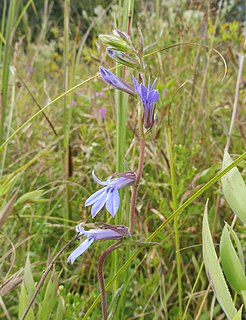
Lobelia puberula, or downy lobelia, is a perennial herbaceous wildflower in the Bellflower family (Campanulaceae) native to eastern and south central United States. It is the most common blue-flowered Lobelia in the Southeast. It grows in mesic to hydric (moist) habitats in sun or partial shade.
Lobelia archeri is a small herbaceous plant in the family Campanulaceae native to Western Australia, first described in 2010 by Neville Walsh.
Lobelia cleistogamoides is a small herbaceous plant in the family Campanulaceae native to Western Australia, and first described in 2007 by Neville Walsh and David Albrecht.
Lobelia fissiflora is a small herbaceous plant in the family Campanulaceae native to Western Australia, and first described in 2010 by Neville Walsh, David Albrecht and Eric Knox
Lobelia simulans is a small herbaceous plant in the family Campanulaceae native to Western Australia, and was first described in 2010 by Neville Walsh, David Albrecht and Eric Knox.
Lobelia feayana, the bay lobelia, is a species of bellflower endemic to Florida. A perennial dicot in the Campanulaceae family, it grows in moist areas such as ditches and is often spotted along roadsides. When clustered, the flowers have been described as appearing as a purple haze. It is pollinated by bees and the colors of the five petaled flowers vary from "bluish to lavender to purplish-pink". It is sometimes mistaken for blue toadflax which can also grow in groupings.
Lobelia georgiana, the Georgia lobelia, is a species of flowering plant in the family Campanulaceae, native to the southeastern United States. It is likely that the range of Lobelia georgiana only extends to Alabama, Georgia and Florida due to misidentification of specimens.


