
Lodi ceramics are ceramics produced in Lodi, a city in the Lombardy region of Northern Italy. Their artistic quality reached its peak in the 18th century.
Lodi ceramics are ceramics produced in Lodi, a city in the Lombardy region of Northern Italy. Their artistic quality reached its peak in the 18th century.
The production of ceramic in the Lodi region has ancient origins. Findings include fragments from pre-historic period and amphoras, little votive statues and lamps decorated in relief from the Roman period. [1] [2]
A large production of terracotta for architectural decorations was developed in the 14th century, such as in the facades of the churches of Lodi, and in particular in the ornaments of the cloister of the Ospedale Maggiore, [3] in the decorations of Palazzo Mozzanica, [4] and in Piazza Broletto and Piazza Mercato. [1] [2] The first written documents testifying to the presence of furnaces in the Lodi area date back to the 16th century and then to the 17th century. The production of ceramics had little economic importance. This was due to the little dimension of the local market, which mostly required ceramics for ordinary use; moreover the production of ceramics was hindered by the many taxes, both on the import of the raw material, the earth from Stradella, and on the export of the products. Finally, furnaces could not be built in the city, because of fire risk and the nuisance of fumes. [1] [2]
The presence of ceramics manufacture in the 16th century [5] and of at least 3 furnaces in Lodi in the 17th century is well documented. [1] [2] These furnaces must have been capable of producing high quality ceramics, given the importance of some orders,such as that for the House of Gonzaga in 1526 [5] and that by Cardinal Federico Borromeo in 1623. [1] [2] [5] Furthermore, the ceramics of Lodi must have had a good reputation considering that Lodi ceramics workers are documented to be present in Savona in 1545, [5] in Brescia and Como areas [1] [2] and in Veneto [5] in the 17th century and given customs documents that certify the export of Lodi ceramics throughout the Duchy of Milan, up to Borgomanero. [1] [2] [5] Unfortunately, no 17th century ceramics from Lodi have been preserved, only fragments. [1] [2] [5]
Following the war of the Spanish Succession, at the beginning of the 18th century the territory of Lodi was annexed, with the Duchy of Milan, to the realm of the House of Habsburg of Austria. Economic reforms were introduced that boosted economy and trade. In the field of ceramics however many duties on raw materials and exports remained. In spite of these duties, a few factories were established in Lodi, including that of Coppellotti, already active in the 17th century, Rossetti and Ferretti, which produced ceramics of the highest quality in Lodi. Artists and decorators were able to move more freely than before and this enabled the production of ceramics in Lodi to acquire techniques and decorations from Northern Europe and France, such as the Bérain decoration and a third, lower temperature firing. [1] [2] Ceramics workers and artists, as well as products, were found in northern and central Italy, in particular in Bassano, the Modena area and Sassuolo, Piedmont and Pesaro. [1] [2] In 1796, the battle of Lodi between Napoleon Bonaparte and the Austrian troops marked the decline of ceramic production in Lodi, due both to the material damage suffered by the Ferretti factory located near the battleground by the Adda river, and to the economic decline during the period of the Napoleonic wars and the following restoration. [1] [2]
In 1823 the Ferretti furnace was taken over by Dossena, who managed it as a modern business. Ceramics were no longer handcrafted on commission, but produced to be sold on the market. After a period of success witnessed by exports to Ireland and Scotland and by the purchase of some ceramics by the House of Savoy, the furnace closed at the end of the 19th century. [2]

The main material for the production of ceramics was the earth of Stradella, a clay rich in limestone, which, thanks to its malleability, made the ceramics very thin and light. [6] The main component for the glaze was sand from San Colombano al Lambro, rich in silicon, but tin was also added to the glaze. Tin-glazing made the ceramics uniform. [6] Having a tin based glaze, Lodi ceramics are to be considered maiolica. The firing technique was based on gran fuoco (double firing) or on piccolo fuoco (third firing).
The gran fuoco technique, also known as underglaze decoration, was the only one in use until the mid 18th century, but was still used even after the introduction of the piccolo fuoco (third fire) technique around 1750. Two firings were carried out at about 950 °C. With the first firing, the product was hardened and could then be glazed and painted, with the glaze not fixed yet by the second firing. The colours spread into the un-fired glaze. [7] Since colours were painted over un-fired glaze, which was porous and absorbent, any errors could not be amended. [8] Only those colours that could withstand the high temperature of the second firing could be used: manganese for violet, antimony for yellow, iron for a reddish colour, cobalt for blue, copper for green. Cobalt blue tended to spread to the glaze, creating blue hues, and this also happened when it was mixed with yellow to create green. [7] Proper red colour was rare, given the high chances of burning during firing at high temperature. Strong shades of orange or manganese brown were often used instead [8]

In the second half of the 18th century the technique of third fire – piccolo fuoco, also known as overglaze decoration, was introduced, which made it possible to obtain a greater range of more vibrant colours. After two firings at about 950 °C, identical to those of the technique of gran fuoco, the glaze, already vitrified, was painted with colours that would have degraded at higher temperature and a third firing was carried out at about 600-650 °C. The fact that colours were painted on a surface already vitrified meant that errors could be corrected. [9] One of the new pigments that could be used thanks to the third firing was Purple of Cassius, a red obtained from gold chloride, which made it possible to introduce various shades of red, from pink to purple. [8] [9] The first European factory where the piccolo fuoco technique was developed was that of Paul Hannong in Strasbourg. [8] [9] Antonio Ferretti was one of the first artisans to introduce this technique in Italy [9]

The Coppellotti factory was active from 1641 to the end of the 18th century; the best ceramics date back to the period 1735-1740 and were produced with the gran fuoco technique: plates, centerpieces, teapots, coffeemakers, sugar bowls. [7] Some of the decorative motives were influenced by French ceramics, in particular the decoration known as 'De lambrequins et rayonnants', introduced from Rouen, with arabesques, draperies and geometric-floral compositions arranged in a radial pattern. Most of these ceramics are in turquoise monochrome. [7] There are also many other original polychrome decorations representing fruit, fish, landscapes, castles, peasants, wayfarers, music players, oriental figures, accompanied by animals, such as birds and dogs [7]

The Rossetti factory was active in Lodi between 1729 and 1736. [10] Rossetti ceramics were fired with the Gran fuoco technique [11] and most are in monochromatic turquoise. Rossetti excelled in the decoration known as the 'Bérain' style, which takes its name from the French decorator Jean Bérain the Elder, with pillars, balustrades, capitals, urns, shells, stylized leaves garlands, divinities and satyrs. [12] Some ceramics feature landscapes in the center, with views of cities and castles, hills, lakes, clouds and birds. [10] There are also two examples of polycrome Rossetti ceramics, representing scenes of a lake and a town. [10]

The Ferretti factory was active in Lodi in the 18th century until the beginning of the 19th century. At the start of the second half of the eighteenth century, the piccolo fuoco technique was introduced. It is believed that Antonio Ferretti was one of the first to introduce this technique in Italy. The best known decoration of the Ferretti ceramics is the one with naturalistic flowers, with very bright and lively colours, which could be obtained thanks to the piccolo fuoco technique. [9] The most commonly painted flowers were wild flowers, such as forget-me-not, buttercups, Centaurea cyanus, campanula, primroses and dog rose; but also cultivated varieties were represented, such as roses, tulips and carnations. [13] Other decorations included Chinese and Oriental figures, and some fruit decorations, with the technique of the piccolo fuoco; and still lifes with fruit and fish with the technique of gran fuoco [9]
These are some of the museums where Lodi ceramics are on display [14]


Lodi is a city and comune in Lombardy, northern Italy, primarily on the western bank of the River Adda. It is the capital of the province of Lodi.

Delftware or Delft pottery, also known as Delft Blue or as delf, is a general term now used for Dutch tin-glazed earthenware, a form of faience. Most of it is blue and white pottery, and the city of Delft in the Netherlands was the major centre of production, but the term covers wares with other colours, and made elsewhere. It is also used for similar pottery, English delftware.

Faience or faïence is the general English language term for fine tin-glazed pottery. The invention of a white pottery glaze suitable for painted decoration, by the addition of an oxide of tin to the slip of a lead glaze, was a major advance in the history of pottery. The invention seems to have been made in Iran or the Middle East before the ninth century. A kiln capable of producing temperatures exceeding 1,000 °C (1,830 °F) was required to achieve this result, the result of millennia of refined pottery-making traditions. The term is now used for a wide variety of pottery from several parts of the world, including many types of European painted wares, often produced as cheaper versions of porcelain styles.

In different periods of time and in different countries, the term majolica has been used for two distinct types of pottery.

Islamic pottery occupied a geographical position between Chinese ceramics, and the pottery of the Byzantine Empire and Europe. For most of the period, it made great aesthetic achievements and influence as well, influencing Byzantium and Europe. The use of drinking and eating vessels in gold and silver, the ideal in ancient Rome and Persia as well as medieval Christian societies, is prohibited by the Hadiths, with the result that pottery and glass were used for tableware by Muslim elites, as pottery also was in China but was much rarer in Europe and Byzantium. In the same way, Islamic restrictions greatly discouraged figurative wall painting, encouraging the architectural use of schemes of decorative and often geometrically patterned titles, which are the most distinctive and original specialty of Islamic ceramics.

Maiolica is tin-glazed pottery decorated in colours on a white background. The most renowned Italian maiolica is from the Renaissance period. These works were known as istoriato wares when depicting historical and mythical scenes. By the late 15th century, multiple locations, mainly in northern and central Italy, were producing sophisticated pieces for a luxury market in Italy and beyond. In France, maiolica developed as faience, in the Netherlands and England as delftware, and in Spain as talavera. In English, the spelling was anglicised to majolica, but the pronunciation usually preserved the vowel with an i as in kite.

Tin-glazing is the process of giving tin-glazed pottery items a ceramic glaze that is white, glossy and opaque, which is normally applied to red or buff earthenware. Tin-glaze is plain lead glaze with a small amount of tin oxide added. The opacity and whiteness of tin glaze encourage its frequent decoration. Historically this has mostly been done before the single firing, when the colours blend into the glaze, but since the 17th century also using overglaze enamels, with a light second firing, allowing a wider range of colours. Majolica, maiolica, delftware and faience are among the terms used for common types of tin-glazed pottery.

Ceramic glaze, or simply glaze, is a glassy coating on ceramics. It is used for decoration, to ensure the item is impermeable to liquids and to minimise the adherence of pollutants.

Montelupo Fiorentino is a comune (municipality) in the Metropolitan City of Florence in the Italian region of Tuscany, located about 20 kilometres southwest of Florence.

Paolo Gorini was an Italian mathematician, professor, scientist, and politician renowned as a pioneer of cremation in Europe, primarily in the United Kingdom.

In-glaze or inglaze is a method of decorating pottery, where the materials used allow painted decoration to be applied on the surface of the glaze before the glost firing so that it fuses into the glaze in the course of firing.
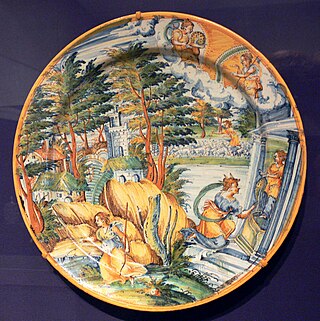
Tin-glazed pottery is earthenware covered in lead glaze with added tin oxide which is white, shiny and opaque ; usually this provides a background for brightly painted decoration. It has been important in Islamic and European pottery, but very little used in East Asia. The pottery body is usually made of red or buff-colored earthenware and the white glaze imitated Chinese porcelain. The decoration on tin-glazed pottery is usually applied to the unfired glaze surface by brush with metallic oxides, commonly cobalt oxide, copper oxide, iron oxide, manganese dioxide and antimony oxide. The makers of Italian tin-glazed pottery from the late Renaissance blended oxides to produce detailed and realistic polychrome paintings.

Talavera pottery is a Mexican and Spanish pottery tradition from Talavera de la Reina, in Spain. In 2019, it was included in UNESCO's Representative List of the Intangible Cultural Heritage of Humanity.

The Doccia porcelain manufactory, at Doccia, a frazione of Sesto Fiorentino, near Florence, was in theory founded in 1735 by marchese Carlo Ginori near his villa, though it does not appear to have produced wares for sale until 1746. It has remained the most important Italian porcelain factory ever since.
Francesco Poli is an Italian art critic and curator. He teaches History of Contemporary Art at the Academy of Fine Arts of Brera. He is also "chargé de cours" at University of Paris 8 and teaches Art and Communication at the University of Turin.

Giovanni Pietro da Cemmo was an Italian painter.

Ceramics of Jalisco, Mexico has a history that extends far back in the pre Hispanic period, but modern production is the result of techniques introduced by the Spanish during the colonial period and the introduction of high-fire production in the 1950s and 1960s by Jorge Wilmot and Ken Edwards. Today various types of traditional ceramics such as bruñido, canelo and petatillo are still made, along with high fire types like stoneware, with traditional and nontraditional decorative motifs. The two main ceramics centers are Tlaquepaque and Tonalá, with a wide variety of products such as cookware, plates, bowls, piggy banks and many types of figures.

Lead-glazed earthenware is one of the traditional types of earthenware with a ceramic glaze, which coats the ceramic bisque body and renders it impervious to liquids, as terracotta itself is not. Plain lead glaze is shiny and transparent after firing. Coloured lead glazes are shiny and either translucent or opaque after firing. Three other traditional techniques are tin-glazed, which coats the ware with an opaque white glaze suited for overglaze brush-painted colored enamel designs; salt glaze pottery, also often stoneware; and the feldspathic glazes of Asian porcelain. Modern materials technology has invented new glazes that do not fall into these traditional categories.
The Manifattura Italiana Porcellane Artistiche Fabris was created by sculptor Luigi Fabris from Bassano del Grappa who, after acquiring Raffaele Passarin's pottery factory in Bassano, made the ceramic facade of Grand Hotel Ausonia & Hungaria at Lido di Venezia, which was finished in 1916.

The Museum Giuseppe Gianetti is a ceramics museum located in Saronno, Italy. The Museum includes collections of different types of porcelain, majolica, and ceramics that belonged to the Italian industrialist Giuseppe Gianetti. These showcase more than 200 pieces of Meissen porcelain, which represents the Museum's most substantial collection. Other collections cover Oriental porcelain, Italian and European majolica, and porcelain. The original collections have been expanded to include the Aldo Marcenaro Collection and a collection of contemporary ceramics.