Sir Anerood Jugnauth GCSK, KCMG, QC, MP, PC is a Mauritian politician who has served as both President and Prime Minister of Mauritius. He is Member of Parliament for Piton & Riviere Du Rempart.

Elections in Angola take place within the framework of a multi-party democracy and a presidential system. The National Assembly is directly elected by voters, whilst the leader of the largest party or coalition in the National Assembly automatically becomes President. The country is currently a one-party dominant state, with the MPLA as the dominant party.
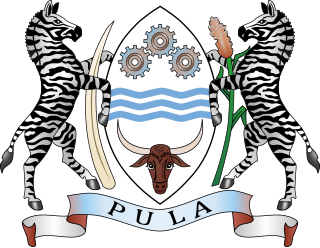
Elections in Botswana take place within the framework of a multi-party democracy and a parliamentary system. The National Assembly is mostly directly elected, and in turn elects the President and some of its own members. The Ntlo ya Dikgosi is a mixture of appointed, hereditary and indirectly elected members.
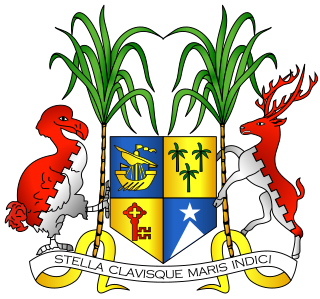
Elections in Mauritius gives information on elections and election results in Mauritius. Since 1967, Mauritius has experienced 11 free and fair democratic general elections to choose a government.

Elections in Gabon take place within the framework of a presidential multi-party democracy with the Gabonese Democratic Party, in power since independence, as the dominant party. The President and National Assembly are directly elected, whilst the Senate is indirectly elected.

Elections in Zambia take place within the framework of a multi-party democracy and a presidential system. The President and National Assembly are simultaneously elected for five-year terms.
The Sudanese Union – African Democratic Rally was a political party in Mali.
Sookdeo Bissoondoyal was a Mauritian politician and one of the leading figures in the independence movement.

The unicameral National Assembly is the legislative body of the Republic of Cape Verde.

The National Assembly is the legislative branch of the government of Angola. The National Assembly is a unicameral body, with 220 members: 130 members elected by proportional representation and 90 members elected by provincial districts.
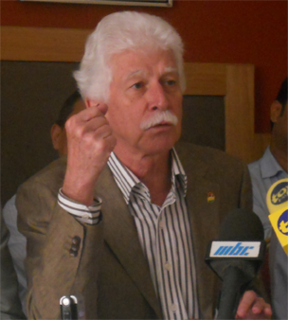
A general election was held in Mauritius on 5 May 2010. The coalition comprising Mauritius Labour Party under Navin Ramgoolam, the Militant Socialist Movement under Pravind Jugnauth and the Mauritian Social Democrat Party under Xavier Luc Duval, won a majority with 41 seats in the parliament. The Mauritian Militant Movement-led coalition under Paul Berenger finished second with 18 seats. The Mauritian Solidarity Front won one seat and the Rodrigues Movement won the two remaining seats. The elections were the ninth to be held since independence from the United Kingdom in 1968.
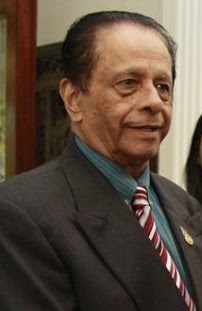
General elections were held in Mauritius on 15 September 1991. Three main parties gained seats in this election: the Militant Socialist Movement, Mauritian Militant Movement and the Labour Party. The MSM formed an alliance with the MMM and the Labour party formed an alliance with the Mauritian Social Democrat Party (PMSD). On 17 September 1991, results showed that MSM-MMM won 57 seats out of 60 elected seats. This gave 95% of seats to MSM-MMM leader Anerood Jugnauth and 5% to Labour Party-PMSD leader Navin Ramgoolam.
General elections were held in Mauritius on 20 November 1995. The result was a victory for the Labour Party-Mauritian Militant Movement alliance led by Navin Ramgoolam, which won all 60 constituency seats on Mauritius. Along with 1982, it was one of two elections in which a party won every seat. The Militant Socialist Movement (MSM) led by Anerood Jugnauth lost power after 13 years, with Jugnauth resigning two days after the results were announced. Navin Ramgoolam became Prime Minister and appointed Paul Berenger as Deputy Prime Minister.
General elections were held in Botswana on 26 October 1974. With 205,050 registered voters, turnout was just 31.22%. The result was a third successive landslide victory for the Botswana Democratic Party (BDP), who won 27 of the 32 elected seats, including four in which they were unopposed. Local elections were held on the same day, with a turnout of just 30.3%, and saw the BDP strengthen its position.
General elections were held in Mauritius on 23 December 1976. Although the Mauritian Militant Movement won the most seats, a coalition government was formed by the Independence Party and the Mauritian Social Democrat Party. Around 400 candidates representing thirty-one parties contested the election, but only the three aforementioned parties won seats.

General elections were held in Mauritius on 11 June 1982. 360 candidates representing 22 parties contested the election, the result of which was a victory for the Mauritian Militant Movement-Mauritian Socialist Party alliance, which won all 60 of the directly elected mainland seats.
General elections were held in Mauritius on 21 August 1983. The result was a victory for an alliance of the Militant Socialist Movement, the Labour Party and the Mauritian Social Democrat Party, which between them won 46 seats. The Militant Socialist Movement (MSM) won 32 seats, whilst the Labour Party secured 9 seats and PMSD five. This alliance allowed Jugnauth to continue as Prime Minister while bringing Seewoosagur Ramgoolam and Gaetan Duval back into the government after their severe defeat in the 1982 elections. Shortly after, Ramgoolam was appointed as Governor General, Duval became Deputy Prime Minister and Satcam Boolell became Minister of Foreign Affairs.
General elections were held in Mauritius on 26 and 27 August 1953. The result was a victory for the Labour Party, which won 13 of the 19 elected seats on the Legislative Council. However, as with the 1948 election, the Governor-General Hillary Blood appointed twelve conservatives to the Council, largely to ensure the dominance of English and French speakers.
General elections were held in Mauritius on 30 August 1987. The result was a victory for the Alliance, composed of the Labour Party, the Mauritian Socialist Movement and the Mauritian Social Democrat Party, which won 44 of the 70 seats.