| ||||||||||||||||||||||||||||
| ||||||||||||||||||||||||||||
All 70 seats in the National Assembly 35 seats needed for a majority | ||||||||||||||||||||||||||||
|---|---|---|---|---|---|---|---|---|---|---|---|---|---|---|---|---|---|---|---|---|---|---|---|---|---|---|---|---|
| ||||||||||||||||||||||||||||
| ||||||||||||||||||||||||||||
| This article is part of a series on the politics and government of Mauritius |
|---|
| Constitution |
Government
|
Judiciary |
|
Administrative divisions |
|
General elections were held in Mauritius on 10 December 2014 and resulted in a victory for the Alliance Lepep coalition, [1] which secured 47 of the elected seats under the leadership of Sir Anerood Jugnauth, while the PTR–MMM alliance under Navin Ramgoolam only got 13 seats.
Mauritius, officially the Republic of Mauritius, is an island nation in the Indian Ocean. The main Island of Mauritius is located about 2,000 kilometres (1,200 mi) off the southeast coast of the African continent. The Republic of Mauritius also includes the islands of Rodrigues, Agalega and St. Brandon. The capital and largest city Port Louis is located on the main island of Mauritius.
The Labour Party is a centre-left social-democratic political party in Mauritius, and one of the four main Mauritian political parties along with the Mauritian Militant Movement (MMM), the Militant Socialist Movement (MSM) and the Parti Mauricien Social Démocrate (PMSD). As a member of the Labour Party-MMM alliance, it had four Members of Parliament directly elected in the general election of 2014. The party is led by Navin Ramgoolam.
Navinchandra Ramgoolam, GCSK, FRCP is a Mauritian politician who was Prime Minister of Mauritius from 2005 to 2014 and leader of the Labour Party. He was Leader of the Opposition from 1991 to 1995. He served as Prime Minister for the first time from December 1995 until September 2000, and became Leader of the Opposition again from October 2000 to 4 July 2005. On 5 July 2005, he became prime minister for a second term after his Alliance Sociale won the general elections. He served again as Prime Minister from 2005 to 2014, when he was defeated afterwards.
Prime Minister Navin Rangoolam lost his own seat and accepted defeat after voters rejected his proposals to boost presidential powers. Former president and Alliance Lepep leader, 84-year-old Anerood Jugnauth became prime minister in the Indian Ocean island nation. [1] Alliance Lepep is a coalition led by the Mouvement Socialiste Militant (MSM) with other parties including the Parti Mauricien Social Démocrate (PMSD) and the Muvman Liberater (ML).
The Prime Minister of Mauritius is the head of government of Mauritius. He presides over the Cabinet of Ministers which advises the President of the Country and is collectively responsible to the National Assembly for any advice given and for all action done by or under the authority of any Minister in the execution of his office.
The Parti Mauricien Social Démocrate (PMSD) is a right-wing political party in Mauritius. It is conservative and francophilic. It is the second biggest political party in the National Assembly and constitutes of the formal opposition, since it left government in 2016 with leader Xavier-Luc Duval serving as the Leader of the opposition.
Muvman Liberater is a left-wing political party in Mauritius founded in 2014 by Ivan Collendavelloo, a lawyer, as a breakaway from the Mauritian Militant Movement (MMM) in protest against MMM leader Paul Berenger's alliance with Prime Minister Navin Ramgoolam's Labour Party. It won seven seats in the 2014 General Election, with the elected MPs being Ivan Collendavelloo, Sangeet Fowdar, Anil Gayan, Ravi Rutna, Anwar Husnoo, Eddy Boissezon and Toolsyraj Benydin.
Following the victory of the Alliance de L'Avenir in the 2010 elections, Navin Ramgoolam continued to govern as prime minister. However, during the period 2010-2014, the Mouvement Socialiste Militant (MSM) and the Parti Mauricien Social Démocrate (PMSD) left the coalition and the Labour Party continued to govern alone with a thin majority.
The L'Alliance de L'avenir was a political alliance in Mauritius which was formed in 2010 in respect for the next parliamentary elections which were held on 5 May 2010. It is an alliance of the Labour Party, Mouvement Socialiste Militant and Parti Mauricien Social Démocrate. It was formed by the prime minister Dr. Navin Ramgoolam and is led by three other people, namely Rashid Beebeejaun, Xavier-Luc Duval and Pravind Jugnauth.
In September 2014, the leaders of the Labour Party and the Mouvement Militant Mauricien (MMM), Navin Ramgoolam and Paul Berenger, signed an agreement to enter into an electoral alliance for the next general election. [2] The plan of this agreement vowed to push through constitutional changes giving greater power to the now-ceremonial role of president.
A general election is an election in which all or most members of a given political body are chosen. These are usually held for a nation's primary legislative body, as distinguished from by-elections and local elections.
Soon after, the MSM, the PMSD and the Muvman Liberater (a new party formed from a break-up with the MMM due to their coalition with the PTR) formed a coalition to face the PTR-MMM Alliance in the next general election. [3]
Prime Minister Ramgoolam advised the President Kailash Purryag to dissolve the National Assembly on 6 October 2014. The President announced that the elections would be held on 10 December. [4]
The President of Mauritius is the Head of State of the Republic of Mauritius. Mauritius is a parliamentary republic, and the President functions as a ceremonial figurehead, elected by the National Assembly as set out by the Constitution of Mauritius. The current office-holder is Barlen Vyapoory who is serving on an acting capacity following Ameenah Gurib-Fakim's resignation. The President's official residence is the State House.

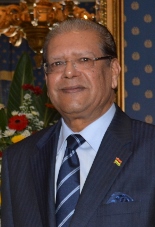
Rajkeswur Purryag, GCSK GCSK, GOSK is a Mauritian politician who served as President of Mauritius from 2012 to May 2015. He was elected as the fifth President of Mauritius by the National Assembly and took office on 21 July 2012. He succeeded Sir Anerood Jugnauth, who spent nine years as President from 2003 until resigning in March 2012. Kailash Purryag previously served as Member of Parliament, Minister and Speaker of the National Assembly; he made his debut in the political arena at an early age in 1976.
The National Assembly is Mauritius's unicameral legislature, which was called the Legislative Assembly until 1992, when the country became a republic. The Constitution of Mauritius provides for the parliament of Mauritius to consist of the President and the National Assembly. The parliament of Mauritius is modelled after the Westminster system of parliamentary democracy, where members of parliament are voted in at regular general elections, on the basis of a first past the post system.
The National Assembly has 62 elected members elected in 20 three-seat constituencies and one two-seat constituency (the island of Rodrigues). The elections are held using the block vote system, whereby voters have as many votes as there are seats available. [5]
In addition to the elected members, the Electoral Supervisory Commission has the power to appoint a further eight members. The additional members are chosen from amongst the unsuccessful candidates who received the highest number of votes, and are appointed with the aim of balancing the parliamentary representation of different ethnic groups. [6]
The contest was mostly between the PTR–MMM alliance led by Navin Ramgoolam and the Alliance Lepep led by Anerood Jugnauth.
The Labour Party (PTR) and Mouvement Militant Mauricien (MMM) alliance is led by Navin Ramgoolam and is based on an agreement of power sharing and the implementation of a Second Republic with a more presidential system.
The current system is purely based on the Westminster style of government where the head of state (being the President) is a ceremonial figurehead with very few executive powers. Under the PTR-MMM agreement, the new President would be elected through a single-round election across the country. Additional powers would include the prerogative to preside over the cabinet of ministers (currently led by the Prime Minister), dissolve the National Assembly, recommendations in various institutions including the appointment of ministers. The President would also be able to address the National Assembly as and when required, and would be elected for a 7-year term, as opposed to the five-year term served by the National Assembly.
While some political observers define this agreement as innovative (re-balancing the powers which are concentrated in the hands of the Prime Minister) and a unification of the population through votes (as both parties have similar electorates in numbers), other people mention that Ramgoolam had always favored a presidential system of government while Berenger had argued for a Second Republic since 1987.
The agreement concluded that if the coalition wins a three-quarters majority in parliament, a bill would be passed to implement the new republic, with Navin Ramgoolam resigning to present himself as a presidential candidate while Paul Berenger would replace him as Prime Minister.
The Labour Party and the MMM each proposed 30 candidates, with each party having either one or two candidates in every mainland constituency. Like other mainland parties, however, they did not contest the two seats allocated to the island of Rodrigues.
The Alliance Lepep (Alliance of the People) is composed of three parties and is led by Anerood Jugnauth. It was formed as a response to the formation of the PTR-MMM alliance. The parties included in the alliance are as follows: [7]
The program of the Alliance has mainly been on the following measures that they will be taking as soon as they are elected to form the next government. They are as follows:
The alliance maintained that the point system is inappropriate and that it misapplied and penalizes professional drivers. However, it does not say whether the system will be fully or partially abolished or new criteria will apply.
As a citizen, Pravind Jugnauth initiated a case concerning the new identity card in the Supreme Court. He believes that giving and storing personal information including fingerprints and 3G scanned passport photos is an invasion of privacy. He promised that the “Data Bank” storing the data would be destroyed.
The MSM-PMSD-ML alliance promised to introduce private television.
The MBC Act will be reviewed to increase more impartiality in political and national coverage in a view to protect free and fair election campaigns.
The old age pension which is currently at Rs 3623 (US$115) per month will be increased to Rs 5000 (US$157) per month.
Introduction of a minimum national wage rate.
Results for the election were declared the day after the election. The Alliance Lepep secured 47 out of the 62 elected seats in the National Assembly, while the Alliance Ptr-MMM got 13, and the remaining two elected seats went to the Organisation du Peuple Rodriguais (OPR), according to official results. [1] As per the system referred to as the 'Best Loser system', the Electoral Commissioner's Office designated 7 additional seats from the non-elected candidates to occupy the National Assembly based on the religious and ethnic declarations of the candidates not elected. The Alliance Lepep coalition obtained an additional 4 seats whilst the Alliance Ptr-MMM obtained an additional 3 seats. [8]
936,975 individuals were registered to vote, and the participation rate was 74.11%. [9]
| Party | Votes | % | Seats | ||
|---|---|---|---|---|---|
| Elected | Top-up | Total | |||
| Alliance Lepep (MSM–PMSD–ML) [lower-alpha 1] | 1,016,551 | 49.83 | 47 | 4 | 51 |
| PTR/MMM [lower-alpha 2] | 785,645 | 38.51 | 13 | 3 | 16 |
| Mauritian Solidarity Front | 41,815 | 2.05 | 0 | 0 | 0 |
| Rezistans ek Alternativ | 23,117 | 1.13 | 0 | 0 | 0 |
| Rodrigues People's Organisation | 21,874 | 1.07 | 2 | 0 | 2 |
| Mauritian Social Democratic Movement | 19,338 | 0.95 | 0 | 0 | 0 |
| Lalit | 11,550 | 0.57 | 0 | 0 | 0 |
| Rodrigues Movement | 11,113 | 0.54 | 0 | 0 | 0 |
| Agreement for Parliamentary Democracy | 10,548 | 0.52 | 0 | 0 | 0 |
| Les Verts Fraternels | 10,191 | 0.50 | 0 | 0 | 0 |
| Parties with less than 0.5% of the vote | 61,714 | 3.03 | 0 | 0 | 0 |
|---|---|---|---|---|---|
| Réveille des Jeunes | 9,775 | 0.48 | 0 | 0 | 0 |
| Social Justice Party | 8,395 | 0.41 | 0 | 0 | 0 |
| Free Citizens' Forum | 8,210 | 0.40 | 0 | 0 | 0 |
| Rodrigues Militant Movement–Rodrigues Patriotic Front | 5,787 | 0.28 | 0 | 0 | 0 |
| Malin Party | 5,071 | 0.25 | 0 | 0 | 0 |
| Authentic Mauritian Movement | 4,071 | 0.20 | 0 | 0 | 0 |
| The Liberals | 3,256 | 0.16 | 0 | 0 | 0 |
| Ensam | 2,363 | 0.12 | 0 | 0 | 0 |
| Muvman Travayis Militant | 2,216 | 0.11 | 0 | 0 | 0 |
| Movement Enn Sel Direction | 1,853 | 0.09 | 0 | 0 | 0 |
| Liberal Action Party | 1,570 | 0.08 | 0 | 0 | 0 |
| Union Patriots Ilois Mauriciens | 1,293 | 0.06 | 0 | 0 | 0 |
| Mauritian Workers' Movement | 1,027 | 0.05 | 0 | 0 | 0 |
| Socialist Front | 1,005 | 0.05 | 0 | 0 | 0 |
| Mauritian People's Party | 585 | 0.03 | 0 | 0 | 0 |
| Militant Lepep Movement | 563 | 0.03 | 0 | 0 | 0 |
| Parti Tireurs de Sable | 542 | 0.03 | 0 | 0 | 0 |
| Link to Build | 448 | 0.02 | 0 | 0 | 0 |
| Independent Forward Bloc | 423 | 0.02 | 0 | 0 | 0 |
| Ti Zwazo | 398 | 0.02 | 0 | 0 | 0 |
| Rodrigues Independence Movement | 388 | 0.02 | 0 | 0 | 0 |
| Mauritian Socialist Rally | 351 | 0.02 | 0 | 0 | 0 |
| Poor People Party | 349 | 0.02 | 0 | 0 | 0 |
| Mauritian Democratic Party | 320 | 0.02 | 0 | 0 | 0 |
| Mauritian Patriotic Front | 314 | 0.02 | 0 | 0 | 0 |
| National Liberation Front | 271 | 0.01 | 0 | 0 | 0 |
| Movement for People's Liberation | 171 | 0.01 | 0 | 0 | 0 |
| Regional Assembly Man-Animal-Nature | 156 | 0.01 | 0 | 0 | 0 |
| Mauritius New Generation Forces | 145 | 0.01 | 0 | 0 | 0 |
| National Socialist Movement | 121 | 0.01 | 0 | 0 | 0 |
| Mauritian National Congress | 115 | 0.01 | 0 | 0 | 0 |
| Four Cats Political Party | 66 | 0.00 | 0 | 0 | 0 |
| Mauritian Action Committee | 63 | 0.00 | 0 | 0 | 0 |
| Mauritius Party Rights | 33 | 0.00 | 0 | 0 | 0 |
| Independents | 26,516 | 1.30 | 0 | 0 | 0 |
| Total | 2,039,972 | 100 | 62 | 7 | 69 |
| Source: Electoral Commission | |||||
Soon after the result was declared, the Alliance Lepep leader, Anerood Jugnauth, said in a press conference that they will put the country back on track for another economic miracle and that they will start working on the program on which they have been elected. [10] At 84 years of age, he will become prime minister for the third time in the history of Mauritius with six mandates (1982, 1983, 1987, 1991, 2000 and 2014), after having served from 1982 to 1995 and 2000 to 2003. [9] He was also President of Mauritius from 2003 to 2012.
In a broadcast on the state-owned television station, Navin Ramgoolam conceded his loss and wished the winning team good luck. [11]
The known history of Mauritius begins with its discovery by Arabs, followed by Europeans and its appearance on maps in the early 16th century. Mauritius was successively colonized by the Dutch, the French and the British, and became independent in 1968.
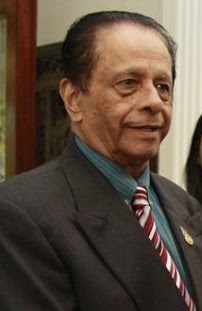
Sir Anerood Jugnauth GCSK, KCMG, QC, MP, PC is a Mauritian politician who has served as both President and Prime Minister of Mauritius. He is Member of Parliament for Piton & Riviere Du Rempart.
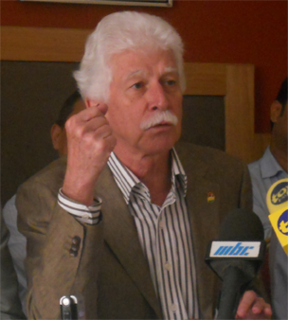
Paul Raymond Bérenger GCSK, MP is a Mauritian politician who was Prime Minister of Mauritius from 2003 to 2005. He has been Leader of the Opposition on several occasions — from 1983 to 1987, 1997 to 2000, 2005 to 2006, 2007 to 2013, October 2013 to 15 September 2014, and again since December 2014. Following his party's defeat in the 2014 general elections, he became Leader of the Opposition for the sixth time, making him the longest ever to serve in this constitutional position. He was also Deputy Prime Minister from 1995 to 1997 and again from 2000 to 2003, and he was a cabinet minister in the government of Anerood Jugnauth in 1982 and 1991. Bérenger, a Christian of Franco-Mauritian descent, has been the only non-Hindu Prime Minister of Mauritius.
Sir Seewoosagur Ramgoolam was a Mauritian politician, statesman and philanthropist. He was a leader in the Mauritian independence movement, and served as the first Chief Minister and Prime Minister of Mauritius, as well as its Governor-General. He was the Chairperson of the Organisation of African Unity from 1976 to 1977. As the leader of the Labour Party, Ramgoolam fought for the rights of labourers and led Mauritius to independence in 1968.

The Mouvement Militant Mauricien (MMM) is a left-wing socialist political party in Mauritius. The party was formed by a group of students in the late 1960s. The MMM advocates what it sees as a "fairer" society, without discrimination on the basis of social class, race, community, caste, religion, gender or sexual orientation.
Elections in Mauritius gives information on elections and election results in Mauritius. Since 1967, Mauritius has experienced 11 free and fair democratic general elections to choose a government.
The Militant Socialist Movement is a centre-left political party in Mauritius that adheres to the philosophies of socialism and political democracy. It is the largest single political party in the National Assembly of Mauritius, winning 34 of the 69 seats in the 2014 general elections. With political development, 6 MPs from the opposition joined officially the party making the current majority at 40. It also holds the largest number of seats in all city/town councils through the country with 60 councilors out of 120.
The 2000 Mauritian general elections took place on 11 September 2000 for the National Assembly of Mauritius with the votes counted on 12 September 2000.
A general election was held in Mauritius on 5 May 2010. The coalition comprising Mauritius Labour Party under Navin Ramgoolam, the Militant Socialist Movement under Pravind Jugnauth and the Mauritian Social Democrat Party under Xavier Luc Duval, won a majority with 41 seats in the parliament. The Mauritian Militant Movement-led coalition under Paul Berenger finished second with 18 seats. The Mauritian Solidarity Front won one seat and the Rodrigues Movement won the two remaining seats. The elections were the ninth to be held since independence from the United Kingdom in 1968.
Pravind Kumar Jugnauth MP Esq. is a Mauritian politician who is Prime Minister of Mauritius, in office since 2017, and also holds another portfolio as Minister of Finance. He is currently leader of the Militant Socialist Movement (MSM), which has the majority seats Pravind Jugnauth previously served as Minister of Technology, Communication and Innovation following the victory of their alliance LEPEP in the 2014 general elections from December 2014 to July 2015. He has occupied various positions in both government and opposition since 2000. He was Minister of Agriculture from 2000 to 2003, Deputy Prime Minister & Minister of Finance from 2003 to 2005. While he served in Navin Ramgoolam's cabinet from 2010 to 2011 as Vice Prime Minister and Minister of Finance He is also Member of Parliament for the 8th constituency Quartier Militaire and Moka. He left the coalition government and was appointed Leader of the Opposition in September 2014 until he was named as minister in his father's cabinet following their victory.
Charles Gaëtan Xavier Luc DuvalGCSK is a Mauritian politician who was Deputy Prime Minister of Mauritius in the cabinet of Sir Anerood Jugnauth from December 2014 to December 2016. He was also Minister of Tourism & External Communications and serves as 1st Member of Parliament elected from Constituency No 18 Belle Rose & Quatres Bornes. He is the leader of the Mauritian Social Democrat Party (PMSD), which was a minority party in the Alliance Lepep. After the PMSD left the government on 19 December 2016, Xavier-Luc Duval was appointed as the leader of the opposition by the President. His party, the PMSD, has 11 MPs, and he succeeded Paul Berenger.

General elections were held in Mauritius on 15 September 1991. Three main parties gained seats in this election: the Militant Socialist Movement, Mauritian Militant Movement and the Labour Party. The MSM formed an alliance with the MMM and the Labour party formed an alliance with the Mauritian Social Democrat Party (PMSD). On 17 September 1991, results showed that MSM-MMM won 57 seats out of 60 elected seats. This gave 95% of seats to MSM-MMM leader Anerood Jugnauth and 5% to Labour Party-PMSD leader Navin Ramgoolam.
The Militant Socialist Movement/Mauritian Militant Movement (MSM/MMM) is coalition party that formed the government of the Republic of Mauritius from September 2000 to July 2005. The coalition has been reformed in April 2012 after an electoral agreement between the Militant Socialist Movement (MSM) and Mauritian Militant Movement (MMM) was made with Sir Anerood Jugnauth as leader. The agreements remain the same, 30 seats for the MMM and 30 seats for the MSM. It has also been conveyed that SAJ would be prime minister for 3 years and Paul Berenger would take over for the rest of the parliamentary term if the coalition wins the next general elections. It has also been agreed that Pravind Jugnauth who is leader of the MSM will not be in the Front Bench of the coalition in an eventual government of the MSM/MMM. This is because he has been provisionally charged with using office for gratification by the Independent Commission Against Corruption. He will therefore seat as a back-bencher until he is dismissed from all accusations.
General elections were held in Mauritius on 21 August 1983. The result was a victory for an alliance of the Militant Socialist Movement, the Labour Party and the Mauritian Social Democrat Party, which between them won 46 seats. The Militant Socialist Movement (MSM) won 32 seats, whilst the Labour Party secured 9 seats and PMSD five. This alliance allowed Jugnauth to continue as Prime Minister while bringing Seewoosagur Ramgoolam and Gaetan Duval back into the government after their severe defeat in the 1982 elections. Shortly after, Ramgoolam was appointed as Governor General, Duval became Deputy Prime Minister and Satcam Boolell became Minister of Foreign Affairs.
Nandcoomar Bodha MP is the former Minister of Tourism & Leisure of Mauritius. He has been holding the office since 11 May 2010 to 26 July 2011. He held the same office from 2000 to 2003 in the MSM/MMM coalition government. When Pravind Jugnauth was sworn as Deputy Prime Minister, he took the office of Minister of Agriculture in 2003 up to 2005.He was appointed 8th position in the Cabinet of Navin Ramgoolam.
Leela Devi Dookhun Luchoomun MP is the former Minister of Social Security of Mauritius serving in the cabinet of Navin Ramgoolam having been appointed on 11 May 2010 by President Anerood Jugnauth. She is Member of Parliament representing Constituency No 8, Moka & Quartier Militaire. She is a former Minister of Arts & Culture serving in the cabinet of Paul Berenger for a short period of 6 months.
|publisher= (help)