| This article is part of a series on the politics and government of Mauritius |
|---|
| Constitution |
Government
|
Judiciary |
|
Administrative divisions |
|
General elections were held for the first time in Mauritius between 11 and 20 January 1886. [1] They followed the introduction of a new constitution the previous year. The Democrats and Reformists (also known as the Oligarchs) each won five of the ten elected seats. [1]
Mauritius, officially the Republic of Mauritius, is an island nation in the Indian Ocean. The main Island of Mauritius is located about 2,000 kilometres (1,200 mi) off the southeast coast of the African continent. The Republic of Mauritius also includes the islands of Rodrigues, Agalega and St. Brandon. The capital and largest city Port Louis is located on the main island of Mauritius.
The British colony of Mauritius received a new constitution by letters patent on 16 September 1885. It established a Council of Government of 27 members: eight ex officio members, nine appointed by the governor, and ten elected. The franchise was restricted to men, and there were property and education qualifications designed to exclude the vast majority of Indians.
The new constitution provided for a 28-member Council of Government, which consisted of the Governor, 12 officials, 5 appointed members and 10 elected members. [2] The ten elected members were returned from nine constituencies formed from the nine districts, which all districts returning one member except Port Louis, which returned two. [3] Voting took place in each constituency on a different day, starting in Port Louis on 11 January and ending in Grand Port on 20 January. [1]
The Districts of the Republic of Mauritius are the second-order administrative divisions after the Outer islands of the country. Mauritius is divided into nine districts which consist of 1 city, 4 towns and 130 villages, the capital is Port Louis.
Port Louis is a district of Mauritius, located in the north west of the island, it is the smallest district and has the highest population density. The district is wholly covered by Port Louis, the capital of the country. Port Louis district has an area of 42.7 km2 and the population estimate was at 119,706 as at 31 December 2015.
Grand Port is a district of Mauritius, situated in the east of the island. The name means "large port" in French. The district has an area of 260.3 km2 and the population estimate was at 112,997 as of 31 December 2015.
The franchise for the elections was severely limited; the right to vote was restricted to male British subjects aged 21 and over and who possessed Rs300 of immovable property or movable property worth Rs3,000, a monthly salary of Rs50, those paying rent of Rs25 a month or paying a licence duty of at Rs200 a year. People married to eligible voters, or the oldest son of a qualifying widow were also entitled to vote. [3] As a result, although the population of Mauritius was 359,688, only 4,061 people were eligible to vote, [1] of which just 253 were Asian. [4]
The rupee is the currency of Mauritius. One rupee is subdivided into 100 cents. Several other currencies are also called rupee.
A total of 25 candidates contested the elections; led by William Newton, [1] the Reformists nominated ran candidates in all ten constituencies. The Democrats put forward nine, with their leader Onésipho Beaugeard running in two constituencies. The remaining six candidates were independents, one of whom (Arthur Pitot) also ran in two candidates. [1]
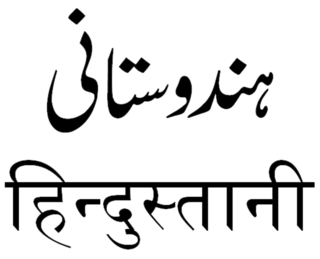
Despite the limited franchise, election notices were published in English, French, Hindustani (written in Arabic script), Tamil and Chinese. [5]
Hindustani, also known as Hindi-Urdu and historically also known as Hindavi, Dehlavi and Rekhta, is a lingua franca of Northern India and Pakistan. It is an Indo-Aryan language, deriving its base primarily from the Khariboli dialect of Delhi. The language incorporates a large amount of vocabulary from Prakrit, Sanskrit, as well as Persian and Arabic. It is a pluricentric language, with two official forms, Modern Standard Hindi and Modern Standard Urdu, which are its standardised registers. According to Ethnologue's 2019 estimates, if Hindi and Urdu are taken together as Hindustani, the language would be the 3rd most spoken language in the world, with approximately 409.8 million native speakers and 785.6 million total speakers.
Tamil is a Dravidian language predominantly spoken by the Tamil people of India and Sri Lanka, and by the Tamil diaspora, Sri Lankan Moors, Douglas, and Chindians. Tamil is an official language of two countries: Sri Lanka and Singapore and official language of the Indian state Tamil Nadu. It has official status in the Indian state of Tamil Nadu and the Indian Union Territory of Puducherry. It is used as one of the languages of education in Malaysia, along with English, Malay and Mandarin. Tamil is spoken by significant minorities in the four other South Indian states of Kerala, Karnataka, Andhra Pradesh and Telangana and the Union Territory of the Andaman and Nicobar Islands. It is one of the 22 scheduled languages of India.
Chinese is a group of related, but in many cases not mutually intelligible, language varieties, forming the Sinitic branch of the Sino-Tibetan language family. Chinese is spoken by the ethnic Chinese majority and many minority ethnic groups in China. About 1.2 billion people speak some form of Chinese as their first language.
| Party | Votes | % | Seats |
|---|---|---|---|
| Democrats | 2,709 | 49.21 | 5 |
| Reformists | 2,136 | 38.80 | 5 |
| Independents | 660 | 11.99 | 0 |
| Total | 5,505 | 100 | 10 |
| Registered voters/turnout | 4,061 | 91.7 | – |
| Source: Le Mauricien | |||
| Constituency | Candidate | Party | Votes | % |
|---|---|---|---|---|
| Flacq (222 registered) | Charles Adam | Reformists | 125 | 59.5 |
| Yves Pierre Jollivet | Democrats | 85 | 40.5 | |
| Grand Port (273 registered) | Henri Joseph Portal | Reformists | 109 | 50.5 |
| Edgar Gallet | Democrats | 62 | 28.7 | |
| Fabien Rault | Independent | 45 | 20.8 | |
| Moka (187 registered) | Henri Leclezio | Reformists | 137 | 81.5 |
| Onéipho Beaugeard | Democrats | 31 | 18.5 | |
| Pamplemousses (270 registered) | Charles Joseph Planel | Democrats | 156 | 51.8 |
| W A Edwards | Reformists | 96 | 31.9 | |
| De Evenor Chazal | Independent | 45 | 15.0 | |
| Louis Vigoureux | Independent | 4 | 1.3 | |
| Plaines Wilhems (653 registered) | Célicourt Antelme | Democrats | 407 | 67.3 |
| Povah Ambrose | Reformists | 194 | 32.1 | |
| Arthur Pitot | Independent | 4 | 0.7 | |
| Port Louis (1,986 registered) | Onésipho Beaugeard | Democrats | 941 | 26.4 |
| Gustave de Conolis | Democrats | 879 | 24.7 | |
| William Newton | Reformists | 705 | 19.8 | |
| John Alexander Ferguson | Independent | 523 | 14.7 | |
| Georges Guibert | Reformists | 511 | 14.4 | |
| Rivière du Rempart (163 registered) | Edgar Antelme | Democrats | 61 | 39.6 |
| Louis Rouillard | Reformists | 55 | 35.7 | |
| P L Chastellier | Independent | 38 | 24.7 | |
| Rivière Noire (115 registered) | Vincent Geoffroy | Reformists | 55 | 51.4 |
| Thorny Pitot | Democrats | 51 | 47.7 | |
| Arthur Pitot | Independent | 1 | 0.9 | |
| Savanne (192 registered) | Virgil Naz | Reformists | 149 | 80.5 |
| Anderson James Forrester | Democrats | 36 | 19.5 |
Suffrage, political franchise, or simply franchise is the right to vote in public, political elections. In some languages, and occasionally in English, the right to vote is called active suffrage, as distinct from passive suffrage, which is the right to stand for election. The combination of active and passive suffrage is sometimes called full suffrage.
Sir Anerood Jugnauth GCSK, KCMG, QC, MP, PC is a Mauritian politician who has served as both President and Prime Minister of Mauritius. He is Member of Parliament for Piton & Riviere Du Rempart.
Electoral systems for the legislatures of the individual Australian states and territories are broadly similar to the electoral system used in federal elections in Australia.
The Legislative Council, or upper house, is one of the two chambers of the Parliament of South Australia. Its central purpose is to act as a house of review for legislation passed through the lower house, the House of Assembly. It sits in Parliament House in the state capital, Adelaide.

The Mouvement Militant Mauricien (MMM) is a left-wing socialist political party in Mauritius. The party was formed by a group of students in the late 1960s. The MMM advocates what it sees as a "fairer" society, without discrimination on the basis of social class, race, community, caste, religion, gender or sexual orientation.
Elections in Guyana take place within the framework of a multi-party representative democracy and a presidential system. The National Assembly is directly elected, with the nominee of the party or alliance that receives the most votes becoming President.
The Representation of the People Act 1948 was an Act of the Parliament of the United Kingdom that altered the law relating to parliamentary and local elections. It is noteworthy for abolishing plural voting, including by the abolition of the twelve separate university constituencies; and for again increasing the number of members overall, in this case to 613.
National constituencies were a former feature of the Fijian electoral system. They were created as a compromise between demands for universal suffrage on a common voters' roll, and for a strictly communal franchise, with Parliamentary constituencies allocated on an ethnic basis and elected only by voters enrolled as members of specific ethnic groups.
Sussex was a constituency of the House of Commons of the Parliament of England then of the Parliament of Great Britain from 1707 to 1800 and of the Parliament of the United Kingdom from 1801 to 1832. It was represented by two Knights of the Shire, elected by the bloc vote system.
General elections were held in Kuwait on 29 June 2006. They were the first elections in Kuwait in which women were able to vote and run for office.
In most countries, suffrage, the right to vote, is generally limited to citizens of the country. Some countries, however, extend voting rights to resident non-citizens. Such voting rights extended to non-citizens are often restricted or limited in some ways, with the details of the restrictions or limitations varying from one country to another. Voting rights to non-citizens may or may not extend to a right to run for an elected or other public office.
Constituencies of Mauritius are the electoral boundaries within the Republic of Mauritius. The country follows the Westminster system and elects sixty members of parliament for a term of five years. There are in all twenty-one constituencies in the republic, each of them returning three members with the exception of Constituency No 21, which returns only two members. The constitution stipulates in there shall be twenty constituencies and one created specially for the Rodrigues island.
The 1995 Hong Kong Legislative Council election for members of the Legislative Council of Hong Kong (LegCo) was held on 17 September 1995. It was the last and the first fully elected legislative election in the colonial period before transferring Hong Kong's sovereignty to China two years later. The elections returned 20 members from directly elected geographical constituencies, 30 members from indirectly elected functional constituencies, and 10 members from elections committee constituency who were elected by all District Board members.
The 1994 Hong Kong District Board elections were held on 18 September 1994 for all 18 districts of Hong Kong and 346 members from directly elected constituencies. It was the last district-level elections in the colonial period before the handover of Hong Kong in 1997. It was the first elections to be held after the abolition of the appointed seats as proposed by the new electoral arrangements, as the last step of the democratisation by the then Governor Chris Patten before the handover.
General elections were held for the first time in Nyasaland on 15 March 1956.
The 2016 London Assembly election was an election held on 5 May 2016 to elect the members of the London Assembly. It took place on the same day as the London mayoral election and the United Kingdom local elections.
General elections were held in Mauritius in 1891.
General elections were held in Nigeria for the first time on 20 September 1923. The Nigerian National Democratic Party (NNDP) won three of the four elected seats in the Legislative Council.
General elections were held in Fiji in July 1937, the first in which an equal number of Europeans and Indo-Fijians were elected.