Sir Anerood Jugnauth GCSK, KCMG, QC, MP, PC is a Mauritian politician who has served as both President and Prime Minister of Mauritius. He is Member of Parliament for Piton & Riviere Du Rempart.

Sir Seewoosagur Ramgoolam was a Mauritian politician, statesman and philanthropist. He was a leader in the Mauritian independence movement, and served as the first Chief Minister and Prime Minister of Mauritius, as well as its Governor-General. He was the Chairperson of the Organisation of African Unity from 1976 to 1977. As the leader of the Labour Party, Ramgoolam fought for the rights of labourers and led Mauritius to independence in 1968.
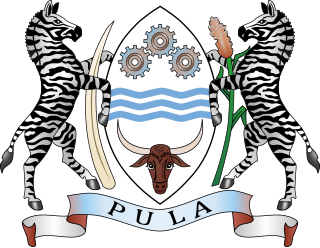
Elections in Botswana take place within the framework of a multi-party democracy and a parliamentary system. The National Assembly is mostly directly elected, and in turn elects the President and some of its own members. The Ntlo ya Dikgosi is a mixture of appointed, hereditary and indirectly elected members.
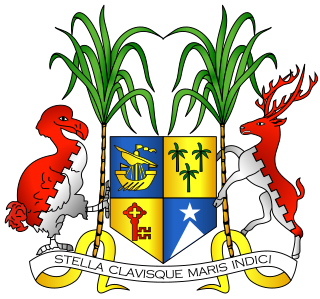
Elections in Mauritius gives information on elections and election results in Mauritius. Since 1967, Mauritius has experienced 11 free and fair democratic general elections to choose a government.

Navinchandra Ramgoolam, GCSK, FRCP is a Mauritian politician who was Prime Minister of Mauritius from 2005 to 2014 and leader of the Labour Party. He was Leader of the Opposition from 1991 to 1995. He served as Prime Minister for the first time from December 1995 until September 2000, and became Leader of the Opposition again from October 2000 to 4 July 2005. On 5 July 2005, he became prime minister for a second term after his Alliance Sociale won the general elections. He served again as Prime Minister from 2005 to 2014, when he was defeated afterwards.
The Parti Mauricien Social Démocrate (PMSD) is a right-wing political party in Mauritius. It is conservative and francophilic. It is the second biggest political party in the National Assembly and constitutes of the formal opposition, since it left government in 2016 with leader Xavier-Luc Duval serving as the Leader of the opposition.
The Militant Socialist Movement is a centre-left political party in Mauritius that adheres to the philosophies of socialism and political democracy. It is the largest single political party in the National Assembly of Mauritius, winning 34 of the 69 seats in the 2014 general elections. With political development, 6 MPs from the opposition joined officially the party making the current majority at 40. It also holds the largest number of seats in all city/town councils through the country with 60 councilors out of 120.
Sookdeo Bissoondoyal was a Mauritian politician and one of the leading figures in the independence movement.

The National Assembly is the legislative branch of the government of Angola. The National Assembly is a unicameral body, with 220 members: 130 members elected by proportional representation and 90 members elected by provincial districts.
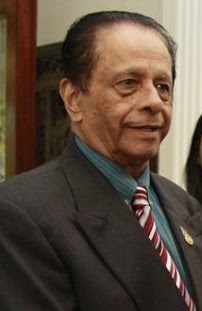
The 2000 Mauritian general elections took place on 11 September 2000 for the National Assembly of Mauritius with the votes counted on 12 September 2000.
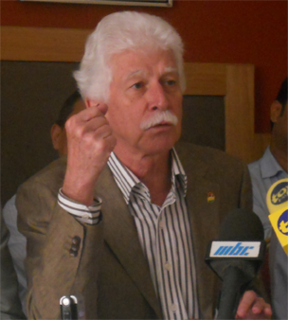
A general election was held in Mauritius on 5 May 2010. The coalition comprising Mauritius Labour Party under Navin Ramgoolam, the Militant Socialist Movement under Pravind Jugnauth and the Mauritian Social Democrat Party under Xavier Luc Duval, won a majority with 41 seats in the parliament. The Mauritian Militant Movement-led coalition under Paul Berenger finished second with 18 seats. The Mauritian Solidarity Front won one seat and the Rodrigues Movement won the two remaining seats. The elections were the ninth to be held since independence from the United Kingdom in 1968.
General elections were held in Mauritius on 15 September 1991. Three main parties gained seats in this election: the Militant Socialist Movement, Mauritian Militant Movement and the Labour Party. The MSM formed an alliance with the MMM and the Labour party formed an alliance with the Mauritian Social Democrat Party (PMSD). On 17 September 1991, results showed that MSM-MMM won 57 seats out of 60 elected seats. This gave 95% of seats to MSM-MMM leader Anerood Jugnauth and 5% to Labour Party-PMSD leader Navin Ramgoolam.
General elections were held in Mauritius on 20 November 1995. The result was a victory for the Labour Party-Mauritian Militant Movement alliance led by Navin Ramgoolam, which won all 60 constituency seats on Mauritius. Along with 1982, it was one of two elections in which a party won every seat. The Militant Socialist Movement (MSM) led by Anerood Jugnauth lost power after 13 years, with Jugnauth resigning two days after the results were announced. Navin Ramgoolam became Prime Minister and appointed Paul Berenger as Deputy Prime Minister.
General elections were held in Mauritius on 7 August 1967. The result was a victory for the Independence Party, a coalition led by the Labour Party, which won a total of 43 seats, allowing Labour leader and incumbent Prime Minister Seewoosagur Ramgoolam to form a government.
General elections were held in Mauritius on 11 June 1982. 360 candidates representing 22 parties contested the election, the result of which was a victory for the Mauritian Militant Movement-Mauritian Socialist Party alliance, which won all 60 of the directly elected mainland seats.
General elections were held in Mauritius on 21 August 1983. The result was a victory for an alliance of the Militant Socialist Movement, the Labour Party and the Mauritian Social Democrat Party, which between them won 46 seats. The Militant Socialist Movement (MSM) won 32 seats, whilst the Labour Party secured 9 seats and PMSD five. This alliance allowed Jugnauth to continue as Prime Minister while bringing Seewoosagur Ramgoolam and Gaetan Duval back into the government after their severe defeat in the 1982 elections. Shortly after, Ramgoolam was appointed as Governor General, Duval became Deputy Prime Minister and Satcam Boolell became Minister of Foreign Affairs.
General elections were held in Mauritius on 30 August 1987. The result was a victory for the Alliance, composed of the Labour Party, the Mauritian Socialist Movement and the Mauritian Social Democrat Party, which won 44 of the 70 seats.