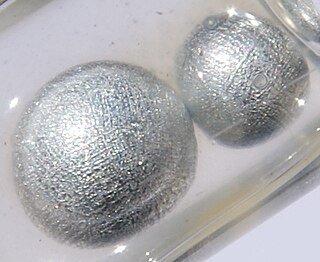
Potassium is a chemical element; it has symbol K and atomic number 19. It is a silvery white metal that is soft enough to easily cut with a knife. Potassium metal reacts rapidly with atmospheric oxygen to form flaky white potassium peroxide in only seconds of exposure. It was first isolated from potash, the ashes of plants, from which its name derives. In the periodic table, potassium is one of the alkali metals, all of which have a single valence electron in the outer electron shell, which is easily removed to create an ion with a positive charge. In nature, potassium occurs only in ionic salts. Elemental potassium reacts vigorously with water, generating sufficient heat to ignite hydrogen emitted in the reaction, and burning with a lilac-colored flame. It is found dissolved in seawater, and occurs in many minerals such as orthoclase, a common constituent of granites and other igneous rocks.

Potash includes various mined and manufactured salts that contain potassium in water-soluble form. The name derives from pot ash, plant ashes or wood ash soaked in water in a pot, the primary means of manufacturing potash before the Industrial Era. The word potassium is derived from potash.
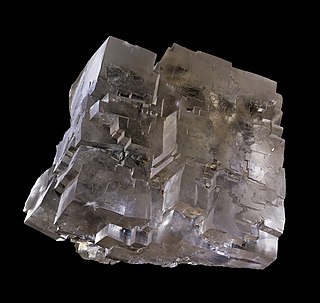
Sodium chloride, commonly known as edible salt, is an ionic compound with the chemical formula NaCl, representing a 1:1 ratio of sodium and chlorine ions. It is transparent or translucent, brittle, hygroscopic, and occurs as the mineral halite. In its edible form, it is commonly used as a condiment and food preservative. Large quantities of sodium chloride are used in many industrial processes, and it is a major source of sodium and chlorine compounds used as feedstocks for further chemical syntheses. Another major application of sodium chloride is deicing of roadways in sub-freezing weather.

The Eder is a 177-kilometre-long (110 mi) major river in Germany that begins in eastern North Rhine-Westphalia and passes in to Hesse, where it empties into the River Fulda.

The German Patent and Trade Mark Office is the German national patent office, with headquarters in Munich, and offices in Berlin and Jena. In 2006 it employed 2556 people, of which about 700 were patent examiners.
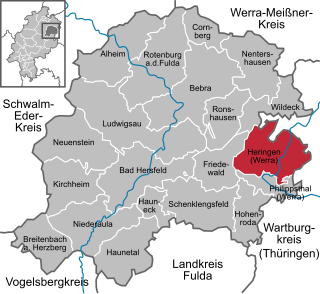
Heringen (Werra) is a small town in Hersfeld-Rotenburg district in eastern Hesse, Germany lying right at the boundary with Thuringia.

Polyhalite is an evaporite mineral, a hydrated sulfate of potassium, calcium and magnesium with formula: K2Ca2Mg(SO4)4·2H2O. Polyhalite crystallizes in the triclinic system, although crystals are very rare. The normal habit is massive to fibrous. It is typically colorless, white to gray, although it may be brick red due to iron oxide inclusions. It has a Mohs hardness of 3.5 and a specific gravity of 2.8. It is used as a fertilizer.

A spoil tip is a pile built of accumulated spoil – waste material removed during mining. Spoil tips are not formed of slag, but in some areas, such as England and Wales, they are referred to as slag heaps. In Scotland the word bing is used. In North American English the term is mine dump or mine waste dump.

Dibenzylideneacetone or dibenzalacetone, often abbreviated dba, is an organic compound with the formula C17H14O. It is a pale-yellow solid insoluble in water, but soluble in ethanol.

Philippsthal (Werra) is a market community in Hersfeld-Rotenburg district in eastern Hesse, Germany, right at the boundary with Thuringia.

Wintershall Holding GmbH, based in Kassel, was Germany's largest crude oil and natural gas producer. It was a wholly owned subsidiary of BASF. The company was active in oil and gas exploration and production with operations in Europe, North Africa, South America as well as Russia and the Middle East region. Wintershall employed more than 2,000 people worldwide. In the 2018 financial year the company produced around 171 million barrels of oil equivalent (boe) of oil and gas. Revenues amounted to 4.09 billion euros.
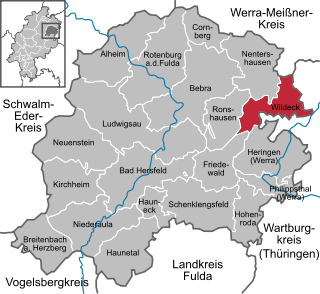
Wildeck is a municipality in Hersfeld-Rotenburg district in northeastern Hesse, Germany lying right at the boundary with Thuringia, 54 km southeast of Kassel.

Chemische Fabrik Kalk (CFK) was a German chemicals company based in Kalk, a city district of Cologne. The company was founded in 1858 as Chemische Fabrik Vorster & Grüneberg, Cöln by Julius Vorster and Hermann Julius Grüneberg and was renamed to Chemische Fabrik Kalk GmbH in 1892. At times the company was the second-largest German producer of soda ash and was, with almost 2400 employees, one of the largest employers in Cologne. For decades the chimneys and the water tower of the factory dominated the skyline of Cologne-Kalk.
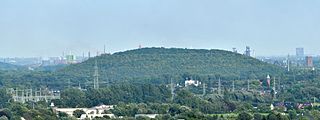
The Halde Rheinpreußen is a spoil tip in the German city Moers which lies 70 metres (230 ft) above its ambit. It is part of the category Panoramas of the Ruhr Industrial Heritage Trail.

The Stone Bridge in Regensburg, Germany, is a 12th-century bridge across the Danube linking the Old Town with Stadtamhof. For more than 800 years, until the 1930s, it was the city's only bridge across the river. It is a masterwork of medieval construction and an emblem of the city.
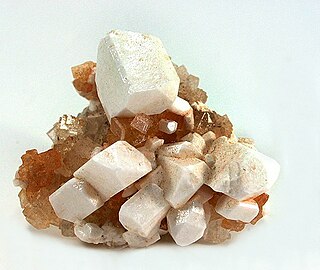
Leonite is a hydrated double sulfate of magnesium and potassium. It has the formula K2SO4·MgSO4·4H2O. The mineral was named after Leo Strippelmann, who was director of the salt works at Westeregeln in Germany. The mineral is part of the blodite group of hydrated double sulfate minerals.

Brine mining is the extraction of useful materials which are naturally dissolved in brine. The brine may be seawater, other surface water, groundwater, or hyper-saline solutions from several industries. It differs from solution mining or in-situ leaching in that those methods inject water or chemicals to dissolve materials which are in a solid state; in brine mining, the materials are already dissolved.

The Salzungen Werra Upland is a natural region in Germany that forms part of the East Hesse Highlands in the German states of Hesse and Thuringia.
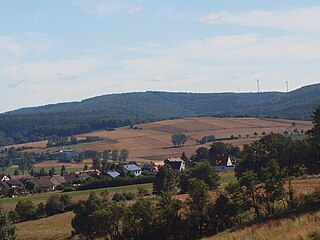
The Seulingswald is a hill range in the German Central Uplands which reaches heights of up to 480.3 m above sea level (NHN). It is part of the Fulda-Werra Uplands in the East Hesse Highlands within the Hessian county of Hersfeld-Rotenburg; small ridges extend into the Thuringian county of Wartburgkreis. It is a sandstone range and one of the largest contiguous woodland areas in Hesse.

The Hornungskuppe is a wooded hill, 439 m above sea level (NHN), in the Thuringian Zipfel on the border of Hesse and Thuringia in Germany. It is part of the natural region of the Seulingswald.


