
The Industrial Revolution, sometimes divided into the First Industrial Revolution and Second Industrial Revolution, was a period of global transition of the human economy towards more widespread, efficient and stable manufacturing processes that succeeded the Agricultural Revolution. Beginning in Great Britain, the Industrial Revolution spread to continental Europe and the United States, from around 1760 to about 1820–1840. This transition included going from hand production methods to machines; new chemical manufacturing and iron production processes; the increasing use of water power and steam power; the development of machine tools; and the rise of the mechanised factory system. Output greatly increased, and the result was an unprecedented rise in population and the rate of population growth. The textile industry was the first to use modern production methods, and textiles became the dominant industry in terms of employment, value of output, and capital invested.

The spinning jenny is a multi-spindle spinning frame, and was one of the key developments in the industrialisation of textile manufacturing during the early Industrial Revolution. It was invented in 1764–1765 by James Hargreaves in Stan hill, Oswaldtwistle, Lancashire in England.

Samuel Slater was an early English-American industrialist known as the "Father of the American Industrial Revolution", a phrase coined by Andrew Jackson, and the "Father of the American Factory System". In the United Kingdom, he was called "Slater the Traitor" and "Sam the Slate" because he brought British textile technology to the United States, modifying it for American use. He memorized the textile factory machinery designs as an apprentice to a pioneer in the British industry before migrating to the U.S. at the age of 21.

Quarry Bank Mill in Styal, Cheshire, England, is one of the best preserved textile factories of the Industrial Revolution. Built in 1784, the cotton mill is recorded in the National Heritage List for England as a designated Grade II* listed building. Quarry Bank Mill was established by Samuel Greg, and was notable for innovations both in machinery and also in its approach to labour relations, the latter largely as a result of the work of Greg's wife, Hannah Lightbody. The family took a somewhat paternalistic attitude toward the workers, providing medical care for all and limited education to the children, but all laboured roughly 72 hours per week until 1847 when a new law shortened the hours.
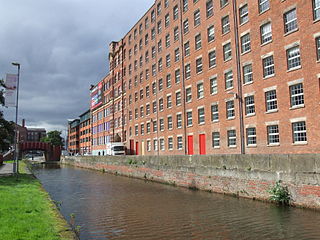
A cotton mill is a building that houses spinning or weaving machinery for the production of yarn or cloth from cotton, an important product during the Industrial Revolution in the development of the factory system.

The water frame is a spinning frame that is powered by a water-wheel.
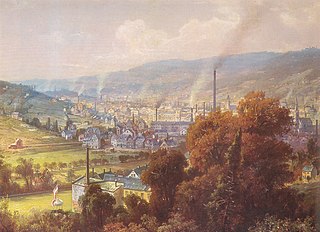
Textile manufacture during the British Industrial Revolution was centred in south Lancashire and the towns on both sides of the Pennines in the United Kingdom. The main drivers of the Industrial Revolution were textile manufacturing, iron founding, steam power, oil drilling, the discovery of electricity and its many industrial applications, the telegraph and many others. Railroads, steamboats, the telegraph and other innovations massively increased worker productivity and raised standards of living by greatly reducing time spent during travel, transportation and communications.

The textile industry is primarily concerned with the design, production and distribution of textiles: yarn, cloth and clothing.

The spinning mule is a machine used to spin cotton and other fibres. They were used extensively from the late 18th to the early 20th century in the mills of Lancashire and elsewhere. Mules were worked in pairs by a minder, with the help of two boys: the little piecer and the big or side piecer. The carriage carried up to 1,320 spindles and could be 150 feet (46 m) long, and would move forward and back a distance of 5 feet (1.5 m) four times a minute.

Cotton-spinning machinery is machines which process prepared cotton roving into workable yarn or thread. Such machinery can be dated back centuries. During the 18th and 19th centuries, as part of the Industrial Revolution cotton-spinning machinery was developed to bring mass production to the cotton industry. Cotton spinning machinery was installed in large factories, commonly known as cotton mills.

The Amalgamated Association of Operative Cotton Spinners and Twiners, also known as the Amalgamation, was a trade union in the United Kingdom which existed between 1870 and 1970. It represented male mule spinners in the cotton industry.

Ace Mill is a cotton spinning mill in Chadderton in the Metropolitan Borough of Oldham, Greater Manchester. It was built as Gorse No. 2 Mill, in 1914 and cotton was first spun in 1919 by the Ace Mill Ltd, who renamed the mill. It was taken over by the Lancashire Cotton Corporation in the 1930s and passed to Courtaulds in 1964. Production ended in 1967.

A doffer is someone who removes "doffs" holding spun fiber such as cotton or wool from a spinning frame and replaces them with empty ones. Historically, spinners, doffers, and sweepers each had separate tasks that were required in the manufacture of spun textiles. From the early days of the industrial revolution, this work, which requires speed and dexterity rather than strength, was often done by children. After World War I, the practice of employing children declined, ending in the United States in 1933. In modern textile mills, doffing machines have now replaced humans.
Piece-rate lists were the ways of assessing a cotton operatives pay in Lancashire in the nineteenth and early twentieth centuries. They started as informal agreements made by one cotton master and their operatives then each cotton town developed their own list. Spinners merged all of these into two main lists which were used by all, while weavers used one 'unified' list.
The United Textile Factory Workers' Association (UTFWA) was a trade union federation in Great Britain. It was active from 1889 until 1975.

De Museumfabriek is a museum in Enschede, Netherlands. The new museum is located partly in a renovated Jannink textile factory, in reference to Enschede's textile history, and partly in an adjourning new building designed by the Amsterdam-based firm SeARCH. The project architect was Bjarne Mastenbroek. It is an Anchor point on the European Route of Industrial Heritage.

The Ministry of Textiles is a ministry in the Government of Maharashtra. It is responsible for the promotion of the textile industry in Maharashtra.

UCO Galveston was a cotton spinning mill in Ghent, located at Wiedauwkaai 52. It was also known as NV Galveston or Cotonnière Galveston.

The cotton industry was the first and leading industry of Catalan industrialisation which led, by the mid-19th century, to Catalonia becoming the main industrial region of Spain. It is the one Mediterranean exception to the tendency for early industrialisation to be concentrated in northern Europe. The Catalan cotton industry, in common with many European countries and the United States, was the first large-scale application of modern technology and the factory system.


