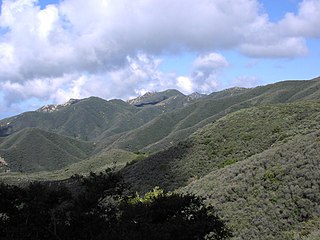
Chaparral is a shrubland plant community found primarily in California, in southern Oregon and in the northern portion of the Baja California Peninsula in Mexico. It is shaped by a Mediterranean climate and infrequent, high-intensity crown fires.
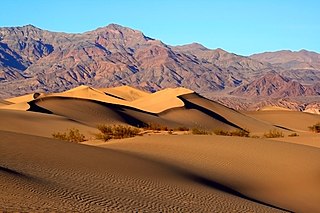
The Mojave Desert is a desert in the rain shadow of the southern Sierra Nevada mountains and Transverse Ranges in the Southwestern United States. Named for the indigenous Mohave people, it is located primarily in southeastern California and southwestern Nevada, with small portions extending into Arizona and Utah.

Pinus ponderosa, commonly known as the ponderosa pine, bull pine, blackjack pine, western yellow-pine, or filipinus pine is a very large pine tree species of variable habitat native to mountainous regions of western North America. It is the most widely distributed pine species in North America.

Arnica is a genus of perennial, herbaceous plants in the sunflower family (Asteraceae). The genus name Arnica may be derived from the Greek arni, "lamb", in reference to the plants' soft, hairy leaves. Arnica is also known by the names mountain tobacco and confusingly, leopard's bane and wolfsbane—two names that it shares with the entirely unrelated genus Aconitum.

The ecology of the Sierra Nevada, located in the U.S. states of California and Nevada, is diverse and complex. The combination of climate, topography, moisture, and soils influences the distribution of ecological communities across an elevation gradient from 500 to 14,500 feet. Biotic zones range from scrub and chaparral communities at lower elevations, to subalpine forests and alpine meadows at the higher elevations. Particular ecoregions that follow elevation contours are often described as a series of belts that follow the length of the Sierra Nevada. There are many hiking trails, paved and unpaved roads, and vast public lands in the Sierra Nevada for exploring the many different biomes and ecosystems.

Hesperocyparis bakeri, previously known Cupressus bakeri, with the common names Baker cypress, Modoc cypress, or Siskiyou cypress, is a rare species of western cypress tree endemic to a small area across far northern California and extreme southwestern Oregon, in the western United States.

Juniperus occidentalis, known as the western juniper, is a shrub or tree native to the Western United States, growing in mountains at altitudes of 800–3,000 meters (2,600–9,800 ft) and rarely down to 100 m (330 ft). It is listed as Least Concern on the IUCN Red List because it is a widespread species with an increasing population.
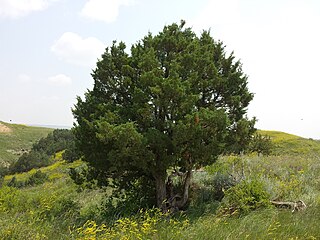
Juniperus scopulorum, the Rocky Mountain juniper, is a species of juniper native to western North America, from southwest Canada to the Great Plains of the United States and small areas of northern Mexico. They are the most widespread of all the New World junipers. They are relatively small trees, occasionally just a large bush or stunted snag. They tend to be found in isolated groves or even as single trees rather than as the dominant tree of a forest. Though they can survive fires, they are vulnerable to them especially when young and this is one of the factors that can limit their spread into grasslands.

Nepenthes spathulata is a tropical pitcher plant native to Java and Sumatra, where it grows at elevations of between 1100 and 2900 m above sea level. The specific epithet spathulata is derived from the Latin word spathulatus, meaning "spatula shaped", and refers to the shape of the lamina.

Monardella is a genus of approximately 40 species of annual and perennial plants native to western North America from British Columbia to northwestern Mexico. They are grown for their highly aromatic foliage, which in some species is used for herbal teas. The two-lipped, tubular flowers are formed in terminal clusters and are most usually red, pink, or purple.

The Sierra Nevada subalpine zone refers to a biotic zone below treeline in the Sierra Nevada mountain range of California, United States. This subalpine zone is positioned between the upper montane zone at its lower limit, and tree line at its upper limit.

Prunus fasciculata, also known as wild almond, desert almond, or desert peach is a spiny and woody shrub producing wild almonds, which is native to western deserts of North America.
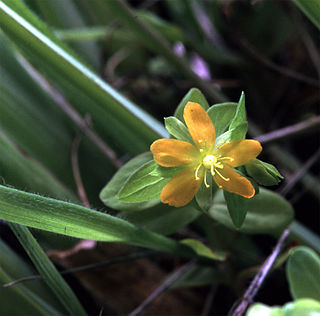
Hypericum anagalloides is a species of flowering plant in the St. John's wort family Hypericaceae. It is known by the common names creeping St. John's-wort, tinker's penny and bog St. John's-wort.

Collinsia torreyi is a species of flowering plant in the plantain family known by the common name Torrey's blue-eyed Mary. It is native to California and adjacent sections of Oregon and Nevada, where it grows in the coniferous forests of several mountain ranges, including the Sierra Nevada.

Hesperocyparis nevadensis is a species of western cypress tree with the common name Paiute cypress native to a small area in the Sierra Nevada Mountains of California in the western United States. It was formerly known as Cupressus nevadensis.

Montane ecosystems are found on the slopes of mountains. The alpine climate in these regions strongly affects the ecosystem because temperatures fall as elevation increases, causing the ecosystem to stratify. This stratification is a crucial factor in shaping plant community, biodiversity, metabolic processes and ecosystem dynamics for montane ecosystems. Dense montane forests are common at moderate elevations, due to moderate temperatures and high rainfall. At higher elevations, the climate is harsher, with lower temperatures and higher winds, preventing the growth of trees and causing the plant community to transition to montane grasslands and shrublands or alpine tundra. Due to the unique climate conditions of montane ecosystems, they contain increased numbers of endemic species. Montane ecosystems also exhibit variation in ecosystem services, which include carbon storage and water supply.
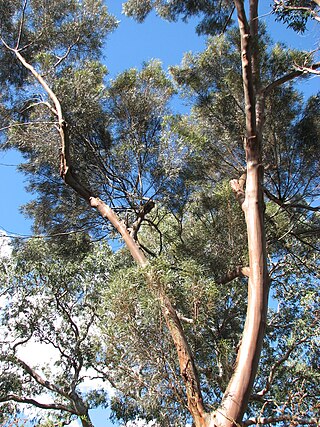
Eucalyptus spathulata, commonly known as swamp mallet, narrow leaved gimlet or swamp gimlet, is a species of mallet that is endemic to Western Australia. It has a dense crown, smooth, satin-like bark, glossy green, linear leaves, flower buds in groups of three or seven, white flowers and cup-shaped to conical fruit.

Blitum is a genus of flowering plants in the amaranth family Amaranthaceae, subfamily Chenopodioideae. It is closely related to genus Spinacia. Its 12 species were traditionally placed in the genera Chenopodium, Monolepis, or Scleroblitum. The species of genus Blitum occur in Asia, Europe, North Africa, the Americas, and Australia.

The flora of the U.S. Sierra Nevada alpine zone is characterized by small, low growing, cushion and mat forming plants that can survive the harsh conditions in the high-altitude alpine zone above the timber line. These flora often occur in alpine fell-fields. The Sierra Nevada alpine zone lacks a dominant plant species that characterizes it, so may or may not be called a vegetation type. But it is found above the subalpine forest, which is the highest in a succession of recognized vegetation types at increasing elevations.

Abrotanella scapigera is an endemic angiosperm of Tasmania, Australia. It is a member of the family Asteraceae, commonly found in alpine regions of northwest and south-central Tasmania. This species is named after its characteristic sparsely leaved flowering stem that distinguishes it from the other 18 species of the Genus.
