
A poppy is a flowering plant in the subfamily Papaveroideae of the family Papaveraceae. Poppies are herbaceous plants, often grown for their colourful flowers. One species of poppy, Papaver somniferum, is the source of the narcotic drug mixture opium which contains powerful medicinal alkaloids such as morphine and has been used since ancient times as an analgesic and narcotic medicinal and recreational drug. It also produces edible seeds. Following the trench warfare in the poppy fields of Flanders, Belgium during World War I, poppies have become a symbol of remembrance of soldiers who have died during wartime, especially in the UK, Canada, Australia, New Zealand and other Commonwealth realms.
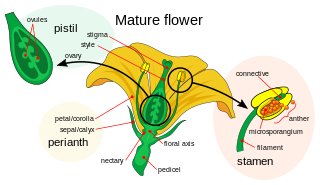
Petals are modified leaves that surround the reproductive parts of flowers. They are often brightly colored or unusually shaped to attract pollinators. All of the petals of a flower are collectively known as the corolla. Petals are usually accompanied by another set of modified leaves called sepals, that collectively form the calyx and lie just beneath the corolla. The calyx and the corolla together make up the perianth, the non-reproductive portion of a flower. When the petals and sepals of a flower are difficult to distinguish, they are collectively called tepals. Examples of plants in which the term tepal is appropriate include genera such as Aloe and Tulipa. Conversely, genera such as Rosa and Phaseolus have well-distinguished sepals and petals. When the undifferentiated tepals resemble petals, they are referred to as "petaloid", as in petaloid monocots, orders of monocots with brightly colored tepals. Since they include Liliales, an alternative name is lilioid monocots.

Arum maculatum is a woodland flowering plant species in the family Araceae. It is native across most of Europe, as well as Eastern Turkey and the Caucasus.

Ochna is a genus comprising 86 species of evergreen trees, shrubs and shrublets belonging to the flowering plant family Ochnaceae. These species are native to tropical woodlands of Africa, Madagascar, the Mascarenes and Asia. Species of this genus are usually called ochnas, bird's-eye bushes or Mickey-mouse plants, a name derived from the shape of the drupelet fruit. The name of this genus comes from the Greek word ὄχνη (ókhnē), used by Theocritus and meaning "wild pear", as the leaves are similar in appearance. Some species, including Ochna integerrima and O. serrulata, are cultivated as decorative plants.

Ochna integerrima, popularly called yellow Mai flower, is a plant species in the genus Ochna and family Ochnaceae. In the wild, it is a small tree or shrub species. The timing of the yellow flowers of this plant make it very popular in southern Vietnam, where plants are purchased during Tết.
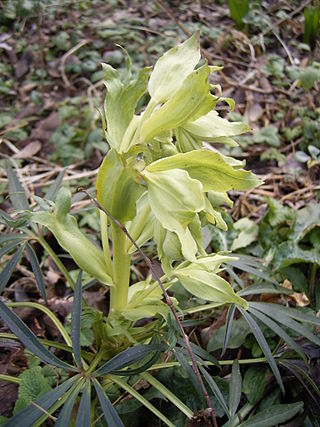
Helleborus foetidus, known variously as stinking hellebore, dungwort, setterwort and bear's foot, is a species of flowering plant in the buttercup family Ranunculaceae, native to the mountainous regions of Central and Southern Europe and Asia Minor. It is found wild in many parts of England, especially on limestone soil.

One of many species of manzanita, Arctostaphylos manzanita has the common names common manzanita and whiteleaf manzanita.
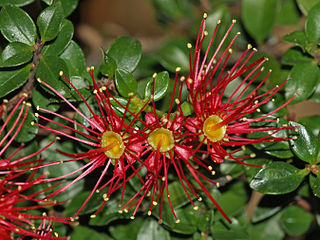
Metrosideros carminea is a forest liane or vine that is endemic to New Zealand. It occurs in coastal and lowland forest from Te Paki in the north of the North Island south to Māhia Peninsula and Taranaki. It is one of a number of New Zealand Metrosideros species which live out their lives as vines, unlike the northern rata (M.robusta), which generally begins as a hemi-epiphyte and grows into a huge tree.

Wodyetia bifurcata, the foxtail palm, is a species of palm in the family Arecaceae, native to Queensland, Australia. It is the sole species in the genus Wodyetia.

Verticordia acerosa is a flowering plant in the myrtle family, Myrtaceae and is endemic to the south-west of Western Australia. It is a shrub with yellow flowers which change colour through red to almost black as they age. There are two varieties which vary in their leaf shape, their flower colour and some of the structures in the flower.

Ochna serrulata is an ornamental garden plant in the family Ochnaceae which is indigenous to South Africa. It is planted in southern African gardens and is an invasive species in Australia and New Zealand.

Ochna pulchra, also known as Lekkerbreek, is a small deciduous southern African tree up to 5 m, commonly found on deep sandy soil and rocky slopes, and belonging to the tropical family of Ochnaceae, which is widespread in Asia and Africa.
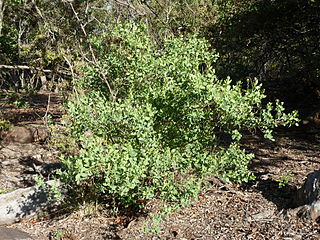
Clutia pulchella, the lightning bush, is a southern African dioecious shrub of the family Peraceae. It occurs at middle altitudes in Namibia, Mozambique, Zimbabwe, Eswatini, Botswana, Lesotho and South Africa.

Vexatorella is a genus containing four species of flowering plant, commonly known as vexators, in the family Proteaceae. The genus is endemic to the Cape Floristic Region of South Africa. The name means “little trouble-maker”, given with reference to the initial difficulties of placing V. latebrosa within the family. All species are shrubs which occur in dry fynbos habitats on the fringes of the Succulent Karoo ecoregion. The inflorescences are similar to those of the related leucospermums but also share features of the leucadendrons, with the floral bracts becoming woody and enlarged following pollination. The flowers are insect-pollinated, with the seeds dispersed by ants (myrmecochory).
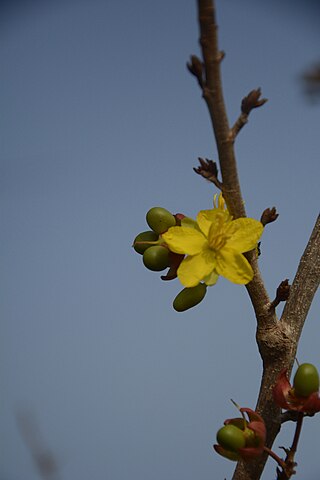
Ochna lanceolata is a species of plant in the family Ochnaceae. It is native to India and Sri Lanka.

Schotia afra is a flowering plant in the legume family, Fabaceae. It belongs to the subfamily Detarioideae. It occurs in Southern Africa. The genus was named for Richard van der Schot by Jacquin who was the director of the Imperial Gardens at Schönbrunn Palace, Vienna. Van der Schot was his head gardener.

Vexatorella obtusata is an evergreen shrub, with narrow, leathery leaves and about 2 cm big, globular flowerheads consisting of well scented, creamy pink flowers, from which a long style with a thickened tip extends. Two subspecies are distinguished, both restricted to different parts of the Western Cape province of South Africa. The creeping V. obtusata subsp. obtusata, also known as the Montagu vexator flowers from September to December, and the upright V. obtusata subsp. albomontana, also known as the Witteberg vexator, that has flowers between August and November.
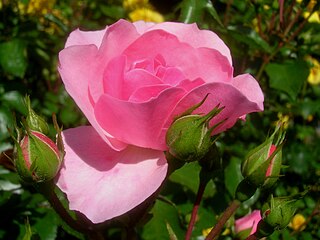
Rosa 'Bonica 82',, is a shrub rose cultivar, bred by Marie-Louise Meilland in France in 1982. The cultivar was named an All-America Rose Selections winner in 1987.
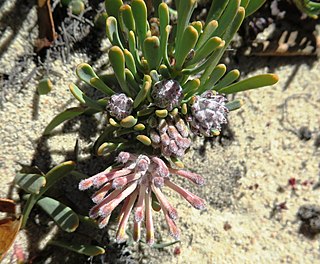
Vexatorella obtusata subsp. obtusata, the Montagu Vexator, is a flower-bearing shrub that belongs to the genus Vexatorella and forms part of the fynbos. The plant is native to the Western Cape and occurs in the Hex River Mountains, Bokker River Mountains, Keeromsberg and Kwadouw Mountains to the Langeberg at Koo as well as the Waboomsberg. The shrub is dense and grows to 2.0 m in diameter. The shrub blooms from September to December.

Vexatorella obtusata subsp. albomontana, the Witteberg vexator, is a flower- bearing shrub that belongs to the genus Vexatorella and forms part of the fynbos. The plant is native to the Western Cape and occurs in the Witteberg, Bonteberg and Anysberg. The shrub is erect and grows to 1.0 m in length. The shrub blooms from August to November.


