Trachischium fuscum, also known as the blackbelly worm-eating snake or the Darjeeling slender snake, is a species of colubrid snake, which is endemic to Asia. The specific name, fuscum, is Latin for "dusky" or "dark brown".
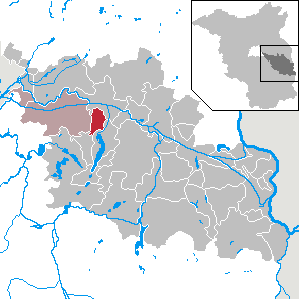
Rauen is a municipality in the Oder-Spree district, in Brandenburg, Germany.
Amt Spreenhagen is an Amt in the district of Oder-Spree, in Brandenburg, Germany. Its seat is in Spreenhagen.

Trichocentrum fuscum, commonly known as the dark trichocentrum, is a species of orchid found from Mexico to Central America.

Fuscin is an antibiotic with the molecular formula C15H16O5 which is produced by the fungus Oidiodendron fuscum and other Oidiodendron species and the fungus Potebniamyces gallicola. Fuscin is an ADP transporter inhibitor.
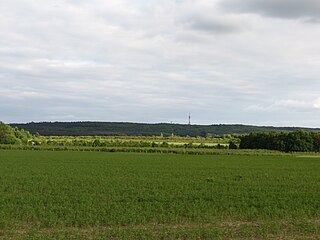
The Rauen Hills are a range of low hills in Brandenburg, Germany. They are named after the town of Rauen.
The RASopathies are a group of developmental syndromes caused by germline mutations in genes belonging to the Ras/MAPK pathway. Common features include intellectual disability, congenital heart defects, skin abnormalities, and craniofacial abnormalities.
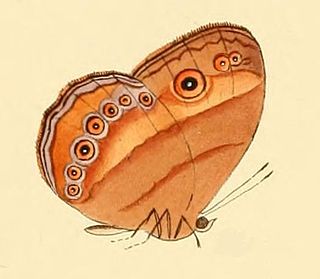
Mycalesis fuscum, the Malayan bush brown, is a butterfly of the family Nymphalidae. It is found on Peninsular Malaysia, Java, Borneo, and Nias.

Tetropium fuscum, the brown spruce longhorn beetle, is a species of beetle in the family Cerambycidae. It was described by Johan Christian Fabricius in 1787. Tetropium fuscum is native to Europe and Northern Asia, and has been introduced to Nova Scotia, Canada. Brown spruce longhorn is a pest of spruce trees.

Pilz GmbH & Co. KG is a German automation technology company in Ostfildern, Germany. In addition to the head office in Germany, Pilz is represented in 42 subsidiaries and branches on all continents.

The Receiver statue is a 22-foot (6.7 m) tall public statue in Green Bay, Wisconsin associated with the Green Bay Packers football team. Originally located outside the Green Bay Packers Hall of Fame, the statue was dedicated to the "great past, present and future enshrinees in the Green Bay Packers Hall of Fame" on June 8, 1985. The player on the statue had number 88 on his jersey and the name listed on the back jersey was "PACKER." The statue was sold in 2003 to Titletown Brewing and was moved to the corner of Dousman Street and Donald Driver Way in front of the old Chicago and North Western Railway Passenger Depot. It was re-dedicated in the likeness of Donald Driver on June 15, 2013.

Sphagnum fuscum, the rusty bogmoss or rusty peat moss, is a peat moss found commonly in Norway and Sweden, and can be found scattered across North America, the United Kingdom, and in southern to eastern Europe.

Nemapogon clematella, the barred white clothes moth, is a moth of the family Tineidae. It is found in most of Europe and in North America, where it has been recorded from Maryland and North Carolina. The habitat consists of woodlands.

Linepithema fuscum is a species of ant in the genus Linepithema. Described by Mayr in 1866, the species is endemic to South America. Linepithema fucsum was the first species-level name assigned to genus Linepithema by Mayr. It is related to L. angulatum, L. keiteli, L. piliferum and L. tsachila. However, only Linepithema fuscum remains without a worker association and it could be possible that males of Linepithema fuscum actually belong to the workers of L. angulatum. Little is known about Linepithema fuscum due to the scarcity of the collected samples.

Prasophyllum fuscum, commonly known as the slaty leek orchid or tawny leek orchid, is a species of orchid endemic to a small region of New South Wales. It has a single tubular green leaf and up to thirty greenish brown to reddish brown flowers. There is debate about the taxonomy of the species with some authorities considering Prasophyllum uroglossum as a separate species. Only about twenty five plants are known to survive in south-western Sydney.

Allantonematidae is a family of insect-parasitic nematodes from the order Tylenchida. Allantonematid nematodes infect a variety of insects including beetles, butterflies, flies, thrips, ants, and more. For instance, the nematode Howardula aoronymphium parasitizes mushroom-feeding fruit flies, Formicitylenchus oregonensis parasitizes carpenter ants, and Metaparasitylenchus hypothenemi parasitizes a pest of coffee beans, the coffee berry borer.
Oidiodendron cereale is a species of ascomycetes fungi in the order Helotiales. This fungus is found globally in temperate climates where average summer temperatures are below 25 °C, but there have been scattered reports from tropical and subtropical environments. It is predominantly found in soil, but little is known regarding their ecological roles in nature. However, an enzymatic study from Agriculture Canada showed that O. cereale can break down a variety of plant, fungal, and animal based substrates found in soil, which may have beneficial effects for plants. On rare occasions, this fungus is found on human skin and hair. There has been one reported case of O. cereale infection in 1969, causing Neurodermitis Nuchae.

Bruna Costa Alexandre is a Brazilian para table tennis player who is two-time World bronze medalist and Paralympic bronze medalist in both singles and teams events along with Danielle Rauen.
Danielle Rauen is a Brazilian para table tennis player. She competed at the 2016 Summer Paralympics, winning a bronze medal, and 2020 Summer Paralympics, in Women's team class 9–10, winning a bronze medal.
Diorygma fuscum is a species of corticolous (bark-dwelling) crustose lichen in the family Graphidaceae. Found in China, it was formally described as a new species in 2016 by Jian Li and Ze-Feng Jia. The type specimen was collected from Wanmulin, Fangdao Town at an altitude of 310 m (1,020 ft); here it was found growing on bark. The specific epithet fuscum ("brown") refers to the lichen's mature ascospores, which are brownish in colour. Secondary chemicals that occur in the lichen include stictic acid (major), and minor to trace amounts of constictic acid, hypostictic acid, and hypoconstictic acid. The presence of stictic acid helps distinguish this species from the similar Diorygma pruinosum.

