Related Research Articles

Stanhopea is a genus of the orchid family (Orchidaceae) from Central and South America. The abbreviation used in horticultural trade is Stan. The genus is named for the 4th Earl of Stanhope (1781-1855), president of the Medico-Botanical Society of London (1829-1837). It comprises 55 species and 5 natural hybrids. These epiphytic, but occasionally terrestrial orchids can be found in damp forests from Mexico to Trinidad to NW Argentina. Their ovate pseudobulbs carry from the top one long, plicate, elliptic leaf.
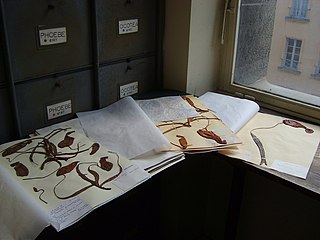
A herbarium is a collection of preserved plant specimens and associated data used for scientific study.

Phragmipedium kovachii is an orchid species found to be new to science in 2001, native to the Andean cloud forests of northern Peru. A species with terrestrial habit and growing in clumps of several individuals, it displays showy pink to purple flowers up to 20 cm (8 in) wide. It is currently considered a critically endangered species by the IUCN, due to overcollection in the wild.

The University of California Botanical Garden is a 34-acre botanical garden located on the University of California, Berkeley campus, in Strawberry Canyon. The Garden is in the Berkeley Hills, inside the city boundary of Oakland, with views overlooking the San Francisco Bay. It is one of the most diverse plant collections in the United States, and famous for its large number of rare and endangered species.

The Marie Selby Botanical Gardens is a 15-acre (6.1 ha) botanical garden located at 900 South Palm Avenue in Sarasota, Florida. The Gardens are located on the grounds of the former home of Marie and William Selby.

Rhizanthella, commonly known as underground orchids, is a genus of flowering plants in the orchid family, Orchidaceae and is endemic to Australia. All are leafless, living underground in symbiosis with mycorrhizal fungi. The inflorescence is a head of flowers held at, or just above the ground but mostly covered by soil or leaf litter and little is known about the mechanism of pollination.

Stenia is a genus in the orchid family (Orchidaceae). It was established by John Lindley in 1837. These epiphytic plants occur in warm, humid habitats of Trinidad and the Amazonian slope of the northern Andean region in South America.

The San Juan Botanical Garden, also known as the Botanical Garden of the University of Puerto Rico, is located in the Caribbean city of San Juan, capital of Puerto Rico. This lush 300-acre (1.2 km2) “urban garden” of native and exotic flora serves as a laboratory for the study, conservation and enrichment of plants, trees, flowers, grasses and many other plants. Seventy-five acres are landscaped and open to the general public as well as researchers.
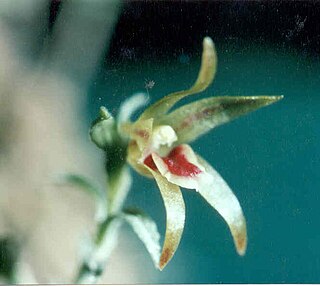
Tomzanonia is a genus of orchids,, consisting of a single species, Tomzanonia filicina endemic to the Massif de la Hotte in Haiti.
The Massif de la Hotte is a mountain range in southwestern Haiti, on the far-western end of the Tiburon Peninsula. The region is relatively remote and is one of the most biologically diverse and significant areas of all of Hispaniola. It also supports some of the last stands of Haiti's dense cloud forest on its peaks. About 2.5 million years ago, the Massif de la Hotte was separated from the rest of the country by a deep, wide sea channel, which resulted in a hotbed of endemism in its bird, plant, and reptile communities.

The Reverend Donald D. Dod, was an American missionary and orchidologist.
Paul Hamilton Allen (1911–1963) was an American botanist noted for his work on the ecology of Central America, orchid systematics and economically important species including bananas. He was married to the former Dorothy Osdieck of Kirkwood, Missouri.
Charles Schweinfurth was an American botanist and plant collector who distinguished himself by his studies on orchids. He predominantly collected species from Peru which he described in his four volume reference work Orchids of Peru (1958). He was a researcher at the Botanical Museum of Harvard University, and director of the Ames Orchid Herbarium where, in 1958, he was succeeded by Leslie Andrew Garay.

The wildlife of Haiti is important to the country because of its biodiversity. According to the World Conservation Monitoring Centre, Haiti is considered to be "one of the most biologically significant countries of the West Indies". With an estimated 5,600 plant species on the island of Hispaniola, some of which only occur in Haiti, 36% are considered as endemic to the island. A mountainous area country, it is situated in the western three-eighths of Hispaniola and shares a border with the Dominican Republic. There are nine life zones, from low desert to high cloud forests, as well as four mountain ranges, and hundreds of rivers and streams and the coral reefs in the seas that surround the islands. Issues of environmental damage, expanding population, deforesting and erosion are of concern; less than 2% of the original forest remains on account of deforestation. This degradation is traced from the 17th century to 19th century starting with the French colonization of the Haiti and population explosion during the 20th century and for the purpose of forestry and sugar-related industries, degraded the forests. and the environment.
Leslie Andrew Garay was an American botanist. He is the retired curator of the Oakes Ames Orchid Herbarium at Harvard University, where he succeeded Charles Schweinfurth in 1958. In 1957 he was awarded a Guggenheim Fellowship.
William Cattley was a British merchant and horticulturist. He was significantly involved with the trade between Britain and Russia, including the importation of grain to England. He also collected, and had others collect on his behalf, plants from locations throughout the world. He was particularly fond of orchids.
Abel Aken Hunter was an American botanist notable for his contributions to science primarily in the collection of the orchids of Panama. From 1915-1935, he was a team member on scientifically significant orchid hunting expeditions with many of the collectors and researchers of the day: Charles Powell, George Pring, Carroll Dodge, Julian Steyermark, and Paul Allen. He earned his reputation in field work as an outgrowth of his friendship with Charles Powell. In a unique period in Panama's history, his first orchid collecting adventure took place with Powell during a fishing trip on the newly man-created Gatun Lake in 1912. By 1915, both Hunter and Powell were living and working in Balboa, Panama. As a hobby, Powell started an orchid garden. Beginning in 1918, the two men would spend leave periods from their employment on extended collecting expeditions: their mission morphing over the years from that of hobby collecting to systematic scientific collecting. In 1919, Powell submitted their findings for identification to German botanist Rudolf Schlechter who published, in 1922, Orchidaceae Powellianae Panamenses, a 95-page study of Powell's Panama orchids—Schlechter naming five of the new to science species to honor Hunter.
Mecranium revolutum is a rare tree from Haiti, specifically in Sud. It is endemic to the Morne Formon-Pic Macaya region of the Massif de la Hotte mountain range. Along with the other species of Mecranium from the area it is called "macrio", or "bwa pijon" in Haitian Creole.

Dora Emilia Mora de Retana was a noted Costa Rican botanist, known primarily for her work with orchids. She compiled an extensive catalogue of the variations of the flower found in Costa Rica which became the seminal reference work on the family Orchidaceae in the country for over a decade. There are at least five species of orchids named in her honor and in 2011, a plaque bearing her name was installed at the Lankester Botanical Garden to recognize her contributions to its development.
Rhizanthella speciosa is a species of flowering plant in the orchid family and is endemic to Barrington Tops in New South Wales. It is a mycoheterotrophic herb that spends its entire life cycle, including flowering, at or below the soil surface. As at September 2020, R. speciosa has not yet been accepted as a valid name by the World Checklist of Selected Plant Families or the Australian Plant Census.
References
- 1 2 3 4 5 D. Ackerman, James; W. Mark Whitten (January 2010). "A NEW ORNITHIDIUM (ORCHIDACEAE: MAXILLARIINAE) FROM THE MASSIF DE LA HOTTE OF HAITI" (PDF). Lankesteriana. Universidad de Costa Rica. 9 (3): 509–512.
- 1 2 Cockrell, Cathy (27 April 2010). "New orchid species is discovered in the UC Botanical Garden collection". UC Berkeley News. University of California, Berkeley. Retrieved 29 April 2010.
- ↑ Panzar, Javier (30 April 2010). "New Orchid Species Found in Flowering UC Collection". The Daily Californian. University of California, Berkeley. Archived from the original on 2 May 2010. Retrieved 1 May 2010.