The airbase was established in the second half of the 1960s by (later commander of the IAF) Benny Peled. The area was initially used to test rockets and projectiles by the 151 Squadron for missile testing, with the test items being fired towards the sea.[citation needed]
Helicopters
In 1975, the 160 Squadron "First Cobra" was established with new AH-1 CobraTzefa attack helicopters (see photo in gallery below) at Tel Nof Airbase.
In 1979, the 160 Squadron "First Cobra (later Southern Cobra)" with its Cobra attack helicopters was relocated from Tel Nof to Palmachim.
In 1981, the 124 Squadron "Rolling Sword" with Bell 212 IroquoisAnafa helicopters (see photo in gallery below) moved from Tel Nof to Palmachim also.
In 1985, the 161 Squadron "Northern Cobra" was launched as the second Cobra squadron at Palmachim, both in the northern area of the base.
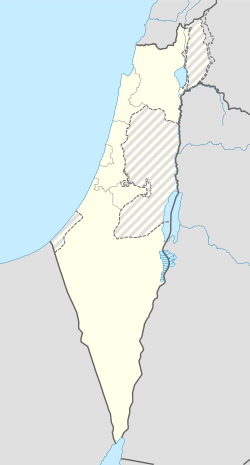
Because of their location on the airbase they were then called the "Northern Cobra" and "Southern Cobra" Squadron (see map also). In 2013, both Cobra squadrons were finally decommissioned.
The 124 Squadron "Rolling Sword" was founded in the 1950s at Tel Nof Airbase as the first helicopter squadron in Israel and flew, among others, the Sikorsky S-55 from 1956 and the slightly larger Sikorsky S-58 from 1958. In 1962, the then German Defense MinisterFranz Josef Strauß sold 24 modern S-58 to Israel,[2] which were then supplemented and finally replaced by Bell 205 (UH-1D/H) helicopters from the end of the 1960s, as some S-58 had been lost in the Six-Day War in 1967. However, as the single-engine Bell 205 increasingly had problems in the desert climate – and many did not survive the Yom Kippur War in 1973 – they were replaced by Bell 212 (UH-1N) helicopters, which had two turbines and were therefore more powerful and more durable. In 1981, the helicopter squadron moved to Palmachim with its Bell 212 machines.[3]
Have been based on Palmachim from 1979 until 2013: AH-1 CobraTzefa attack helicopters
In 1994, 124 Squadron "Rolling Sword" on Palmachim received its first UH-60 Black HawkYanshuf transport helicopters. Later the squadron also received the civil version, called S-70A, for military use.
In 2002, 123 Squadron "Desert Birds" was re-established at Hatzerim Airbase with new UH-60 Black Hawk Yanshuf transport helicopters.
In 2015, 123 Squadron "Desert Birds" moved from Hatzerim to Palmachim Airbase.
During 2026, 193 Squadron "Defenders of the West" will reopen at Palmachim. It was closed on 31 August 2025, at Ramat David Airbase, and at that time flew several Eurocopter AS565 PantherAtalef maritime patrol, maritime surveillance, and SAR helicopters for the Israeli Navy. Upon reopening, it will be equipped with eight SH-60 Seahawk, which were purchased by the IAF and Navy from the US Navy stocks in 2015. These were extensively converted and equipped with Israeli systems.[4][5]
UAVs
Israel was an early adopter of drone development and became one of the leading nations in this field alongside the USA. The Palmachim Airbase played a special role in this. The 200 Squadron "First UAV" was founded here in 1971 and initially used US drones such as the Ryan FirebeeMabat and the Northrop BQM-74 ChukarTelem. But in the course of the 1970s, Israel developed its own models such as the Tadiran Mastiff, the IAI ScoutOriole and later the AAI RQ-2 Pioneer and IAI SearcherHugla, all of which were used for reconnaissance flights – especially over contested areas.[6]
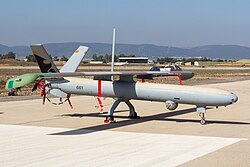
From the mid-1990s, testing and introduction of the IAI Heron1 Shoval UAV began, shortly afterwards of the Elbit Hermes 450Zik and finally from 2009 of its successor Hermes 900Kochav, each by its own squadron. From this point onwards, UAVs were no longer used solely for reconnaissance flights by the IAF, but also for firing guided missiles, something which was not officially confirmed for a long time.[7] But the USAF was able to do it from 1995 onwards with its MQ-1 Predator, and so did Israel not long after with its UAVs.
Based here from mid 1990s until 2023: Heron1Shoval UAVs
Newly built UAV hangars at Palmachim Airbase in 2010
UAV Operator of 147 Squadron "Goring Ram" at Palmachim in 2024
In January 2023, the 200 Squadron "First UAV" with Heron1 UAVs was relocated to Hatzor Airbase.[8] At the beginning of April 2024, the 147 Squadron "Goring Ram" reopened at Palmachim for the fourth time, this time with Hermes 900Kochav UAVs.[7]
Arrow Missiles
Israel's first operational Arrow 2 missile battery was installed southeast of the airbase in 2000 (see map).[9][10] For target detection and tracking, it is used at the Ein Shemer Airfield – together with the Arrow 2 missiles there and others at the Sdot Micha Airbase – the local Super Green Pine Radar with a range of 1000 kilometers. The Arrow 2 missile was developed in the 1990s by Israel together with the USA to defend against larger missiles. The Arrow system is operated by the Israeli Air Defense Command, based on Palmachim. This command is a department of the IAF or the Israeli Air and Space Force and supplements the aircraft squadrons at the bases (see photo in the gallery).[11][12]
A mobile Arrow 2 launcher, like deployed in a battery near the base
An Arrow 2 test launch south of the base on 12 August 2020
The further developed Arrow 3 has also been stationed there since 2017.[13]
Today
Currently two squadrons of UH-60 Black Hawk (Yanshuf) and three squadrons of Hermes 450Zik and Hermes 900Kochav UAVs are stationed at the base (see also under "Units").
In July 2007, it was agreed that once Sde Dov Airport in Tel Aviv was closed, its military terminal would be transferred to Palmachim.[14] The terminal was transferred when Sde Dov Airport ceased operations in July 2019.
Gaza war
Since 7 October 2023, the drones from Palmachim and other Israeli military bases (Tel Nof, Hatzor, Ramat David) are operational in the air over the Gaza Strip around the clock, on the one hand to collect information and to carry out attacks with guided weapons. In cooperation with the ground troops, they are supported in their advance, which, according to Israeli analyzes, is a novelty in modern warfare on this scale and quality.[15]
Training of Shaldag Unit "Kingfisher" of the IAF in September 2022
Note: IAF aircraft can usually be assigned to their squadron by the symbols on the tail
Accidents
Three AH-1 CobraTzefa attack helicopters in front of the ancient fortress Masada in 2010
The AH-1 CobraTzefa attack helicopters of the two squadrons on Palmachim, which had existed since 1975/79 and 1985 respectively, had become old at some point and several accidents, some of them fatal, had occurred. From 1990 onwards they were also in competition with the newer AH-64 Apache, so that all Cobras were finally decommissioned in the course of 2013. In addition, the UAVs also stationed on Palmachim had become increasingly more powerful, are much cheaper to purchase and maintain and no longer endanger the lives of pilots.
On 15 March 1998, an explosion occurred in flight on a AH-1 CobraTzefa, which caused the aircraft to crash over the sea off the coast of Israel. Both pilots were recovered dead.[23]
On the night of 12 March 2013, a AH-1 CobraTzefa crashed into a field near the KibbutzRevadim in central Israel. Both pilots were killed in the accident. The helicopter was returning to the Palmachim base after an exercise. It did not catch fire during the crash and so the accident site was not discovered until early in the morning. The IAF subsequently ordered an investigation and all other AH-1 helicopters were banned from taking off until further notice.[24] Around five weeks later, the cause of the accident was determined to be the fracture of a rear rotor blade, which indicates material fatigue.[25]
On the night of 10–11 September 2024, a UH-60 Black HawkYanshuf from Palmachim crashed during a rescue mission by Unit 669 near Rafah in the southern Gaza Strip. Two soldiers were killed and seven others were injured, some seriously. It is currently assumed that the helicopter was not brought down by enemy fire. IAF commander Major GeneralTomer Bar convened a commission of inquiry.[26]
On 18 June 2025, Iran announced that its air defenses had shot down an Israeli Hermes 900Kochav drone during an airstrike over the Isfahan province in central Iran, and provided video evidence to support this. The IDF confirmed this, saying that the drone was shot down by a surface-to-air missile and that there were no casualties or loss of intelligence.[27] Long-range drones of the Hermes 900Kochav type are stationed only on Palmachim in two squadrons (see: units).
Rockets and satellites
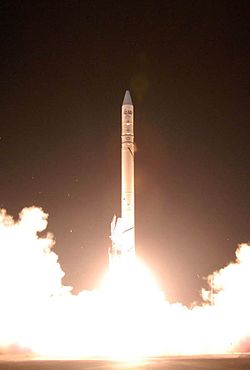
Start of a Shavit 2 missile at the spaceport in 2007
Due to Israel's geographical location and hostile relations with neighboring countries, the rockets launch west across the Mediterranean. This avoids flying over enemy countries that could use the technology in the event of a crash and prevents parts from falling into populated areas. The satellites launched are on non-equatorial orbits and are among the few earth satellites that orbit the earth in an east–west direction. Taking off against the earth's rotation causes approximately 30% higher fuel consumption.
On 17 January 2008, Israel test fired a multi-stage ballistic missile believed to be of the Jericho III type, reportedly capable of carrying "conventional or non conventional warheads".[29] On 2 November 2011, Israel successfully test fired a missile believed to be an upgraded version of the Jericho III; the long trail of smoke was seen throughout central Israel.[31]
References
↑AIP Israel(PDF). Department of Civil Aviation. 18 May 2023. p.355. Archived from the original(PDF) on 28 May 2023.
12"The Rolling Sword Squadron". WayBack-Machine: IAF-Website. Archived from the original on 14 March 2019. Retrieved 3 March 2024.{{cite web}}: CS1 maint: bot: original URL status unknown (link)
↑"The First UAV Squadron". WayBack-Machine: IAF-Website. Archived from the original on 27 July 2023. Retrieved 16 March 2024.{{cite web}}: CS1 maint: bot: original URL status unknown (link)
↑"Multilayered Protection". Website of the Ministry of Defense of Israel (in Hebrew). 1 January 2023. Archived from the original on 17 January 2024. Retrieved 6 November 2023.
↑"The Desert Birds Squadron". WayBack-Machine: IAF-Website (in Hebrew). Archived from the original on 1 June 2019. Retrieved 1 June 2019.{{cite web}}: CS1 maint: bot: original URL status unknown (link)
This page is based on this Wikipedia article Text is available under the CC BY-SA 4.0 license; additional terms may apply. Images, videos and audio are available under their respective licenses.