Species
- P. bispina Davies & Miller, 2008 [1]
- P. infuscata Davies & Miller, 2008 [1]
- P. lalitra Davies & Miller, 2008 [1]
- P. munroi Stuckenberg, 1971 [1] [2]
- P. talea Davies & Miller, 2008 [1]
 |
| Parapachycerina | |
|---|---|
| Scientific classification | |
| Kingdom: | |
| Phylum: | |
| Class: | |
| Order: | |
| Family: | |
| Subfamily: | |
| Genus: | Parapachycerina [1] Stuckenberg, 1971 [2] |
| Type species | |
| Parapachycerina munroi Stuckenberg, 1971 | |
Parapachycerina is a genus of small African flies of the family Lauxaniidae. [1] They are mostly yellow-orange in colour. [1]
|

Paragus is a genus of hoverflies.

The Brachyceran family Vermileonidae is a small family of uncertain affinities and unusual biology. It includes fewer than 80 described species, most of them rare and with restricted distribution, in 10 genera. Historically the vermileonids had been regarded as belonging to the family Rhagionidae, possibly in a subfamily Vermileoninae. Their biology and morphology are so markedly distinct from the main Rhagionidae sensu stricto however, that the placement as a separate family has been widely accepted.
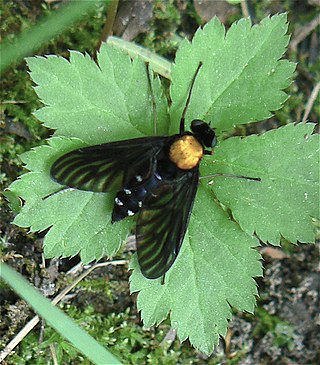
Chrysopilus is common, worldwide genus of predatory snipe flies. There are approximately 300 species in the genus, including fossil members that are sometimes found in amber.

The Lauxaniidae are a family of acalyptrate flies. They generally are small flies with large compound eyes that often are brightly coloured in life, sometimes with characteristic horizontal stripes, such as in Cestrotus species. Many species have variegated patterns on their wings, but in contrast they generally do not have variegated bodies, except for genera such as Cestrotus, whose camouflage mimics lichens or the texture of granitic rocks.

Rhagionidae or snipe flies are a small family of flies. They get their name from the similarity of their often prominent proboscis that looks like the beak of a snipe.

The Celyphidae, commonly known as beetle flies or beetle-backed flies, are a family of flies. About 115 species in about 9 genera are known chiefly from the Oriental and Afrotropic biogeographic regions with one lineage in the New World.
African Invertebrates is a peer-reviewed open access scientific journal that covers the taxonomy, systematics, biogeography, ecology, conservation, and palaeontology of Afrotropical invertebrates, whether terrestrial, freshwater, or marine. It is published by Pensoft Publishers on behalf of the KwaZulu-Natal Museum and the editor-in-chief is David G. Herbert.
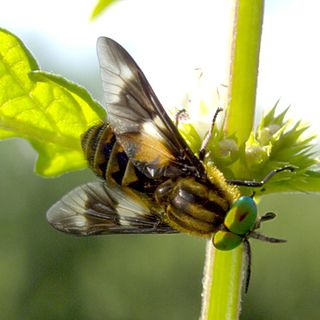
Superfamily Tabanoidea are insects in the order Diptera.

Lonchoptera is a genus of spear-winged flies (Lonchopteridae). Their common name refers to their subacute (pointed) wings, which have a distinct and sexually dimorphic venation.

Athericidae is a small family of flies known as water snipe flies or ibis flies. They used to be placed in the family Rhagionidae, but were removed by Stuckenberg in 1973. They are now known to be more closely related to Tabanidae. Species of Athericidae are found worldwide.
Arthroteles is a genus of snipe fly of the family Rhagionidae. Species of Arthroteles are moderately sized, from 5 to 7.5 mm. They are gray to dark gray in colour. Their antenna bears seven to eight tapering flagellomeres, the first much larger than all others.
Atherimorpha is a genus of snipe fly of the family Rhagionidae.
Afrotethina is a genus of beach flies in the family Canacidae. All known species are Afrotropical in distribution.
Brian Roy Stuckenberg was a South African entomologist who specialised in Diptera.
Afrominettia is a genus of small flies of the family Lauxaniidae.
Alhajarmyia is a genus of wormlion in the family Vermileonidae.
Vermipardus is a genus of wormlion in the family Vermileonidae.
Namaquamyia is a genus of wormlion in the family Vermileonidae, containing a single species, Namaquamyia manselli.
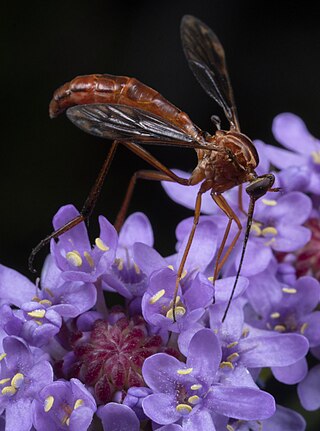
Leptynoma is a genus of wormlions in the family Vermileonidae.
Lampromyia is a genus of wormlion in the family Vermileonidae.
 | This article related to members of the muscomorph flies superfamily Lauxanioidea is a stub. You can help Wikipedia by expanding it. |