Redingeria is a genus of lichenized fungi in the family Graphidaceae. It was circumscribed in 2006 by Andreas Frisch, with Redingeria leiostoma assigned as the type species. The genus name honours Karl Martin Redinger (1907–1940), an Austrian botanist.
Lasioloma is a genus of lichenized fungi in the family Pilocarpaceae. The genus was circumscribed by Swedish lichenologist Rolf Santesson in 1952, with Lasioloma arachnoideum assigned as the type species. Found predominantly in tropical rainforests, genus Lasioloma contains both foliicolous (leaf-dwelling) and corticolous (bark-dwelling) species. The foliicolous species are distinguished by their woolly prothallus, a thallus that ranges from dispersed to continuous, and a hairy apothecial margin. In contrast, corticolous species typically do not have a woolly prothallus, and their thalli are usually continuous, or unbroken. Regardless of the substrate they inhabit, all known Lasioloma species are characterized by the production of campylidia and branched conidia.
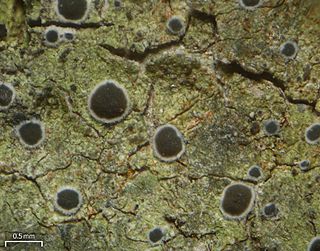
Byssoloma is a genus of leaf-dwelling lichens in the family Pilocarpaceae.
Calenia is a genus of lichen-forming fungi within the family Gomphillaceae.
Synarthonia is a genus of lichen-forming fungi in the order Arthoniales. The genus has not been placed into a family. Synarthonia was circumscribed by Swiss lichenologist Johannes Müller Argoviensis in 1891.
André Aptroot is a Dutch mycologist and lichenologist. His primary research focus is on biodiversity, particularly tropical lichens, encompassing systematics, floristic surveys, and taxonomic reviews. A prolific researcher, he has published more than 500 scientific papers and described hundreds of new fungal and lichen species.
Coccocarpia delicatula is a species of foliicolous (leaf-dwelling) foliose lichen in the family Coccocarpiaceae. Known only from the Galápagos Islands and Réunion, it was described as new to science in 2011. Characterised by its rounded, foliose thallus and unique cylindrical isidia, this lichen is similar in appearance to Coccocarpia domingensis but has distinct differences in isidia shape and arrangement. Found on the bark and wood of dead twigs, Coccocarpia delicatula thrives in sunny, wind- and rain-exposed environments.
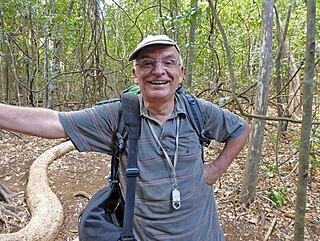
Emmanuël Sérusiaux is a Belgian lichenologist. His career, spanning more than four decades, has combined both lichenology research and political aspects of nature conservation. He spent several periods working as a researcher at the National Fund for Scientific Research and the University of Liège, the latter in which he accepted a faculty position as professor and head of the Plant Taxonomy and Conservation Biology unit. Sérusiaux also served for three non-consecutive appointments as Deputy Chief of Staff in the Government of Wallonia. He retired from both his academic and political positions in 2019.
Bapalmuia serusiauxiana is a species of foliicolous lichen in the family Pilocarpaceae. Found in the Democratic Republic of the Congo, it was described as a new species in 2014 by Dries Van den Broeck, Robert Lücking, and Damien Ertz. The type specimen was collected in Mbangi, about 20 km (12 mi) upstream of Lisala, on the left bank of the Congo River. There, it was found growing on leaves in an old secondary forest. The specific epithet honours Belgian lichenologist Emmanuël Sérusiaux, "an outstanding figure in foliicolous lichen research, especially in tropical Africa".
Allographa aptrootiana is a species of script lichen in the family Graphidaceae that is found in tropical Africa. It was formally described as a new species in 2014 by Dries Van den Broeck, Robert Lücking, and Damien Ertz. The type locality is Yaengo (Orientale Province, Democratic Republic of the Congo; here it was found growing on the bark of an unidentified tree species in an evergreen forest. The lichen somewhat resembles Graphis tetralocularis in overall morphology, but unlike that species it has a completely carbonized excipulum, and does not produce the secondary compound atranorin. The holotype specimen is parasitised with Etayoa trypethelii, a widespread tropical lichenicolous fungus. The specific epithet aptrootiana honours André Aptroot, "in recognition of his many contributions to tropical lichenology". The taxon was transferred to Allographa in 2018 following a reinstatement and reorganization of that genus.
Porina gryseelsiana is a species of foliicolous lichen belonging to the family Porinaceae. It was discovered in Orientale Province, in the Democratic Republic of the Congo on the leaves of understorey plants in a tropical rainforest. It was subsequently described as new to science in 2014. It is a rare species which is only known from this one collection.
Phylloblastia is a genus of foliicolous (leaf-dwelling) lichens in the family Verrucariaceae. The genus was circumscribed in 1921 by Finnish lichenologist Edvard August Vainio, with Phylloblastia dolichospora assigned as the type species.

Piccolia is a small genus of crustose lichens in the class Lecanoromycetes. First circumscribed by Italian lichenologist Abramo Bartolommeo Massalongo in 1864, it contains ten species. Due to a lack of molecular data, it has not been assigned to an order or family.
Phylloblastia verheyeniana is a species of foliicolous (leaf-dwelling) lichen in the family Verrucariaceae. Found in the Democratic Republic of the Congo, it was formally described as a new species in 2014 by Dries Van den Broeck, Robert Lücking, and Damien Ertz. The type specimen was collected by the first author at the Lomami River at an altitude of 487 m (1,598 ft). It is only known to occur in the Congo Basin, where it grows on the leaves of understory plants and shrubs. The species epithet honours Museum of Natural Sciences of Belgium zoologist Erik Verheyen.
Porina weghiana is a rare species of foliicolous (leaf-dwelling) lichen in the family Porinaceae. Found in the Democratic Republic of the Congo, it was formally described as new to science in 2014 by Dries Van den Broeck, Robert Lücking, and Damien Ertz. The type specimen was collected in the valley of Loika at an altitude of 350 m (1,150 ft), where it was found growing on palm tree leaves along the river. It is only known to occur in the type locality. It resembles Porina ornata in appearance but differs in having disc-shaped isidia, yellow perithecia lacking apical appendages, and ascospores that are smaller and have fewer septa. The species epithet is named after the first author's girlfriend, Micheline Wegh.
Alyxoria viridipruinosa is a species of corticolous (bark-dwelling) and lignicolous (wood-dwelling) lichen in the family Lecanographaceae. It is found in Europe, where it grows on hardwood trees.
Gintarasia is a genus of lichen-forming fungi in the family Graphidaceae. It has seven species, all of which are found in Australia. Gintarasia species are corticolous (bark-dwelling), crustose lichens with a thelotremoid form.

Coniocarpon is a genus of lichen-forming fungi in the family Arthoniaceae. It has eight species of corticolous (bark-dwelling) lichens. This genus is distinct for its crystalline orange, red, and purple quinoid pigments in the ascomata that turn purple in potassium hydroxide solution, its colourless, transversely septate ascospores with large apical cells, and its rounded to lirellate ascomata.

