
The Sipuncula or Sipunculida is a class containing about 162 species of unsegmented marine annelid worms. The name Sipuncula is from the genus name Sipunculus, and comes from the Latin siphunculus meaning a "small tube".
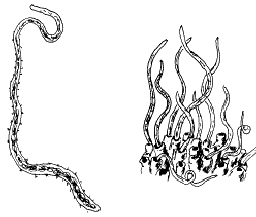
The Naididae are a family of clitellate oligochaete worms like the sludge worm, Tubifex tubifex. They are key components of the benthic communities of many freshwater and marine ecosystems. In freshwater aquaria they may be referred to as detritus worms.

Scalidophora is a group of marine pseudocoelomate protostomes that was proposed on morphological grounds to unite three phyla: the Kinorhyncha, the Priapulida and the Loricifera. The three phyla have four characters in common — chitinous cuticle that is moulted, rings of scalids on the introvert, flosculi, and two rings of introvert retracts. However, the monophyly of the Scalidophora was not supported by two molecular studies, where the position of the Loricifera was uncertain or as sister to the Panarthropoda. Both studies supported a reduced Scalidophora comprising the Kinorhyncha and Priapulida as sister phyla. Their closest relatives are the Panarthropoda, Nematoda and Nematomorpha; thus, they are placed in the group Ecdysozoa.

The Clitellata are a class of annelid worms, characterized by having a clitellum - the 'collar' that forms a reproductive cocoon during part of their life cycles. The clitellates comprise around 8,000 species. Unlike the class of Polychaeta, they do not have parapodia and their heads are less developed.
Eisenia andrei is a close relative of the 'brandling' or 'tiger' worm Eisenia fetida. Like E. fetida, it is epigeic, i.e. it prefers to live in compost or leaf litter rather than mineral soils.

The nuchal organ is a ciliated pit or groove present at the posterior end of the prostomium of annelid worms, some cephalopods, and other invertebrates.
Rhodine is a genus of capitellid segmented worms in the family Maldanidae.

Errantia is a diverse group of marine polychaete worms in the phylum Annelida. Traditionally a subclass of the paraphyletic class Polychaeta, it is currently regarded as a monophyletic group within the larger Pleistoannelida, composed of Errantia and Sedentaria. These worms are found worldwide in marine environments and brackish water.

Linuparus, the spear lobsters, is a genus of medium-sized to large spiny lobsters in the family Palinuridae. It contains four extant species found at depths of 30–500 m (100–1,640 ft) in the Indo-Pacific, and 32 fossil species, ranging from the Early Cretaceous to the Oligocene. L. trigonus is the only extant species also known from the fossil record.
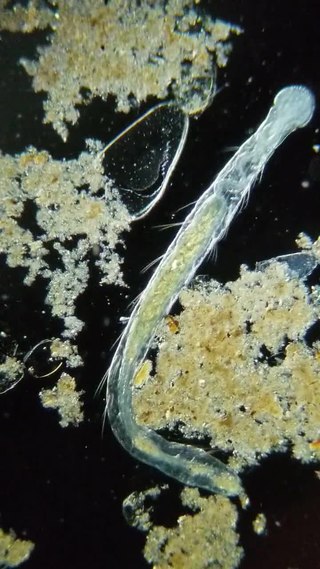
Aeolosoma is a genus of minute annelid worms, variously attributed either to oligochaetes or polychaetes. Unlike most polychaetes, they reside in freshwater environments in various parts of the world.

The annelids, also known as the segmented worms, are a large phylum, with over 22,000 extant species including ragworms, earthworms, and leeches. The species exist in and have adapted to various ecologies – some in marine environments as distinct as tidal zones and hydrothermal vents, others in fresh water, and yet others in moist terrestrial environments.
Opisthopatus cinctipes is a species of velvet worm in the Peripatopsidae family. This species has 16 pairs of legs, all with claws and all used for walking. The color of the dorsal surface varies from blue to olive green. Females range from 7 mm to 50 mm in length, whereas males range from 6 mm to 36 mm. Like other velvet worms in this genus, this species exhibits matrotrophic viviparity, that is, mothers in this genus retain eggs in their uteri and supply nourishment to their embryos, but without any placenta. The type locality is in South Africa.
Parergodrilidae is an enigmatic family of polychaetes with only two genera, one living on the coast, the other terrestrial.

Flabelligeridae is a family of polychaete worms, known as bristle-cage worms, notable for their cephalic cage: long slender chaetae forming a fan-like arrangement surrounding the eversible head. Unlike many polychaetes, they also have large, pigmented, complex eyes.

Siphonostomites hesionoides is a species of polychaete annelid known only from subtidal lagoon deposits from the Early Eocene of Monte Bolca, Verona, Italy.

Eudorylini is a tribe of big-headed flies.
Rhodininae is a subfamily of marine polychaete worms in the family Maldanidae.

Sedentaria is a diverse clade of annelid worms. It is traditionally treated as a subclass of the paraphyletic class Polychaeta, but it is also a monophyletic group uniting several polychaetes and the monophyletic class Clitellata. It is the sister group of Errantia.
Notoproctus is a genus of marine polychaete worms in the family Maldanidae. It is the only member of the subfamily Notoproctinae.
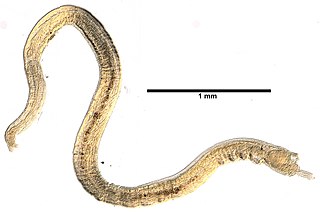
Protodriliformia is a clade of small marine polychaetes, comprised by the groups of meiofaunal interstitial worms Protodrilida and Polygordiidae, formerly considered "archiannelids". It is the most basal clade of Errantia.

