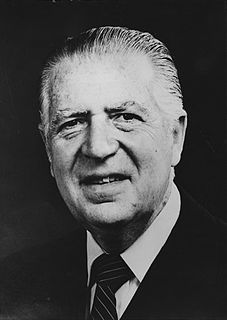
The history of Peru spans 4 millennia, extending back through several stages of cultural development in the mountain region and the lakes. Peru was home to the Norte Chico civilization, the oldest civilization in the Americas and one of the six oldest in the world, and to the Inca Empire, the largest and most advanced state in Pre-Columbian America. It was conquered by the Spanish Empire in the 16th century, which established a Viceroyalty with jurisdiction over most of its South American domains. The nation declared independence from Spain in 1821, but consolidated only after the Battle of Ayacucho, three years later.
The American Popular Revolutionary Alliance - Peruvian Aprista Party is a centre-left Peruvian political party.
Possible Peru is a Peruvian political party. It was founded in 1994 by Alejandro Toledo with the original name of País Posible.

The Socialist Party of Chile is a political party within the centre-left Nueva Mayoría. Its historic leader was President of Chile Salvador Allende, who was deposed in a coup d'état by General Pinochet in 1973. Twenty-seven years later, Ricardo Lagos Escobar represented the Socialist Party in the 1999 presidential elections. He won 48.0% in the first round of voting and was elected with 51.3% in the second round. In the legislative elections on 16 December 2001, as part of the Coalition of Parties for Democracy, the party won 10 out of 117 seats in the Chamber of Deputies and 5 out of 38 elected seats in the Senate. After the 2005 elections, the Party increased its seats to 15 and 8, respectively. In the 2009 elections, it retained 11 Congressional and 5 Senate seats.

Valentín Paniagua Corazao was a Peruvian politician who served as Interim President of Peru. Paniagua was elected by the Peruvian Congress to serve as interim president of the country after Alberto Fujimori was ousted from office by Congress in November 2000.
This article gives an overview of liberalism in Peru. It is limited to liberal parties with substantial support, mainly proved by having had a representation in parliament. The sign ⇒ means a reference to another party in that scheme. For inclusion in this scheme it isn't necessary so that parties labeled themselves as a liberal party.

The Congress of the Republic of Peru is the unicameral body that assumes legislative power in Peru. The congress consists of 130 members (congresistas), who are elected for five-year periods in office on a proportional representation basis.

Christian Democrat Party, a political party in Peru that surged in 1956. Founded by Ernesto Alayza Grundy, Luis Bedoya Reyes, Mario Polar Ugarteche, Héctor Cornejo Chávez, Roberto Ramírez del Villar and others.
Odriíst National Union, was a political party in Peru founded in 1961 by general Manuel A. Odría. The party had Julio de la Piedra amongst its leaders.

The Christian People's Party is a center-right and conservative political party based on Christian Democracy. It was founded in 1966 by a group of the peruvian Christian Democrat Party dissidents, led by Luis Bedoya Reyes. In 2000 its inscription was renewed, and it became part of National Unity, albeit not in a permanent basis.
The Center Front was a Peruvian political coalition formed by the parties Acción Popular (AP), Somos Perú (SP) and Coordinadora Nacional de Independientes (CNI) for the 2006 national election. Its leader and presidential candidate was the late Peruvian ex-president Valentín Paniagua Corazao but following his sudden death on October 16, 2006 the coalition was headed by leader of the Acción Popular party, Víctor Andrés García Belaúnde. The alliance was unsuccessful in the presidential race. At the legislative elections held on 9 April 2006, the party won 7.1% of the popular vote and 5 out of 120 seats in the Congress of the Republic.

Víctor Andrés García Belaúnde, is a Peruvian politician.
National Front was a period in the history of Colombia in which the two main political parties, the Liberal Party and the Conservative Party, agreed to rotate power, intercalating for a period of four presidential terms. The National Front Presidents were Alberto Lleras Camargo (Liberal), Guillermo León Valencia (Conservative), Carlos Lleras Restrepo (Liberal), and Misael Pastrana Borrero (Conservative).
The Conservative Party was an Ecuadorian conservative party formed in 1869. Initially associated with the military of Ecuador the PC became one of the two great parties of state in the country, alternating in power with the Ecuadorian Radical Liberal Party. Its traditional support basis has been amongst the landowning classes, as well as merchants and artisans and it tended to favour a unitary structure rather than federalism.

The term Fujimorism or Fujimorismo denotes the policies and the political ideology of former President of Peru Alberto Fujimori as well as the personality cult built around him, his policies and his family. The ideology is defined by its support for social conservatism and neoliberal economics, as well as its opposition to both the far-left and far-right.

General elections were held in Peru on 10 April 2016 to determine the president, vice-presidents, composition of the Congress of the Republic of Peru and the Peruvian representatives of the Andean Parliament.
General elections were held in Peru on 9 June 1963 to elect the President and both houses of the Congress after the results of the 1962 elections were annulled following a military coup. Supported by Popular Action and the Christian Democrat Party, Fernando Belaúnde Terry won the presidential election with 39% of the vote, whilst the Peruvian Aprista Party emerged as the largest party in both houses of Congress.