
Robert Strange McNamara was an American business executive and the eighth United States Secretary of Defense, serving from 1961 to 1968 under Presidents John F. Kennedy and Lyndon B. Johnson. He played a major role in escalating the United States' involvement in the Vietnam War. McNamara was responsible for the institution of systems analysis in public policy, which developed into the discipline known today as policy analysis.
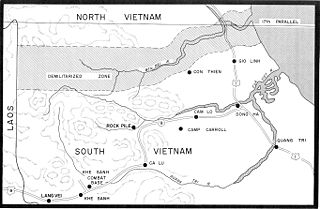
A demilitarized zone, DMZ or DZ is an area in which treaties or agreements between nations, military powers or contending groups forbid military installations, activities or personnel. A DMZ often lies along an established frontier or boundary between two or more military powers or alliances. A DMZ may sometimes form a de facto international border, such as the 38th parallel between North and South Korea. Other examples of demilitarized zones are a 190-kilometre-wide (120 mi) area between Iraq and Kuwait, Antarctica and outer space.

The Tet Offensive, or officially called The General Offensive and Uprising of Tet Mau Than 1968 was one of the largest military campaigns of the Vietnam War, launched on January 30, 1968 by forces of the Viet Cong (VC) and North Vietnamese People's Army of Vietnam (PAVN) against the forces of the South Vietnamese Army of the Republic of Vietnam (ARVN), the United States Armed Forces and their allies. It was a campaign of surprise attacks against military and civilian command and control centers throughout South Vietnam. The name of the offensive comes from the Tết holiday, the Vietnamese New Year, when the first major attacks took place.

The Korean Demilitarized Zone is a strip of land running across the Korean Peninsula. It is established by the provisions of the Korean Armistice Agreement to serve as a buffer zone between North Korea and South Korea. The demilitarized zone (DMZ) is a border barrier that divides the Korean Peninsula roughly in half. It was created by agreement between North Korea, China and the United Nations Command in 1953. The DMZ is 250 kilometres long, and about 4 kilometres wide.

The Battle of Khe Sanh was conducted in the Khe Sanh area of northwestern Quảng Trị Province, Republic of Vietnam, during the Vietnam War. The main US forces defending Khe Sanh Combat Base (KSCB) were two regiments of the United States Marines Corps supported by elements from the United States Army and the United States Air Force (USAF), as well as a small number of Army of the Republic of Vietnam (ARVN) troops. These were pitted against two to three divisional-size elements of the North Vietnamese People's Army of Vietnam (PAVN).

In the military science of fortification, wire obstacles are defensive obstacles made from barbed wire, barbed tape or concertina wire. They are designed to disrupt, delay and generally slow down an attacking enemy. During the time that the attackers are slowed down by the wire obstacle they are easy to target with machinegun and artillery fire. Depending on the requirements and available resources, wire obstacles may range from a simple barbed wire fence in front of a defensive position, to elaborate patterns of fences, concertinas, "dragon's teeth" and minefields hundreds of metres thick.

Operation Commando Hunt was a covert U.S. Seventh Air Force and U.S. Navy Task Force 77 aerial interdiction campaign that took place during the Vietnam War. The operation began on 11 November 1968 and ended on 29 March 1972. The objective of the campaign was to prevent the transit of People's Army of Vietnam (PAVN) personnel and supplies on the logistical corridor known as the Ho Chi Minh Trail that ran from the southwestern Democratic Republic of Vietnam through the southeastern portion of the Kingdom of Laos and into the Republic of Vietnam.
Operation Igloo White was a covert United States joint military electronic warfare operation conducted from late January 1968 until February 1973, during the Vietnam War. These missions were carried out by the 553d Reconnaissance Wing, a U.S. Air Force unit flying modified EC-121R Warning Star aircraft, and VO-67, a specialized U.S. Navy unit flying highly modified OP-2E Neptune aircraft. This state-of-the-art operation utilized electronic sensors, computers, and communications relay aircraft in an attempt to automate intelligence collection. The system would then assist in the direction of strike aircraft to their targets. The objective of those attacks was the logistical system of the People's Army of Vietnam (PAVN) that snaked through southeastern Laos and was known as the Ho Chi Minh Trail.
The Vietnamese Demilitarized Zone was a demilitarized zone established as a dividing line between North and South Vietnam from 7/1954 to 1976 as a result of the First Indochina War to against reunited Vietnam.

The Korean DMZ Conflict, also referred to as the Second Korean War by some, was a series of low-level armed clashes between North Korean forces and the forces of South Korea and the United States, largely occurring between 1966 and 1969 at the Korean DMZ.

The Rockpile and known in Vietnamese as Thon Khe Tri, is a solitary karst rock outcropping north of Route 9 and south of the former Vietnamese Demilitarized Zone (DMZ). Its relatively inaccessible location, reached only by helicopter, made it an important United States Army and Marine Corps observation post and artillery base from 1966 to 1969.

Con Thien was a United States Marine Corps combat base located near the Vietnamese Demilitarized Zone (DMZ) about 3 km from North Vietnam in Gio Linh District, Quảng Trị Province. It was the site of fierce fighting from February 1967 through February 1968.
The McNamara Line, an operational strategy employed by the United States in 1966–1968 during the Vietnam War, aimed to prevent infiltration of South Vietnam by NVA forces from North Vietnam and Laos. Physically, the McNamara Line ran across South Vietnam from the South China Sea to the Laotian border along the Vietnamese Demilitarized Zone (DMZ). The eastern part included fortified field segments, with Khe Sanh as linchpin, along with stretches where roads and trails were guarded by high-tech acoustic and heat-detecting sensors on the ground and interdicted from the air. Assorted types of mines, including so-called gravel mines, and troops at choke points backed sophisticated electronic surveillance. Named the barrier system by Robert McNamara, it was one of the key elements, along with gradual aerial bombing, of his war strategy in Vietnam.

NLF and PAVN battle tactics comprised a flexible mix of guerrilla and conventional warfare battle tactics used by the Main Force of the People's Liberation Armed Forces and the NVA to defeat their U.S. and South Vietnamese (GVN/ARVN) opponents during the Vietnam War.

Operation Prairie was a U.S. military operation in Quảng Trị Province, South Vietnam that sought to eliminate People's Army of Vietnam (PAVN) forces south of the Demilitarized Zone (DMZ). Over the course of late 1965 and early 1966 the Viet Cong (VC) and the PAVN intensified their military threat along the DMZ. The tactical goal of these incursions was to draw United States military forces away from cities and towns. Operation Hastings, a series of actions in defense of the DMZ, lasted from 15 July to 3 August 1966. It was considered a strategic success. Operation Prairie was conceived as a larger, longer mission covering the same areas along the DMZ.

In the Vietnam War, after the assassinations of Ngo Dinh Diem and John F. Kennedy in late 1963 and the Gulf of Tonkin incident in 1964 and the continuing political instability in the South, the United States made a policy commitment to begin joint warfare in South Vietnam, a period of gradual escalation and Americanization, involving the commitment of large-scale combat forces from the United States and allied countries. It was no longer assumed the Republic of Vietnam could create a desirable situation without major external assistance. This phase of the war lasted until the election of Richard Nixon, and the change of U.S. policy to Vietnamization, or giving the main combat role back to the South Vietnamese military.
The 324th Division is an infantry division of the 4th Military Region.

Operation Lancaster was a U.S. Marine Corps operation that took place in northern Quảng Trị Province from November 1967 to January 20, 1968.
Operation Thor was a U.S. combined arms operation against People's Army of Vietnam (PAVN) positions around, Mũi Lay, North Vietnam from 1-8 July 1968.

Operation Prairie II was a U.S. military operation in Quảng Trị Province, South Vietnam that sought to eliminate People's Army of Vietnam (PAVN) forces south of the Demilitarized Zone (DMZ) that took place from 1 February to 18 March 1967.


