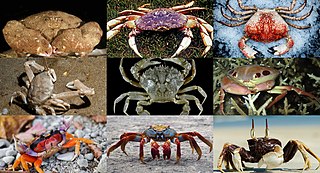
Crabs are decapod crustaceans of the infraorder Brachyura, which typically have a very short projecting tail-like abdomen, usually hidden entirely under the thorax. They live in all the world's oceans, in freshwater, and on land, are generally covered with a thick exoskeleton, and have a single pair of pincers on each arm. They first appeared during the Jurassic period, around 200 million years ago.

Hermit crabs are anomuran decapod crustaceans of the superfamily Paguroidea that have adapted to occupy empty scavenged mollusc shells to protect their fragile exoskeletons. There are over 800 species of hermit crab, most of which possess an asymmetric abdomen concealed by a snug-fitting shell. Hermit crabs' soft (non-calcified) abdominal exoskeleton means they must occupy shelter produced by other organisms or risk being defenseless.
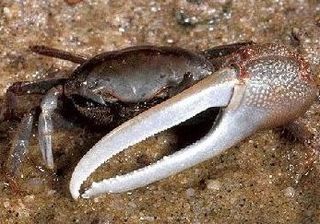
The fiddler crab or calling crab may be any of more than one hundred species of semiterrestrial marine crabs in the family Ocypodidae, well known for their sexually dimorphic claws; the males' major claw is much larger than the minor claw, while the females' claws are both the same size. A smaller number of ghost crab and mangrove crab species are also found in the family Ocypodidae. This entire group is composed of small crabs, the largest being slightly over two inches (5 cm) across. Fiddler crabs are found along sea beaches and brackish intertidal mud flats, lagoons, swamps, and various other types of brackish or salt-water wetlands.

The Japanese spider crab is a species of marine crab and is the biggest one that lives in the waters around Japan. At around 3.7 meters, it has the largest leg-span of any arthropod. The Japanese name for this species is taka-ashi-gani,, literally translating to “tall legs crab”. It goes through three main larval stages along with a prezoeal stage to grow to its great size.

The Dungeness crab makes up one of the most important seafood industries along the west coast of North America. Its typical range extends from Alaska's Aleutian Islands to Point Conception, near Santa Barbara, California. Dungeness typically grow 6-7 inches at their widest point and inhabit eelgrass beds and sandy bottoms. Its common name comes from the Dungeness Spit in the Strait of Juan de Fuca, Washington state, United States, which shelters a shallow bay inhabited by the crabs.

Horseshoe crabs are marine and brackish water arthropods of the family Limulidae and are the only surviving xiphosurans. Despite their name, they are not true crabs or crustaceans. Rather, they are chelicerates. This makes them more closely related to arachnids like spiders, ticks, and scorpions.

Xanthidae is a family of crabs known as gorilla crabs, mud crabs, pebble crabs or rubble crabs. Xanthid crabs are often brightly coloured and are highly poisonous, containing toxins which are not destroyed by cooking and for which no antidote is known. The toxins are similar to the tetrodotoxin and saxitoxin produced by puffer fish, and may be produced by bacteria in the genus Vibrio living in symbiosis with the crabs, mostly V. alginolyticus and V. parahaemolyticus.

The Christmas Island red crab is a species of land crab that is endemic to Christmas Island and Cocos (Keeling) Islands in the Indian Ocean. Although restricted to a relatively small area, an estimated 43.7 million adult red crabs once lived on Christmas Island alone, but the accidental introduction of the yellow crazy ant is believed to have killed about 10–15 million of these in recent years. Christmas Island red crabs make an annual mass migration to the sea to lay their eggs in the ocean. Although its population is under great assault by the ants, as of 2020 the red crab had not been assessed by the International Union for Conservation of Nature (IUCN) and it was not listed on their Red List. The crab's annual mass migration to the sea for spawning is described as an "epic" event. Millions emerge at the same time, halting road traffic and covering the ground in a thick carpet of crabs.

Cancer (♋︎) is the fourth astrological sign in the zodiac, originating from the constellation of Cancer. It spans from 90° to 120° celestial longitude. Under the tropical zodiac, the Sun transits this area between approximately June 22 and July 22.

Portunus pelagicus, also known as the blue crab, blue swimmer crab, blue manna crab and flower crab is a species of large crab found in the Indo-Pacific, including off the coasts Indonesia, Malaysia, Cambodia, Thailand, the Philippines, and Vietnam; and in the intertidal estuaries around most of Australia and east to New Caledonia.

The Ocypodidae are a family of semiterrestrial crabs that includes the ghost crabs and fiddler crabs. They are found on tropical and temperate shorelines around the world.

The crab claw sail is a fore-and-aft triangular sail with spars along upper and lower edges. The crab claw sail was first developed by the Austronesian peoples by at least 2000 BCE. It is used in many traditional Austronesian cultures in Island Southeast Asia, Micronesia, Island Melanesia, Polynesia, and Madagascar. It is sometimes known as the Oceanic lateen or the Oceanic sprit, even though it is not restricted to Oceania, is neither a lateen sail nor a spritsail, and has an independent older origin.

The pie crust crab, is a species of crab found around New Zealand and south-eastern Australia.
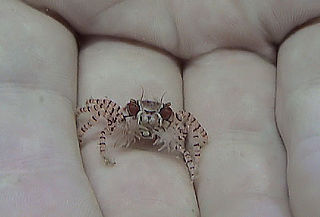
Lybia is a genus of small crabs in the family Xanthidae. Their common names include boxer crabs, boxing crabs and pom-pom crabs. They are notable for their mutualism with sea anemones, which they hold in their claws for defense. In return, the anemones get carried around, which may enable them to capture more food particles with their tentacles. Boxer crabs use at least three species of anemones, including Bundeopsis spp. and Triactis producta. The bonding with the anemone is not needed for survival, however, and boxer crabs have frequently been known to live without them, sometimes substituting other organisms such as sponges and corals for the sea anemones.

The coconut crab is a terrestrial species of giant hermit crab, and is also known as the robber crab or palm thief. It is the largest terrestrial arthropod known, with a weight of up to 4.1 kg (9 lb). The distance from the tip of one leg to the tip of another can be as wide as 1 m. It is found on islands across the Indian and Pacific Oceans, as far east as the Gambier Islands, Pitcairn Islands and Caroline Island and as far south as Zanzibar. While its range broadly shadows the distribution of the coconut palm, the coconut crab has been extirpated from most areas with a significant human population such as mainland Australia and Madagascar.
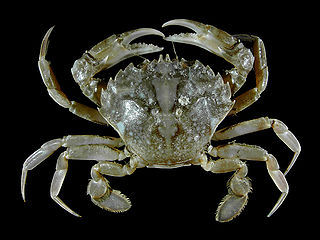
Eubrachyura is a group of decapod crustaceans comprising the more derived crabs. It is divided into two subsections, based on the position of the genital openings in the two sexes. In the Heterotremata, the openings are on the legs in the males, but on the sternum in females, while in the Thoracotremata, the openings are on the sternum in both sexes. This contrasts with the situation in other decapods, in which the genital openings are always on the legs. Heterotremata is the larger of the two groups, containing the species-rich superfamilies Xanthoidea and Pilumnoidea and all the freshwater crabs. The eubrachyura is well known for actively and constantly building its own burrows. The fossil record of the Eubrachyura extends back to the Cretaceous; the supposed Bathonian representative of the group, Hebertides jurassica, ultimately turned out to be Cenozoic in age.
Heterotremata is a clade of crabs, comprising those crabs in which the genital openings are on the sternum in females, but on the legs in males. It comprises 68 families in 28 superfamilies.

Ranina ranina, also known as the Huỳnh Đế crab, (red) frog crab or spanner crab, is a species of crab found throughout tropical and subtropical habitats. It is often fished for its meat, and is the only known species in its genus.

Orithyia sinica, sometimes called tiger crab or the tiger face crab, is a "singularly unusual" species of crab, whose characteristics warrant its separation into a separate genus, family and even superfamily, having previously been included in the Dorippoidea or Leucosioidea. Its larvae, for instance, are unlike those of any other crab.

The Wealthy is an American apple cultivar, and was the earliest to thrive in the Minnesota climate. Horticulturalist Peter Gideon first grew it in 1868, after years of trial and error with various apple varieties.

