The Journal of Labelled Compounds and Radiopharmaceuticals is a peer-reviewed scientific journal that was established in 1965. It is published in fourteen issues per year by John Wiley & Sons on behalf of the International Isotope Society and covers all aspects of research and development leading to and resulting in labelled compound preparation. The current editor-in-chiefs are R F Dannals and V Derdau.
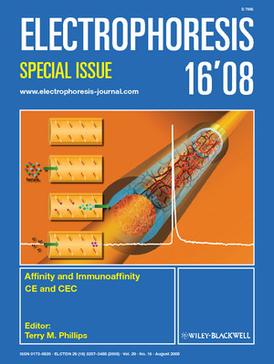
Electrophoresis is a peer-reviewed scientific journal covering all aspects of electrophoresis, including new or improved analytical and preparative methods, development of theory, and innovative applications of electrophoretic methods in the study of proteins, nucleic acids, and other compounds.

The Journal of Chromatography A is a peer-reviewed scientific journal publishing research papers in analytical chemistry, with a focus on techniques and methods used for the separation and identification of mixtures.
Energy & Environmental Science is a monthly peer-reviewed scientific journal publishing original (primary) research and review articles. The journal covers work of an interdisciplinary nature in the biochemical and biophysical sciences and chemical and mechanical engineering disciplines. It covers energy area. Energy & Environmental Science is published by the Royal Society of Chemistry and the editor-in-chief is Joseph Hupp.

The Journal of Magnetism and Magnetic Materials is a peer-reviewed scientific journal that covers both basic research on magnetism and technological applications including magnetic recording. In addition to full-length research articles, it publishes review articles and rapid communications. A special section, "Information Storage: Basic and Applied", covers topics on magnetic media. The editor-in-chief is S. D. Bader.

Analytical Methods is a monthly peer-reviewed scientific journal covering research on the development of analytical techniques. It is published by the Royal Society of Chemistry and the editor-in-chief is Scott Martin.
SLAS Discovery is a peer-reviewed scientific journal published by the Society for Laboratory Automation and Screening (SLAS) in partnership with SAGE Publications. The editor-in-chief is Robert M. Campbell, Ph.D.. The journal explores how scientists develop and utilize novel technologies and/or approaches to provide and characterize chemical and biological tools to understand and treat human disease. This includes scientific and technical advances in target identification/validation; biomarker discovery; assay development; virtual, medium- or high-throughput screening; lead generation/optimization; chemical biology; and informatics. The journal was published from 1996 through 2016 with the title Journal of Biomolecular Screening. Its name changed in 2017 to more accurately reflect the evolution of its editorial scope.[1]
Journal of Analytical Toxicology (JAT) is a peer-reviewed scientific journal focusing on analytical toxicology.
The Journal of Biomedical Materials Research is a peer-reviewed scientific journals of biomedical material science. It was established in 1967. In 1974, it absorbed Biomedical Materials Symposium (1971–1974). In 1990, it absorbed the journal Journal of Applied Biomaterials (1990–1995). In 2002, it split into two parts, Journal of Biomedical Materials Research Part A, and Journal of Biomedical Materials Research Part B. The two parts are published by John Wiley & Sons.
Combinatorial Chemistry & High Throughput Screening is a peer-reviewed scientific journal that covers combinatorial chemistry. It was established in 1998 and is published by Bentham Science Publishers. The editor-in-chief is Gerald H. Lushington. The journal has 5 sections: Combinatorial/ Medicinal Chemistry, Chemo/Bio Informatics, High Throughput Screening, Pharmacognosy, and Laboratory Automation.

Society for Laboratory Automation and Screening (SLAS) is a scientific and professional society formed in 2010 as a merger between the Association for Laboratory Automation and the Society for Biomolecular Sciences. The mission of SLAS is "to bring together researchers in academia, industry and government to advance life sciences discovery and technology via education, knowledge exchange and global community building."

The Journal of Biomedical Optics is a monthly peer-reviewed scientific journal published by SPIE. It covers the application of optical technology to health care, biomedical research, and experimental medicine. The editor-in-chief is Brian W. Pogue.

The Journal of Neuroscience Methods is a peer-reviewed scientific journal covering scientific techniques and protocols used in any branch of neuroscience research. It was established in 1979. The editor-in-chief is Giuseppe Di Giovanni, Professor of Neuroscience at the University of Malta and Honorary Professor at Cardiff University, UK. Journal Neuroscience Methods is published 18 times a year by Elsevier.

Bioanalysis is a biweekly peer-reviewed scientific journal established in 2009 and published by Future Science. The editor-in-chief is Neil Spooner. The journal covers the field of bioanalysis, including drug and metabolite assays, chromatography and separation sciences, ligand binding assays, metabolomics, and key detection methods.
Biopolymers is a biweekly peer-reviewed scientific journal covering the study of biopolymers from a biochemical and biophysical perspective. It was established in 1963 and is published by John Wiley & Sons. The editor-in-chief is Hilary J. Crichton. The journal has three sections: Peptide Science, Nucleic Acid Sciences, and Biospectroscopy. Peptide Science is the affiliate journal of the American Peptide Society. According to the Journal Citation Reports, the journal has a 2015 impact factor of 2.248, ranking it 39th out of 72 journals in the category "Biophysics" and 186th out of 289 in the category "Biochemistry & Molecular Biology".

Nature Astronomy is a peer reviewed scientific journal published by Nature Portfolio. It was first published in January 2017, although the first content appeared online in December 2016. The editor-in-chief is May Chiao, who is a full-time professional editor employed by the journal. The founding editors of this journal, in addition to May Chiao, were Paul Woods, Luca Maltagliati and Marios Karouzos.
Environmental Toxicology and Chemistry is a monthly peer-reviewed scientific journal covering environmental toxicology and environmental chemistry. It was established in 1982 and is published by Wiley-Blackwell in conjunction with the Society of Environmental Toxicology and Chemistry. The founding editor-in-chief was C.H. Ward, and the current one is G.A. Burton, Jr.. According to the Journal Citation Reports, the journal has a 2021 impact factor of 4.218, ranking it 117th out of 279 journals in the category Environmental sciences and 29th out of 94 in the category Toxicology.
FEMS Yeast Research is a peer-reviewed scientific journal focusing on yeast and yeast-like organisms. The journal was established in 2001. It is published by Oxford University Press on behalf of the Federation of European Microbiological Societies and the editor-in-chief is John Morrissey.
Pathogens and Disease is a peer-reviewed scientific journal covering research on all pathogens. It was originally established in 1988 as FEMS Microbiology Immunology when it split from FEMS Microbiology Letters. It was renamed FEMS Immunology and Medical Microbiology in 1993, and obtained its current name in 2013.
Clarivate Plc is a British-American publicly traded analytics company that operates a collection of subscription-based services, in the areas of bibliometrics and scientometrics; business / market intelligence, and competitive profiling for pharmacy and biotech, patents, and regulatory compliance; trademark protection, and domain and brand protection. In the academy and the scientific community, Clarivate is known for being the company which calculates the impact factor, using data from its Web of Science product family, that also includes services/applications such as Publons, EndNote, EndNote Click, and ScholarOne. Its other product families are Cortellis, DRG, CPA Global, Derwent, MarkMonitor, CompuMark, and Darts-ip, and also the various ProQuest products and services.
1. Eglen, Richard (July 19, 2016). "Coming in the New Year: SLAS Discovery and SLAS Technology". Society for Laboratory Automation and Screening.
2. "Journals Ranked by Impact: Medical Laboratory Technology." 2017 Journal Citation Reports. Web of Science (Sciences ed.). Clarivate Analytics. 2017.
3. "Journals Ranked by Impact: Chemistry, Analytical." 2017 Journal Citation Reports. Web of Science (Sciences ed.). Clarivate Analytics. 2017.
4. "Journals Ranked by Impact: Biochemical Research Methods." 2017 Journal Citation Reports. Web of Science (Sciences ed.). Clarivate Analytics. 2017.
