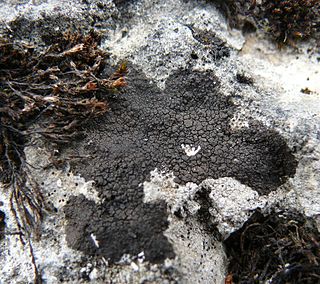
Verrucariaceae is a family of lichens and a few non-lichenised fungi in the order Verrucariales. The lichens have a wide variety of thallus forms, from crustose (crust-like) to foliose (bushy) and squamulose (scaly). Most of them grow on land, some in freshwater and a few in the sea. Many are free-living but there are some species that are parasites on other lichens, while one marine species always lives together with a leafy green alga.

Placidium is a genus of crustose to squamulose to almost foliose lichens. The genus is in the family Verrucariaceae. Most members grow on soil, but some grow on rock (saxicolous). The fruiting bodies are perithecia, flask-like structures immersed in the lichen body (thallus) with only the top opening visible, dotting the thallus. Lichen spot tests are all negative. Members of the genus lack rhizines, but otherwise resemble members of the genus Clavascidium.
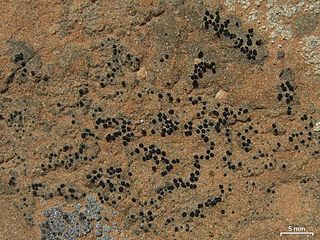
Staurothele is a genus of saxicolous (rock-dwelling), crustose lichens in the family Verrucariaceae. It has about 40 species. When the fungus is part of a lichen, the genus of lichen is commonly called rock pimples.
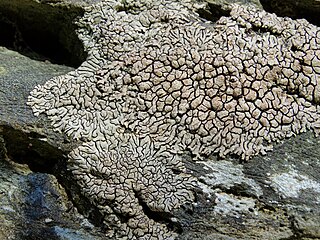
Placopyrenium is a genus of saxicolous (rock-dwelling), crustose lichens in the family Verrucariaceae.

Bryoria is a genus of lichenized fungi in the family Parmeliaceae. Many members of this genus are known as horsehair lichens. The genus has a widespread distribution, especially in boreal and cool temperate areas.
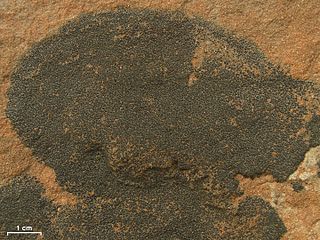
Staurothele areolata is blackish-brown crustose lichen in the family Verrucariaceae. It is found in western North America.
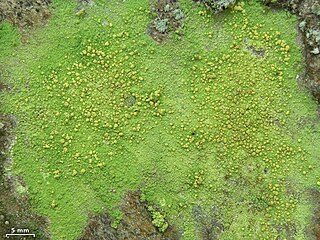
Psilolechia lucida is a species of saxicolous lichen in the family Psilolechiaceae. It is widely distributed through the world, where it grows on natural and artificial rocky substrates in the shade, often in sheltered underhangs. It forms a greenish crust on the surface of its substrate.

Umbilicaria hyperborea, commonly known as blistered rock tripe, is a species of foliose lichen in the family Umbilicariaceae. It is widely distributed in arctic and alpine regions.
Heteroplacidium zamenhofianum is a species of lichenicolous (lichen-eating) lichen in the family Verrucariaceae. As a juvenile, it is parasitic on some members of the lichen genus Staurothele, but later becomes independent and develops a brown, crustose thallus. Characteristic features of the lichen include its dark brown, somewhat squamulous thallus and relatively small ascospores. It is widely distributed in Europe and North America.
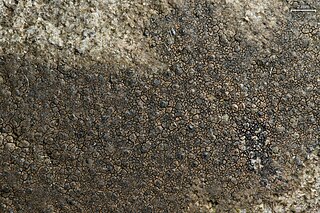
Willeya is a genus of saxicolous (rock-dwelling), crustose lichens in the family Verrucariaceae. It has 12 species. Most species are found in southeast Asia, although individual representatives are known from Australia, Europe, and North America.

Placidium arboreum, commonly known as the tree stipplescale, is a species of corticolous (bark-dwelling), squamulose (scaley) lichen in the family Verrucariaceae. Placidium arboreum is primarily found in the southeastern United States, but it also has occurrences in the western and northeastern United States, Mexico, the West Indies, Argentina, and Ontario, Canada. In its habitat, it typically grows at the base of hardwood trees, particularly oak species, and can occasionally be found on other tree genera or even over mosses on limestone. Its preferred substrate is the bark of oak trees, and the lichen usually establishes itself in bark crevices.
Staurothele elenkinii is a species of saxicolous (rock-dwelling) lichen in the family Verrucariaceae. It was described as new to science by Ukrainian lichenologist Alfred Oxner in 1927, from the steppes of Ukraine. In 2013 it was recorded from the northeast Caucasus, in Russia. It is also widespread on dry rocks in the North American west, ranging from the Northwest Territories south to the southwestern United States. It grows on shales, sandstones, and calcareous rocks.
Verrucaria oulankaensis is a rare species of saxicolous (rock-dwelling) crustose lichen in the family Verrucariaceae. It is found in north-eastern Finland, where it occurs on calcareous rocks on river shores.
Staurothele nemorum is a species of saxicolous (rock-dwelling) lichen in the family Verrucariaceae. Found in the United States, it was formally described as a new species in 2019 by Caleb Morse and Douglas Ladd. The type specimen was collected from the University of Kansas Ecological Reserves, in Baldwin City (Kansas). The species epithet nemorum, which combines the Latin roots nemus and -oris, alludes to the habitat of this lichen. It occurs in the southern Great Plains in central North America, and has been collected in the states of Kansas, Missouri, Oklahoma, and Texas. It prefers dry sites, often on south- and west-facing exposures, where it grows on pebbles and cobbles of limestone and calcareous sandstone.

Polycauliona bolacina, the waxy firedot lichen, is a species of saxicolous (rock-dwelling), crustose lichen in the family Teloschistaceae. It is found in western North America.

Tomnashia luteominia, the red firedot lichen, is a species of saxicolous (rock-dwelling), crustose lichen in the family Teloschistaceae. It is widely distributed along the North American west coast. The lichen has two varieties: var. bolanderi has distinctive red apothecia, while var. luteominia has orange-brown apothecia.

Hydropunctaria amphibia is a species of saxicolous (rock-dwelling), crustose lichen in the family Verrucariaceae. One of several marine lichens in the genus Hydropunctaria, is widely distributed across Europe, extending from Norway to the Mediterranean and the Iberian coasts, and has a nearly ubiquitous presence along the Catalan coast of Spain. In North America, it is found along the Atlantic Coast from Nova Scotia to the Boston Harbor islands, where its presence in low-pollution areas indicates its potential as a bioindicator for marine lichen community health, and on the west coast in British Columbia, particularly in the Gwaii Haanas's upper littoral fringe. The black, crust-like thallus grows on seashore rocks – both siliceous rocks and limestone – in the lower supralittoral zone, an area also known as the splash zone. Originally described more than two centuries ago as a species of Verrucaria, Hydropunctaria amphibia sets itself apart from other species in Hydropunctaria through the distinct shape of the perithecium apex, which is either flat-topped or scalloped, in contrast to the typically rounded or immersed apex seen in its relatives.

Umbilicaria angulata, commonly known as the asterisk rocktripe, is a species of saxicolous (rock-dwelling), foliose lichen in the family Umbilicariaceae. It is found in northwestern North America and east Eurasia, where it grows on acidic rock.

Melanelia hepatizon, commonly known as the rimmed camouflage lichen or the rimmed brown-shield, is a species of saxicolous (rock-dwelling), foliose lichen in the family Parmeliaceae. Its thallus, ranging in colour from brown to black, features narrow, elongated lobes that can be flat, convex, or concave. This lichen has a circumpolar distribution, occurring in Asia, Europe, North America, Iceland, and Greenland.

