
Miletus symethus, the great brownie, is a small butterfly found in India that belongs to the lycaenids or blues family. The species was first described by Pieter Cramer in 1777.

Azanus jesous, the African babul blue or topaz-spotted blue, is a small butterfly found in Africa, Egypt, Syria, India, Sri Lanka and Myanmar that belongs to the lycaenids or blues family.

Mesapamea secalis, the common rustic, is a moth of the family Noctuidae. The species was first described by Carl Linnaeus in his 1758 10th edition of Systema Naturae. It is found in Europe, north-west Africa, Turkey and northern Iran.
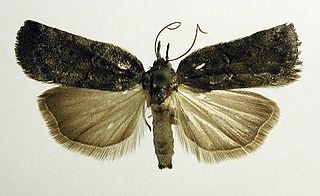
Nycteola revayana, the oak nycteoline, is a moth of the family Nolidae. The species was first described by Giovanni Antonio Scopoli in 1772. It is found from Europe and east across the Palearctic to Japan and India.

Cosmopterix abnormalis is a moth of the family Cosmopterigidae. It is known from the Cayman Islands, Haiti and Jamaica.

Cosmopterix etmylaurae is a moth of the family Cosmopterigidae. It is known from Costa Rica.

Cosmopterix montisella is a moth of the family Cosmopterigidae. It is known from the United States, where it is found from New York and Oregon south to New Mexico, Arizona and California. Single specimens have been collected in Arkansas and Iowa. The species is now also established in Michigan.
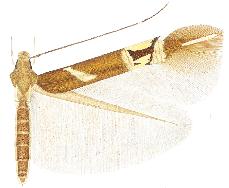
Cosmopterix nitens is a moth of the family Cosmopterigidae. It is known from the United States, where it is found from coastal South Carolina to south-western Texas. It is also established in Michigan.
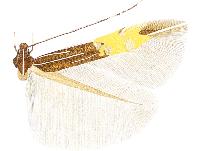
Cosmopterix opulenta is a moth of the family Cosmopterigidae. It is known from the United States and Costa Rica.

Cosmopterix similis is a moth of the family Cosmopterigidae. It is known from the US Virgin Islands and the British Virgin Islands (Guana).

Cosmopterix sinelinea is a moth of the family Cosmopterigidae. It is known from South Carolina, United States.
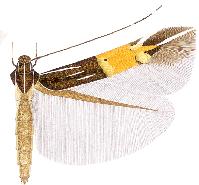
Cosmopterix taygete is a moth of the family Cosmopterigidae. It is known from Bahia, Brazil.

Pebobs kale is a moth of the family Cosmopterigidae. It is known from Peru and Trinidad and Tobago.

Hellinsia inquinatus is a moth of the family Pterophoridae. It is found in North America, including Florida, Mississippi, Oklahoma, Tennessee, Maryland, Alabama, Texas, Missouri, Colorado and Arizona. It has also been recorded from Hispaniola, Mexico, Puerto Rico and St. Thomas Island.
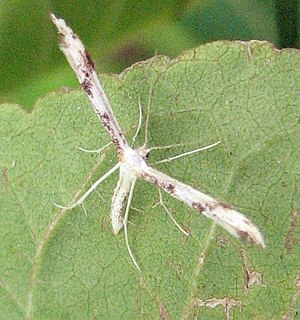
Adaina montanus is a moth of the family Pterophoridae. It is found in North America, including south-eastern Canada and the north-eastern United States.

Elaphria venustula is a moth of the family Noctuidae. It is found in most of Europe, except the north. In the east, the range extends through the Palearctic to the Pacific Ocean.
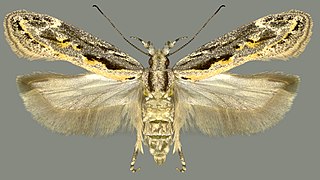
Ornativalva plutelliformis is a moth of the family Gelechiidae. It was described by Staudinger in 1859. It is found from southern Europe and North Africa east to western Asia and China (Xinjiang).
Aristotelia squamigera is a moth of the family Gelechiidae. It was described by Walsingham in 1909. It is found in Mexico (Guerrero).
Symmoca calidella is a moth in the family Autostichidae. It was described by Walsingham in 1905. It is found in Algeria.
Psittacastis stigmaphylli is a moth in the family Depressariidae. It was described by Lord Walsingham in 1912. It is found on Jamaica.

