
Włocławek is a city in the Kuyavian–Pomeranian Voivodeship in central Poland along the Vistula River, bordered by the Gostynin-Włocławek Landscape Park. As of December 2021, the population of the city is 106,928.

Zamość is a historical city in southeastern Poland. It is situated in the southern part of Lublin Voivodeship, about 90 km (56 mi) from Lublin, 247 km (153 mi) from Warsaw. In 2021, the population of Zamość was 62,021.
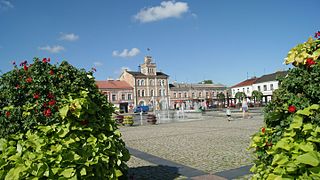
Skierniewice is a city in central Poland with 47,031 inhabitants (2021), situated in the Łódź Voivodeship. It is the capital of Skierniewice County. The town is situated almost exactly halfway between Łódź and Warsaw. Through the town runs the small river Łupia, also called Skierniewka.

Łowicz is a town in central Poland with 27,436 inhabitants (2021). It is situated in the Łódź Voivodeship. Together with a nearby station of Bednary, Łowicz is a major rail junction of central Poland, where the line from Warsaw splits into two directions—towards Poznań, and Łódź. Also, the station Łowicz Main is connected through a secondary-importance line with Skierniewice.

Biłgoraj is a town in south-eastern Poland with 25,838 inhabitants as of December 2021. Since 1999 it has been situated in Lublin Voivodeship; it was previously located in Zamość Voivodeship (1975–1998). It is located south of Lublin and it is also the capital of Biłgoraj County. Historically, the town belongs to Lesser Poland, and is located in southeastern corner of the province, near the border with another historic land, Red Ruthenia. Biłgoraj is surrounded by a forest, with three rivers flowing through it.
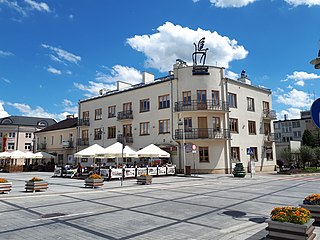
Piaseczno is a town in east-central Poland with 47,660 inhabitants. It is situated in the Masovian Voivodeship, within the Warsaw metropolitan area, just south of Warsaw, approximately 16 kilometres south of its center. It is a residential area and a suburb of Warsaw. It is the capital city of Piaseczno County.

Gęsiówka is the colloquial Polish name for a prison that once existed on Gęsia ("Goose") Street in Warsaw, Poland, and which, under German occupation during World War II, became a Nazi concentration camp.

Kraków Old Town is the historic central district of Kraków, Poland. It is one of the most famous old districts in Poland today and was the centre of Poland's political life from 1038 until King Sigismund III Vasa relocated his court to Warsaw in 1596.
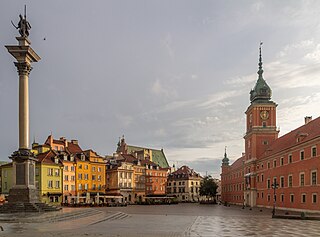
Warsaw Old Town, also known as Old Town, and historically known as Old Warsaw, is a neighbourhood, and an area of the City Information System, in the city of Warsaw, Poland, located within the district of Śródmieście. It is the oldest portion of the city, and contains numerous historic buildings, mostly from 17th and 18th centuries, such as the Royal Castle, city walls, St. John's Cathedral, and the Barbican, the Old Town Market Square and the Warsaw Mermaid Statue. The settlement itself dates back to between the 13th and 14th centuries, and was granted town privileges c. 1300.
The ideas of the Age of Enlightenment in Poland were developed later than in Western Europe, as the Polish bourgeoisie was weaker, and szlachta (nobility) culture (Sarmatism) together with the Polish–Lithuanian Commonwealth political system were in deep crisis. The period of Polish Enlightenment began in the 1730s–40s, peaked in the reign of Poland's king, Stanisław August Poniatowski, went into decline with the Third Partition of Poland (1795) – a national tragedy inspiring a short period of sentimental writing – and ended in 1822, replaced by Romanticism.

Stanisław Mokronowski (1761-1821) was a prominent member of the Polish landed gentry of Bogoria coat of arms. A general of the Polish Army and a royal Chamberlain, Mokronowski took part in both the Polish–Russian War of 1792 and Kościuszko's Uprising of 1794.
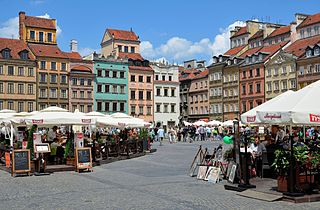
Warsaw's Old Town Market Place is the center and oldest part of the Old Town of Warsaw, Poland. Immediately after the Warsaw Uprising, it was systematically blown up by the German Army. After World War II, the Old Town Market Place was restored to its prewar appearance.

Tadeusz Pankiewicz, was a Polish Roman Catholic pharmacist, operating in the Kraków Ghetto during the Nazi German occupation of Poland. He was recognized as "Righteous Among the Nations" by Yad Vashem on February 10, 1983, for rescuing countless Jews from the Holocaust.
The Generation of Columbuses is a term denoting the generation of Poles who were born soon after Poland regained its independence in 1918, and whose adolescence was marked by World War II.

Mieczysław Jan Ireneusz Lubelski was a Polish monumental sculptor and ceramicist. In Poland he was part of the Poznań-based art movement, Świt, (Dawn). He was the author of many public sculptures and monuments, as well as of Religious art in several Polish cities, many of which did not survive the war. A Holocaust survivor, he was hidden by Catholic clergy in Kielce, took part in the Warsaw Uprising and after captivity in a German POW camp, resumed the final years of his career in the United Kingdom. After World War II he became especially known for the Polish Air Force Memorial in Northolt, and for reinstating some of his shattered work in Communist Poland. He also took on interior ceramic designs for exiled Poles in London.

Dawid Moryc Apfelbaum, sometimes also known as Mieczysław Dawid Apfelbaum, is a disputed soldier who some contend was incorrectly credited as the commander of the Jewish Military Union that fought in the 1943 Warsaw Ghetto Uprising, during the Second World War. It is claimed that he died on 28 April 1943. Some allege he also served as a lieutenant of the Polish Armed Forces prior to the conflict.

Powązki Military Cemetery is an old military cemetery located in the Żoliborz district, western part of Warsaw, Poland. The cemetery is often confused with the older Powązki Cemetery, known colloquially as "Old Powązki". The Old Powązki cemetery is located to the south-east of the military cemetery.

Jan Kiliński Monument is a monument in Warsaw, Poland, located on Podwale Street, next to the intersection with Piekarska Street, in the Old Town neighbourhood of the Downtown district. The 8-metre-tall monument consists of a 4-metre-tall bronze statue of Jan Kiliński, a 19th-century artisan, politician, and rebel, who was a colonel in the insurgents forces during the Kościuszko Uprising, placed on a granite pedestal. It was designed by Stanisław Jackowski, and unveiled on 19 April 1936 at the Krasiński Square. It was removed from there in 1942, during the German occupation, and reinstalled in 1946. The monument was moved to its current location in 1959.

Plac Wolności, known in English as Liberty Square, is an octagonal public square located in central Łódź, Poland. Completed in 1823, it is the northern endpoint of the commercial Piotrkowska Street. Its present name commemorates Poland regaining its independence in 1918.
