
Standard anatomical terms of location deal unambiguously with the anatomy of animals, including humans. Terms used generally derive from Latin or Greek roots and used to describe something in its standard anatomical position. This position provides a definition of what is at the front ("anterior"), behind ("posterior") and so on. As part of defining and describing terms, the body is described through the use of anatomical planes and anatomical axes.

Jumping spiders or the Salticidae are a family of spiders. As of 2019, it contained over 600 described genera and over 6000 described species, making it the largest family of spiders at 13% of all species. Jumping spiders have some of the best vision among arthropods and use it in courtship, hunting, and navigation. Although they normally move unobtrusively and fairly slowly, most species are capable of very agile jumps, notably when hunting, but sometimes in response to sudden threats or crossing long gaps. Both their book lungs and tracheal system are well-developed, and they use both systems. Jumping spiders are generally recognized by their eye pattern. All jumping spiders have four pairs of eyes, with the anterior median pair being particularly large.

Tord Tamerlan Teodor Thorell was a Swedish arachnologist.
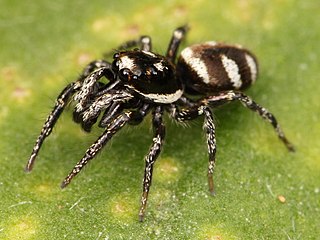
The zebra spider is a common jumping spider of the Northern Hemisphere. Like other jumping spiders it does not build a web. It has a particularly large pair of forward facing eyes that help it to locate and stalk its prey before pouncing on it. Their common name refers to their vivid black-and-white colouration, whilst their scientific name derives from Salticus from the Latin for “dancing”, in reference to their agility, and the Greek scenicus, translating to “theatrical” or “of a decorative place,” in reference to the flashy, zebra-like coloration of the species.
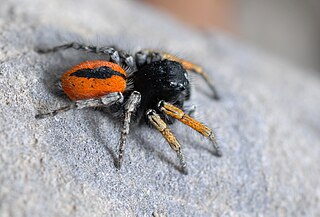
Philaeus chrysops is a species of jumping spider (Salticidae).

Portia labiata is a jumping spider found in Sri Lanka, India, southern China, Burma (Myanmar), Malaysia, Singapore, Java, Sumatra and the Philippines. In this medium-sized jumping spider, the front part is orange-brown and the back part is brownish. The conspicuous main eyes provide vision more acute than a cat's during the day and 10 times more acute than a dragonfly's, and this is essential in P. labiata′s navigation, hunting and mating.

Phaeacius is a spider genus of the family Salticidae, found in sub-tropical China and between India and the Malay Peninsula, including Sri Lanka, Sumatra and the Philippines. Although other spiders can jump, salticids including Phaeacius have significantly better vision than other spiders, and their main eyes are more acute in daylight than a cat's and 10 times more acute than a dragonfly's. The main eyes focus accurately on an object at distances from approximately 2 centimetres (0.79 in) to infinity, and in practice can see up to about 75 centimetres (30 in). They do not spin webs.

Poultonella is a genus of American jumping spiders that was first described by George and Elizabeth Peckham in 1909. As of August 2019 it contains only two species, found only in the United States: P. alboimmaculata and P. nuecesensis. It is named in honor of Edward Bagnall Poulton.

Talavera is a genus of very small jumping spiders that was first described by George and Elizabeth Peckham in 1909. They average about 2 millimetres (0.079 in) in length, and are very similar to each other. In particular, the Central European species are difficult to distinguish, even when their genital features are studied under a microscope. The name refers to Talavera, a region of Spain where many have been found.

The anatomy of spiders includes many characteristics shared with other arachnids. These characteristics include bodies divided into two tagmata, eight jointed legs, no wings or antennae, the presence of chelicerae and pedipalps, simple eyes, and an exoskeleton, which is periodically shed.

Myrmaplata plataleoides, also called the Kerengga ant-like jumper, is a jumping spider that mimics the Kerengga or weaver ant in morphology and behaviour. This species is found in India, Sri Lanka, China and many parts of Southeast Asia.

Maevia inclemens is a relatively common and colorful jumping spider of North America. In the males there are two forms, a very rare phenomenon in zoology. These use different courting displays, and differ in appearance: the "tufted" morph has a black body and pedipalps ("palps"), three black tufts across its "head", and pale legs; and the "gray" morph has black and white stripes all over its body and legs, orange palps, and no tufts. However, each form accounts for 50% of the adult males, and they are equally successful in mating. A female of Maevia inclemens is 6.5 to 8.0 millimetres long, while males are 4.75 to 6.50 millimetres long.

Spiders are air-breathing arthropods that have eight legs, chelicerae with fangs generally able to inject venom, and spinnerets that extrude silk. They are the largest order of arachnids and rank seventh in total species diversity among all orders of organisms. Spiders are found worldwide on every continent except for Antarctica, and have become established in nearly every habitat with the exceptions of air and sea colonization. As of July 2019, at least 48,200 spider species, and 120 families have been recorded by taxonomists. However, there has been dissension within the scientific community as to how all these families should be classified, as evidenced by the over 20 different classifications that have been proposed since 1900.
This glossary describes the terms used in formal descriptions of spiders; where applicable these terms are used in describing other arachnids.

Carrhotus xanthogramma is a species of 'jumping spiders' belonging to the family Salticidae.
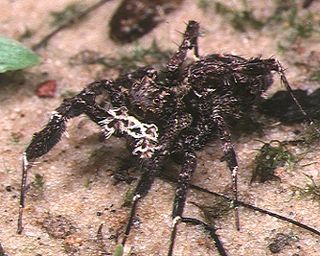
Portia fimbriata, sometimes called the fringed jumping spider, is a jumping spider found in Australia and Southeast Asia. Adult females have bodies 6.8 to 10.5 millimetres long, while those of adult males are 5.2 to 6.5 millimetres long. Both sexes have a generally dark brown carapace, reddish brown chelicerae ("fangs"), a brown underside, dark brown palps with white hairs, and dark brown abdomens with white spots on the upper side. Both sexes have fine, faint markings and soft fringes of hair, and the legs are spindly and fringed. However, specimens from New Guinea and Indonesia have orange-brown carapaces and yellowish abdomens. In all species of the genus Portia, the abdomen distends when the spider is well fed or producing eggs.

Portia schultzi is a jumping spider which ranges from South Africa in the south to Kenya in the north, and also is found in West Africa and Madagascar. In this species, which is slightly smaller than some other species of the genus Portia, the bodies of females are 5 to 7 mm long, while those of males are 4 to 6 mm long. The carapaces of both sexes are orange-brown with dark brown mottling, and covered with dark brown and whitish hairs lying over the surface. Males have white tufts on their thoraces and a broad white band above the bases of the legs, and these features are less conspicuous in females. Both sexes have tufts of orange to dark orange above the eyes, which are fringed with pale orange hairs. Males' abdomens are yellow-orange to orange-brown with blackish mottling, and on the upper sides are black and light orange hairs, and nine white tufts. Those of females are pale yellow and have black markings with scattered white and orange-brown hairs on the upper side. P. schultzi has relatively longer legs than other Portia, and a "lolloping" gait.
Portia africana is a jumping spider found in Angola, Cameroon, the Central African Republic, Gabon, Ghana, the Ivory Coast, Sierra Leone, Zaire and Zambia. Its conspicuous main eyes provide vision more acute than a cat's during the day and 10 times more acute than a dragonfly's, and this is essential in P. africana′s navigation, hunting and mating.

Oxyopes lineatus is a species of spider in the family Oxyopidae, the so-called lynx spiders.

Hypochilus thorelli is a species of spider in the family Hypochilidae. Unlike almost all other araneomorph or "true" spiders, members of the family have four book lungs. They are often called "lampshade spiders" because of the shape of their webs which are usually built underneath ledges or projections. H. thorelli is found in the southern Appalachian Mountains of the eastern United States.


