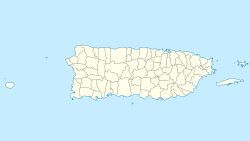
Vega Baja barrio-pueblo is a barrio and downtown area that serves as the administrative center (seat) of Vega Baja, a municipality of Puerto Rico. Its population in 2010 was 816.
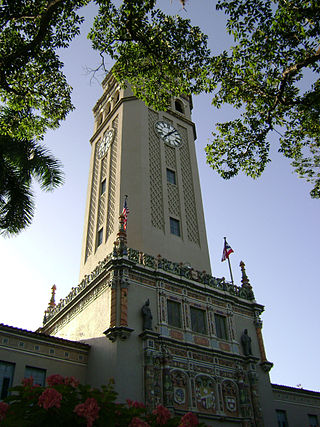
Roosevelt Tower, more popularly known as La Torre, is a 173.54 feet clock tower located above the main entrance to the Baldorioty de Castro Building in the University of Puerto Rico, Río Piedras Campus. The tower is also referred to as El Faro and it is considered a symbol of the University of Puerto Rico and of higher education in Puerto Rico. The tower, along with the main historic quadrangle in campus, have been listed on the National Register of Historic Places since 1984, and on the Puerto Rico Register of Historic Sites and Zones since 2000.

Villa Del Mar, popularly known as El Castillo, is a historic 1917 residence located in Naguabo, Puerto Rico, in the vicinity of the Malecón of Naguabo.

The Church of Nuestra Señora de las Mercedes de San Miguel de Hato Grande, also known as the Church Las Mercedes of San Lorenzo, is a historic Roman Catholic parish church located in San Lorenzo Pueblo, the administrative and historic center of the municipality of San Lorenzo, Puerto Rico. Las Mercedes was named in honor of both the Virgin Mary and Doña Mercedes Delgado Manso, the wife of the then mayor of San Lorenzo and a descendant of Don Sebastián Delgado Manso, one of the founders of the city of Caguas.
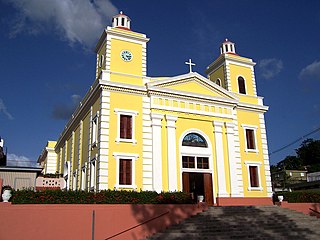
The Church of Saint Michael the Archangel of Utuado is a historic Roman Catholic parish church located in Utuado Pueblo, the administrative and historic center of the municipality of Utuado, Puerto Rico. The church is listed in the Inventory of the Historic Churches of Puerto Rico, the Puerto Rico Register of Historic Sites and Zones and the United States National Register of Historic Places due to its architectural and historical significance.

The Church Nuestra Señora del Rosario of Naguabo is a historic 19th-century Roman Catholic parish church located in Naguabo Pueblo, the administrative and historic center of the municipality of Naguabo, Puerto Rico.
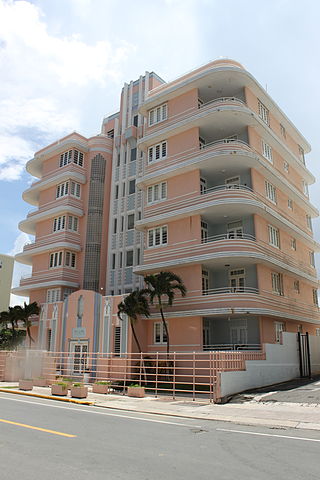
The Miami Building, also known as the Miami Apartments or the 868 Ashford Building, is a historic Art Deco building located in the Avenida Ashford of the Condado section of Santurce in the city of San Juan, Puerto Rico. The building was added to the National Register of Historic Places in 1984 and to the Puerto Rico Register of Historic Sites and Zones in 1995.

The González Vivaldi Residence is a late 19th-century historic house located in Yauco Pueblo, the administrative and historic center of the municipality of Yauco, Puerto Rico. The house was built in 1880 in the traditional Criollo vernacular style with elements of Neoclassical and Art Nouveau architecture that was typical to the private residences of wealthy landowners of the region at the time. The structure combines masonry and wood, with well-preserved wooden interiors that have not been altered since its construction. The house was added to the National Register of Historic Places in 1987 and to the Puerto Rico Register of Historic Sites and Zones in 2001.

Teatro Ideal, also known as La Plaza Theater, is a historic theater and performing arts venue located in the main town square of Yauco Pueblo, the administrative and historic center of the municipality of Yauco, Puerto Rico. The theater was added to the National Register of Historic Places in 1988, and to the Puerto Rico Register of Historic Sites and Zones in 2001.

The Heygler Residence is a historic 19th-century house located in Mayagüez Pueblo, the administrative and historic center of the municipality of Mayagüez, Puerto Rico. The house is notable for its arcade-balcony that is typical of 19th-century urban residences in western Puerto Rico and has been listed in the National Register of Historic Places since 1988. It was also added to the Puerto Rico Register of Historic Sites and Zones.
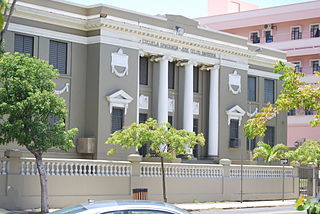
The José Celso Barbosa Graded School is a historic school building located in the Puerta de Tierra historic district in the city of San Juan, Puerto Rico. The school is named after Puerto Rico statehood movement founder Dr. José Celso Barbosa and has been listed in the National Register of Historic Places since 1989, and on the Puerto Rico Register of Historic Sites and Zones since 2000. The school was built between 1924 and 1927 and designed by the firm del Valle & Co. in a Neoclassical-style with the intention of making it a public secondary school for recently graduated students from the nearby Brambaugh School. It forms part of the monumental sequence of buildings and memorials that contribute to the Puerta de Tierra Historic District, which also includes the Capitol of Puerto Rico.
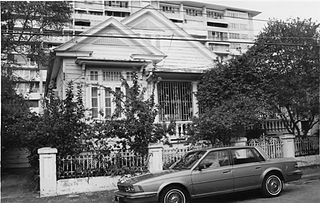
665 McKinley Street is a historic Spanish Creole vernacular-style house located in Miramar, a historic residential area of Santurce in the city of San Juan, Puerto Rico. The house was built in 1906 during a transitional period in the history of architecture in Puerto Rico when the local adaptations of Spanish vernacular styles were transitioning into the Spanish Revival styles that was being imported from the United States and adapted into the tropical environments of the island. The house is well-preserved and retains all elements of this period and, with the exception of the rear balcony, no modifications or alterations that modify the architectural integrity have been made. For this reason, it was added to the National Register of Historic Places in 1991, and on the Puerto Rico Register of Historic Sites and Zones in 2000.
The second Delerme-Anduze House, also known as the Rosendo Delerme House at 355 Antonio Mellado Street, is a historic 19th-century Spanish Creole-style house located in Isabel Segunda, the largest and main administrative and historic settlement of the island-municipality of Vieques, Puerto Rico. Local historical accounts such as "The Immigrations to Vieques, 1823-1898", describe the residence as the second house in Vieques to be owned by Augusto Neré Delerme, a wealthy French immigrant from Guadeloupe who built it in 1876 as a wedding gift for his wife Cecilia Anduze, a native of Saint Thomas. The house was lived by their son Julio Delerme-Anduze and afterwards by his descendants. The residence was added to the National Register of Historic Places and the Puerto Rico Register of Historic Sites and Zones for its architectural and historical significance as it represents a prime example of Spanish vernacular architecture with elements of the French Creole architecture from the West Indies that was popular in Vieques at the time.
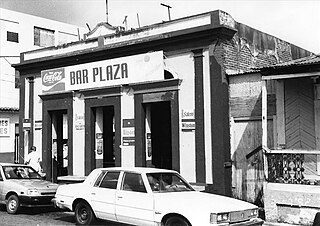
Vieques Pharmacy refers to a historic building that has formerly housed a pharmacy and the main post office of the island-municipality of Vieques, Puerto Rico. The building is located in front of the main town square of Isabel Segunda, the main settlement and administrative center of Vieques. The building is a one-story masonry structure originally intended to be a commercial building. It dates to 1898 when it functioned as a pharmacy, the then called Farmacia de Vieques Liberty Drug underwent remodeling between 1900 and 1903 when the building was under the ownership of Victor Molinary Duteil, a French-Puerto Rican pharmacist and vice-consul of Denmark in Vieques. He was responsible for strengthening the diplomatic and economic ties between Vieques and the then Danish Virgin Islands and later, during and after the Spanish-American War, he helped establish various federal institutions in the island such as a post office and worked as an official translator for the U.S. government until 1910 when he was elected mayor of the island-municipality. Throughout the rest of its history the building continued to serve as a convenience store and as a bar. The building today maintains its architectural integrity and today is the oldest and best-preserved building of its type in Vieques, and the building was added to the National Register of Historic Places in 1994, and to the Puerto Rico Register of Historic Sites and Zones in 2001.

The Vieques City Hall, also known as the Vieques Municipal House and formerly known as Casa del Rey, is a historic civic building located in the main town square of Isabel Segunda, the administrative center and main settlement of the island-municipality of Vieques, Puerto Rico. It was added to the National Register of Historic Places in 1994, and to the Puerto Rico Register of Historic Sites and Zones in 2001.
The Rafael Acevedo House, also called the Mirella Acevedo Sanes House, is a historic residence located in the town of Isabel Segunda, the largest settlement in the Puerto Rican island-municipality of Vieques. It was designed and built in 1900 by Pedro Peterson, a local engineer and master builder. The residence was added to the National Register of Historic Places in 1994 and to the Puerto Rico Register of Historic Sites and Zones in 2001 for being the best-preserved hipped-gable house in Vieques and for being a superb example of the vernacular trends that represent the result of different architectural imports from the British and French West Indies into the Spanish Caribbean.
The Jaime Puig Lemoine Residence, also known as the Carmen Puig Residence, is a historic Bungalow/Craftsman-style house located in the town of Isabel Segunda, the largest settlement in the Puerto Rican island-municipality of Vieques. It was built in 1930 by Catalan and French-Puerto Rican architect Jaime Puig Lemoine in the American Craftsman style, an architectural style that was successfully imported from the United States to Puerto Rico during the first half of the 20th century. It also incorporates elements of Modernism and the local Spanish Creole vernacular architectures. It was added to the National Register of Historic Places in 1994, and to the Puerto Rico Register of Historic Sites and Zones in 2001.

The Berta Sepúlveda House is a historic residence located in Sabana Grande Pueblo, the administrative and historic center of the municipality of Sabana Grande, Puerto Rico. It was designed by Mayagüez-native self-made architect Rafael Bofill and built between 1926 and 1927 in a traditional vernacular style with elements inspired by the newly emerging Modern architecture, particularly the Prairie-style. Its most distinctive feature is its wide curved balcony with its Tuscan-style columns. It was added to the National Register of Historic Places in 1994 and on the Puerto Rico Register of Historic Sites and Zones in 2000.
The J. J. María le Guillou Tombs, better known as the Guillou Tombs, refers to a historic graveyard consisting of six tombs belonging to the Le Guillou family, the founders of Isabel Segunda, the main town in the island-municipality of Vieques, Puerto Rico. The site, listed in the National Register of Historic Places in 1994 and on the Puerto Rico Register of Historic Sites and Zones in 2001, can be found in what is today the Puerto Diablo barrio, just outside of the town of Isabel Segunda. This is the site of a former sugarcane plantation, Hacienda La Pacience, the first of its kind to be established in the island of Vieques. It was established by Teófilo José Jaime María Le Guillou, a Spanish-naturalized French immigrant from Quimperlé, Brittany who is considered the founder of the modern municipality of Vieques. The site today consists of six individual tombs that were built between 1843 and 1855 in a Neoclassical style for the members of the Le Guillou family.

Figueroa Apartments, better known today as the Pinto-Lugo & Rivera Building, is a historic Art Deco-style building located in the Isla Grande district of Santurce in the city of San Juan, Puerto Rico. The apartments were built in 1935 based on an Art Deco design by architect Armando Morales Cano with elements Spanish Revival style. It was built at a time when the Miramar district of Santurce was rapidly expanding, specially along the Fernández Juncos and Ponce de León avenues. The building today is no longer residential, and it hosts private office spaces. It was added to the National Register of Historic Places in 2000 and to the Puerto Rico Register of Historic Sites and Zones in 2004.