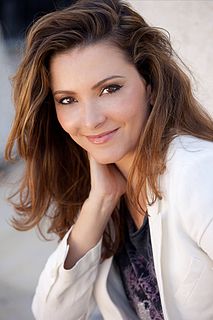
The Mother of Tears (Italian: La Terza madre, literally The Third Mother) is a 2007 Italian-American cultmysteryhorror film written and directed by Dario Argento, and starring Asia Argento, Daria Nicolodi, Moran Atias, Udo Kier and Coralina Cataldi-Tassoni. The film has also been billed in English-speaking media as Mater Lachrymarum, The Third Mother (English translation of the film's original Italian title) and Mother of Tears: The Third Mother.
Italian is a Romance language. Italian, together with Sardinian, is by most measures the closest language to Vulgar Latin of the Romance languages. Italian is an official language in Italy, Switzerland, San Marino and Vatican City. It has an official minority status in western Istria. It formerly had official status in Albania, Malta, Monaco, Montenegro (Kotor) and Greece, and is generally understood in Corsica and Savoie. It also used to be an official language in the former Italian East Africa and Italian North Africa, where it plays a significant role in various sectors. Italian is also spoken by large expatriate communities in the Americas and Australia. In spite of not existing any Italian community in their respective national territories and of not being spoken at any level, Italian is included de jure, but not de facto, between the recognized minority languages of Bosnia-Herzegovina and Romania. Many speakers of Italian are native bilinguals of both standardized Italian and other regional languages.
In modern English, the term cult has come to usually refer to a social group defined by its unusual religious, spiritual, or philosophical beliefs, or its common interest in a particular personality, object or goal. This sense of the term is controversial and it has divergent definitions in both popular culture and academia and it also has been an ongoing source of contention among scholars across several fields of study. It is usually considered pejorative.
A mystery film is a genre of film that revolves around the solution of a problem or a crime. It focuses on the efforts of the detective, private investigator or amateur sleuth to solve the mysterious circumstances of an issue by means of clues, investigation, and clever deduction.
Written by Argento, Jace Anderson, Walter Fasano, Adam Gierasch and Simona Simonetti, the film is the concluding installment of Argento's supernatural horror trilogy The Three Mothers, which began with Suspiria (1977) and succeeded by Inferno (1980). The film depicts the confrontation with the final "Mother" witch, known as Mater Lachrymarum.
Walter Fasano is an Italian film editor. Best known for his collaborations with director Luca Guadagnino, he rose to prominence for his work on the universally-acclaimed film Call Me by Your Name (2017), for which he received many awards and nominations.
The Three Mothers is a trilogy of supernatural horror films by Italian film director Dario Argento. It consists of Suspiria, Inferno and The Mother of Tears. Each film deals with one of the titular "Mothers", a triumvirate of ancient and evil witches whose powerful magic allows them to manipulate world events on a global scale.
Suspiria is a 1977 Italian supernatural horror film directed by Dario Argento, co-written by Argento and Daria Nicolodi, partially based on Thomas De Quincey's 1845 essay Suspiria de Profundis and co-produced by Claudio and Salvatore Argento. The film stars Jessica Harper as an American ballet student who transfers to a prestigious dance academy in Germany but realizes, after a series of brutal murders, that the academy is a front for a supernatural conspiracy. It also features Stefania Casini, Flavio Bucci, Miguel Bosé, Alida Valli, Udo Kier and Joan Bennett, in her final film role.
Plot
The film begins with members of the Catholic Church digging up the body of a 19th-century church official, whose casket has a box-shaped urn chained to it. Inside the box they discover artifacts belonging to Mater Lachrymarum (Moran Atias), the last surviving member of the Three Mothers; an ancient trio of powerful black magic witches. In particular, the box contains a magic cloak that, when worn by Mater Lachrymarum, increases her powers significantly.
Moran Atias is an Israeli actress and model. She gained fame in the Italian films Gas, Oggi sposi, and Mother of Tears. She is best known for her work with Paul Haggis in the 2008 TV series Crash and the 2013 film Third Person. She also starred on the FX television series Tyrant.
The urn is shipped to the Museum of Ancient Art in Rome where Sarah Mandy (Asia Argento), an American studying art restoration, works. Sarah is dating the curator Michael Pierce, a single father who is away from the museum that night. With help from the assistant curator, Sarah opens the box and finds the cloak, a dagger, and three statues representing the three witches. Sending Sarah to her office to retrieve tools to help her translate the text on the artifacts, the curator is promptly attacked by the demonic agents of Mater Lachrymarum. Sarah arrives too late to save her boss (who is being disembowelled by the monsters) and starts to flee the museum. Unfortunately, she is pursued by Mater Lachrymarum's familiar (a baboon) and is only able to escape when a disembodied voice magically throws open a series of locked doors keeping her trapped inside the museum. Sarah tells the police what happened as she spends the night with Michael and his son. Michael visits the Cardinal who sent him the urn only to find out that, shortly after mailing the urn to him, he had a severe stroke and is now in a coma. An assistant of the priest gives Michael a piece of paper, which the Cardinal was writing on before collapsing. On it is scrawled the name "Mater Lachrymarum". As he leaves the hospital, a pair of witches observe Michael leaving the building.
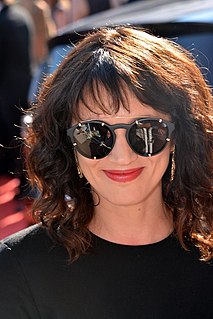
Asia Argento is an Italian actress and director. The daughter of filmmaker Dario Argento, she had roles in the films XXX (2002), Land of the Dead (2005) and Marie Antoinette (2006). She has won two David di Donatello awards for Best Actress for Let's Not Keep in Touch (1994) and Traveling Companion (1996).
Back in Rome, chaos descends as a wave of mass suicides, murder, and violence engulfs the city. Sarah continues her own research only to be summoned by Michael to his apartment. The witches have kidnapped his young son and won't return the boy to him unless he stops his investigation. Sarah begs him to call the police (who are tailing Sarah, ever since the murder at the museum) but Michael refuses to and instead opts to visit a local priest who is a trained exorcist. This goes badly for Michael; the two witches see him and he is soon captured and murdered, along with his son, whose body is cannibalized by the rapidly expanding coven. However, before he is killed, Michael calls Sarah and begs for her to come and help him. As she makes her way through a crowded train station, Sarah is spotted by a gang of witches who, like so many other witches, have arrived in Rome in order to pledge their loyalty to Mater Lachrymarum. Pursued by the witches and the police, the disembodied voice from before instructs Sarah on how to magically make herself invisible. She uses this to avoid the police detective, though she is forced to kill a witch, Katerina, who catches and corners her on the train.
At the priest's home, Sarah meets Marta, a fellow white witch and friend of Sarah's deceased mother. Realizing that Sarah's mother is the voice guiding her, Marta reveals details to Sarah about her parents. Her mother was a powerful white witch who dared to challenge and severely wound Mater Suspiriorum, the eldest and wisest of the Three Mothers. In response to this, Suspiriorum caused the fatal car crash that killed Sarah's parents. Though Mater Suspiriorum and her sister Mater Tenebrarum are now dead, their sibling Mater Lachrymarum has emerged from the shadows to bring about the second age of magic, with the fall of Rome as her coming out party. They talk to the priest, only for him to be killed before he can give the two a copy of a book that would explain Mater Lachrymarum's backstory to them by a patient of his. Escaping back to the city, Sarah goes to her own home but finds Mater Lachrymarum's goons waiting for her. She heads to Marta's house, but once again Mater Lachrymarum's minions strike and Marta and her lesbian lover are murdered. Fleeing, Sarah spots Michael, who takes her back to his apartment. Unfortunately, Sarah soon realizes that Michael is dead and that Mater Lachrymarum is animating his body in an attempt to kill her. As she burns her lover's still-animate body, the ghost of her mother intervenes one final time to grab Michael and banish him (and possibly herself) to Hell.
Sarah locates a powerful alchemist, who Marta mentioned as her only hope to learn how to fight Mater Lachrymarum. After being briefly paralyzed by the alchemist (so that he could perform a test on her to see if she was a white witch or an evil witch), the alchemist gives Sarah the only help he has in locating Mater Lachrymarum's dwelling. Sarah is given a copy of "The Three Mothers" to read, and from this (and from following a group of witches) Sarah finds Mater Lachrymarum's lair; a now run-down and disrepaired mansion. At this point, she is joined by one of the police detectives hunting her and the two go into the catacombs to find Mater Lachrymarum. However, the two become separated, and the detective is tortured alongside the alchemist and his assistant, who dies after his arm is chopped off by one of Mater Lachrymarum's minions. Sarah is caught and brought before Mater Lachrymarum, who offers Sarah up to her cannibal followers. Sarah, having healed the detective's wounds, uses a spear to pull the cloak off Mater Lachrymarum and tosses it into a nearby fire. This causes the mansion to collapse as a pillar falls and impales Mater Lachrymarum. With the Mother's followers crushed as the cave collapses, Sarah and the detective laugh in horror and shock as they reach the surface, as they realize that the threat of the Three Mothers has been defeated once and for all.
The Third Mother is the final film in Argento's trilogy known as The Three Mothers. The trilogy is loosely based on characters from "Levana and Our Ladies of Sorrow", a section of Thomas De Quincey's Suspiria de Profundis. The prose poem outlines the existence of three women that are the personification of sorrow: Mater Lachrymarum, Mater Suspiriorum and Mater Tenebrarum. Argento and Daria Nicolodi recast De Quincey's Three Sorrows as three malevolent witches who rule the world with tears, sighs and shadows. When released in 1977, the first film, Suspiria, introduced the major stylistic elements of the series, including the bold use of primary colors and elaborate setpieces for each murder. The sequel, Inferno, developed the overarching plot continuities concerning the three central witches when released in 1980.
Levana is an ancient Roman goddess involved in rituals pertaining to childbirth. Augustine says that dea Levana is invoked when the child is lifted de terra, from the earth or ground. Her function may be paralleled by the Greek Artemis Orthia, if interpreted as the Artemis who lifts or raises children.
Thomas Penson De Quincey was an English essayist, best known for his Confessions of an English Opium-Eater (1821). Many scholars suggest that in publishing this work De Quincey inaugurated the tradition of addiction literature in the West.
Suspiria de profundis is one of the best-known and most distinctive literary works of the English essayist Thomas De Quincey.
Nicolodi script (1980s)
As early as 1984 Daria Nicolodi asserted in an interview with Fangoria – alongside Argento – that they had "finished the script for the third [film] but there are a few things we are still working on to perfect the project, a couple of special effects and locations, that sort of thing."[1] Although Nicolodi mentioned her version of the script again in an interview for Alan Jones' book, Profondo Argento: The Man, the Myths and the Magic, it was not used in whole or part for The Third Mother.
Argento script (2003/4)
On 29 November 2003, at the Trieste Science Plus Fiction Festival in Northern Italy, Argento revealed that he hoped to start filming The Third Mother in August 2004 and was currently working on the script.[2] Thematically it concerned "mysticism, alchemy, terrorism and Gnosticism [...]. So many people were tortured because the Church said Gnosticism was heresy, and that will be the starting point for the story. [...] It has been over 20 years since I left the Three Mothers behind [...] and it has felt surprisingly good to go back and explore the whole story from a retrospective point of view."[2] The film was to be set in Rome and begin with Mater Lachrymarum in the Middle Ages.[2] Argento originally hoped to cast a Russian model in the role of Mater Lachrymarum.[2] (He later chose Israeli actress Moran Atias.[3]) Argento also said that a Hollywood studio might finance the film.[2]
Anderson and Gierasch script (2005/6)
In late 2005 Argento travelled to the North of Europe to begin conceptual work on The Third Mother.[4] Soon after, it was announced that Jace Anderson and Adam Gierasch had been asked by Argento to help him write the film's script. "When we got there [Rome,] Dario had already done his own pass on the treatment, and we spent three weeks holed up in an apartment, meeting with Dario, visiting the catacombs, and getting the first draft done."[5] Around this time, Fangoria reported that the film would be entitled Mater Lachrymarum.[6]
The script for The Third Mother was still being refined in February 2006, with Anderson and Gierasch having composed a first draft which Argento then revised.[7] This early script began immediately after Inferno, with a witch who survived the destruction of Mater Tenebrarum's home watching a detective (Ennio Fantastichini) investigating a series of murders at a University.[8] Other tentative cast members were Chiara Caselli as a psychiatrist, Max von Sydow as a mysterious university professor, and Giordano Petri as a young investigator who takes the case when Fantastichini's character is killed.[8] At this point, shooting was set to begin in late spring of the same year and was to be released between November 2006 and January 2007.[7] However, in early 2006 rumors circulated that Argento had dismissed Anderson and Gierasch after being displeased with their script. French horror magazine L'Écran Fantastique reported that Argento alone would receive a screenwriting credit. On the tenth of March it was announced that shooting The Third Mother would be delayed until September.[9] In mid-April it was announced that Argento would return to Italy in June to immediately begin filming The Third Mother, which would be "a big budget feature, produced by Medusa along with a major American company [Myriad]."[10] In May 2006 the title Mother of Tears surfaced as a possible name for the film. According to journalist Alan Jones, this title "was never in the running as far as Dario was concerned. That was the title the originally contacted American sales agent Myriad wanted for international distribution."[3] In the same month, rumors from the Cannes Film Festival linked actress Sienna Miller to the film's lead female role.[11] Also at Cannes, Medusa's CEO Giampaolo Letta was quoted by Anderson and Gierasch as saying "This is going to be vintage Argento. Pretty strong stuff."[12] In July it was revealed that The Third Mother had been delayed yet again until "next November or later" and that Argento's daughter, Asia, had been cast in the film.[13]
Filming
Primary filming in Rome on 25 October 2006. In this scene, a mother throws her baby from a bridge in a fit of aberration brought on by the return of the Third Mother
In mid October 2006, Gierasch revealed that The Third Mother would finally begin filming later in the month.[14] Primary filming occurred in Rome, although some parts were filmed in Turin and at the studios of Cinecittà at Terni.[15]
This section needs expansion. You can help by adding to it.(June 2008)
Post-production
The editing of The Third Mother was more or less finished by March 2007.[16] Dubbing the soundtrack into the Italian and English language versions of the film was finished on 5 April 2007.[15]
The film's digital effects were created by Lee Wilson and Sergio Stivaletti.[15] According to the director of photography, Frederic Fasano, the film will begin with a subdued cool color palette that will segue to red as the film progresses.[3]
The Italian distributor of The Third Mother, Medusa Film, believed the film was too violent and requested it to be edited.[17] Medusa's main objection is to "the depiction of perverse sex in the witch gathering satanic scenes and one cannibal killing of a major character."[18] Argento was asked to re-edit the film to make it more mainstream.[18] It was confirmed on 28 May 2007 that the film would receive a rating of 14 in Italy, necessitating the removal of "all hardcore gore" which would later "be re-instated for the dvd release."[19]
Promotion
Promotion of The Third Mother before Cannes 2007 was limited. Several behind-the-scenes photographs surfaced, the first official one at Fangoria on 27 November 2006.[20] A short, eighteen-second preview of The Third Mother was released on 18 December 2006 at Cinecitta.com.[21] Several black-and-white photographs of the filming were published on 19 January 2007 in the book Dario Argento et le cinéma by Bernard Joisten.[22] In May 2007, just before the event at Cannes, a promotional poster for The Third Mother was featured on the cover of Variety magazine's digital edition. The Third Mother premiered at the Toronto International Film Festival on 6 September 2007, just moments before midnight and Argento's 67th birthday (on the 7th).[23] The film debuted in Italy on 24 October 2007 at the Rome Film Festival.[24] Its Italian wide release occurred on 31 October 2007, Halloween.[17] In the United States, Myriad Pictures released the film uncut in select cities in June 2008.[25]
Cannes 2007
The Cannes Film Festival requested that The Third Mother be ready in time for consideration as a 2007 competition contender.[3] However, the film was not screened in its entirety at the festival. On 17 May 2007 at 9:30am Myriad premiered 20 minutes of footage from the film, consisting of eight lengthy scenes, to a packed audience.[26] The preview was preceded by a credit roll and disclaimer that warned of graphic violence.[26] The eight scenes included: the complete beginning to the point where Asia opens the Mother of Tears urn, the arrival of several demons, Daria Nicolodi's "powder puff" scene, a lesbian death scene, Udo Kier's major scene, Asia running through the streets of Rome, Adam James' major scene, and the entrance of Mater Lachrymarum.[26] According to reporter Alan Jones the audiences' reaction was mixed: the acting quality varied and the script contained too much exposition, but the cinematography was beautiful.[26]
Post-Cannes
The day after the Cannes screening, on 18 May at 3:45pm, co-scripter Jace Anderson and actress Coralina Cataldi-Tassoni were on The Third Mother discussion panel at Fangoria's Weekend of Horrors convention on the West Coast.[27] On 27 May, a second promotional poster – featuring an eye weeping tears of blood – surfaced on the internet bearing only the title Mother of Tears.[28] In early June, a teaser trailer for The Third Mother was attached to Grindhouse in Italy. Camera-recorded copies of the trailer surfaced soon afterward on the internet. The Cannes promo reel was also screened during Fangoria's Weekend of Horrors East Coast convention in Secaucus, New Jersey on 1 July at 12:15pm[29] Cataldi-Tassoni introduced the footage.[29] Pirated stills and audio from the preview surfaced the same day on the forum of the Dario Argento fansite DarkDreams.org.[30] In late August, an American trailer for the film was screened at the Rue Morgue Festival of Fear.
US release
The film had its US premiere at the San Francisco International Film Festival on 25 April 2008. This was followed by a limited theatrical run in June courtesy of Myriad Pictures and a DVD release by The Weinstein Company via Dimension Extreme DVDs on 23 September 2008.
Response
Critical reaction
Critical response was mixed, although many reviewers felt the film, despite its flaws, was entertaining. The review aggregator website Rotten Tomatoes reports a 49% approval rating based on 73 reviews, with an average rating of 5.3/10. The website's consensus reads, "As excessive and ketchup laden as predecessors Suspiria and Inferno, Dario Argento's Mother of Tears completes the trilogy with the same baroque grandeur and soggy 1970s sensibilities."[31] On Metacritic, the film has a score of 52 out of 100 based on 18 critics, indicating "mixed or average reviews."[32] The concluding film of The Three Mothers trilogy provided some reviewers with an opportunity to reflect on Argento's career as a whole, and parallels were often drawn between The Mother of Tears and Argento's films from the 1970s and 1980s.
Variety's Dennis Harvey wrote "This hectic pileup of supernatural nonsense is a treasure trove of seemingly unintentional hilarity...this "Mother" is a cheesy, breathless future camp classic."[33] Stephanie Zacharek of Salon.com opined that "Mother of Tears is depraved, bloody and unrepentantly exploitive, and the plot makes virtually no sense—it's the sort of movie nobody, save Argento himself, is crazy enough to make these days. It's also so full of life that it dwarfs contemporary horror pictures of the Saw and Hostel variety."[34] Jim Ridley in The Village Voice felt the film was further evidence of the declining quality of a once great director's abilities, stating that "for people who revere the horror maestro's vital work—roughly the period between his debut, 1970's proto–De PalmagialloThe Bird with the Crystal Plumage, and his 1990 segment of the anthology film Two Evil Eyes — it's painful to watch the Hieronymus Bosch of '70s horror sink this low...If you believe someone of Dario Argento's proven talent would make a movie so deliberately sucky, feel free to join in."[35]Maitland McDonagh hated the film, describing it as "sadly lacking in the baroque atmosphere and visual aesthetic that elevated Argento above the horror hacks—it's flatly lit, indifferently staged, coarsely violent and brutally straightforward. The English-language dubbing is the final indignity: even the voices are ugly."[36]
Writing in The New York Times, Nathan Lee described the film as "...silly, awkward, vulgar, outlandish, hysterical, inventive, revolting, flamboyant, titillating, ridiculous, mischievous, uproarious, cheap, priceless, tasteless and sublime...[I]t may be the most entertaining film of [Argento's] career...It's true that The Mother of Tears, strictly as visual storytelling, suffers by comparison with the first and second Mother movies, or one of Mr. Argento's better baroque thrillers, like The Bird with the Crystal Plumage. But it does something as well as, if not better than, anything in his oeuvre: it goes all the way."[37] Scooter McCrae of Fangoria was extremely enthusiastic about the film, and said that "Mother of Tears is a great movie, and well worth the wait. Does it have flaws? Oh yeah, but so do Tenebrae, Phenomena, Suspiria and Inferno, and they're now all part of the accepted canon of classic Argento cinema."[38]Cinefantastique's Steve Biodrowski also felt the film was worthy of praise, noting that "the experience of watching Mother of Tears is like a delirious descent into primordial chaos, where the powers of darkness hold sway...As a long-awaited coda to Argento's "Three Mothers" trilogy, [it] may not be exactly what was expected, but it is perfectly satisfying resolution...."[39]
Argento has noted that he is dismissive of critical reaction, saying that "the critics don't understand very well. But critics are not important – absolutely not important. Because now audiences don't believe anymore in critics. Many years ago critics wrote long articles about films. Now in seven lines they are finished: 'The story is this. The actor is this. The color is good.'"[40]
Box office performance
In Italy, La Terza madre generated $827,000 in two days at 273 theaters. By the end of its opening week in 303 theaters it had amassed $1,917,934 and took the 4th spot at the Italian box office. To date it has taken 2,077,000 Euros ($3,114,070).[citation needed] During its first week of limited theatrical release in the United States, The Mother of Tears grossed $19,418 at seven theaters, for a per theater gross of $2,774, taking 55th place on Variety's weekly box office chart.[25]
Soundtrack
Claudio Simonetti composed the soundtrack for The Third Mother, which was completed in early April 2007 after four months of work.[15] He chose a classical style with Gothic influences present in many of the choruses. Simonetti described the score as "very different" from his previous work due to the subject matter of the film.[15] The music was influenced by his own work for Argento's Masters of Horror episodes ("Jenifer" and "Pelts") as well as composers such as Carl Orff, Jerry Goldsmith, and Bernard Herrmann (among others).[15] The score also incorporates electronic music and influences from Simonetti's earlier work on Argento films, such as Suspiria and Phenomena.[15]
The piece at the end of Simonetti's "Mater Lachrimarum" is called "Dulcis in Fondo" and was performed by his heavy metal band, Daemonia.[15]Cradle of Filth frontman Dani Filth recorded a song with Simonetti, Mater Lacrimarum, for the soundtrack of the film.[41]
The soundtrack was recorded in the Acquario Studio of Castelnuovo in Porto-Roma. The symphonic orchestra parts were performed by the Orchestra D.I.M.I. The choral parts were performed by the Nova Lyrica chorus in February 2007.[42] Both were recorded in Lead Studios in Rome with the help of sound-man Giuseppe Ranieri. Filmmakers finished dubbing the soundtrack into the film on 5 April 2007.[15] At the preview during the Cannes Film Festival, journalist Alan Jones described Simonetti's score as an "unqualified success".[26]
The soundtrack was released around the same time as the film's Italian wide release (31 October 2007) by Edel Music.[43]
Related Research Articles
Dario Argento is an Italian film director, producer, film critic and screenwriter. He is best known for his work in the horror film genre during the 1970s and 1980s, particularly in the subgenre known as giallo, and for his influence on modern horror films.
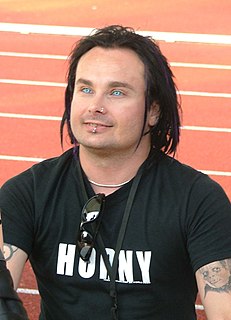
Dani Filth is the lyricist, vocalist and founding member of the metal band Cradle of Filth.
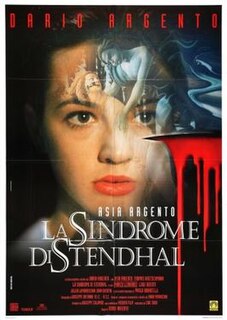
The Stendhal Syndrome(Ital. La Sindrome di Stendhal) is a 1996 Italian horror film written and directed by Dario Argento and starring his daughter Asia Argento. It was the first Italian film to use computer-generated imagery (CGI).
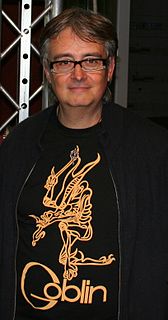
Goblin is an Italian progressive rock band known for their soundtrack work. They frequently collaborate with Dario Argento, most notably creating soundtracks for Profondo Rosso in 1975 and Suspiria in 1977. CD re-releases of their soundtracks have performed well, especially in Germany and Japan. Goblin returned with a series of live concerts in Europe in 2009 and in North America in 2013.
Claudio Simonetti is a Brazilian-born Italian musician and film composer. The keyboardist of the progressive rock band Goblin, Simonetti has specialized in the scores for Italian and American horror films since the 1970s.
Phenomena is a 1985 Italian horror giallo film directed by Dario Argento and starring Jennifer Connelly, Daria Nicolodi, and Donald Pleasence. Its plot focuses on a girl at a remote Swiss boarding school who discovers she has psychic powers that allow her to communicate with insects and uses them to pursue a serial killer who is butchering young women at and around the school.
Inferno is a 1980 Italian supernatural horror film, written and directed by Dario Argento. The film stars Irene Miracle, Leigh McCloskey, Eleonora Giorgi, Daria Nicolodi and Alida Valli. The cinematography was by Romano Albani and Keith Emerson composed the film's musical score. The story concerns a young man's investigation into the disappearance of his sister, who had been living in a New York City apartment building that also served as a home for a powerful, centuries-old witch.
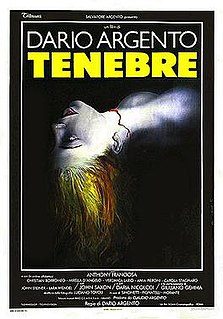
Tenebrae is a 1982 Italian giallo film written and directed by Dario Argento. The film stars Anthony Franciosa as American author Peter Neal, who – while in Rome promoting his latest murder-mystery novel – becomes embroiled in the search for a serial killer who may have been inspired to kill by his novel. John Saxon and Daria Nicolodi co-star as Neal's agent and assistant, while Giuliano Gemma and Carola Stagnaro appear as detectives investigating the murders. John Steiner, Veronica Lario and Mirella D'Angelo also feature in minor roles. The film has been described as exploring themes of dualism and sexual aberration, and has strong metafictional elements; some commentators consider Tenebrae to be a direct reaction by Argento to criticism of his previous work, most especially his depictions of murders of beautiful women.
Dracula 3D is a 2012 vampire horror film co-written and directed by Dario Argento and starring Thomas Kretschmann, Rutger Hauer, Marta Gastini, and Unax Ugalde. An Italian-Spanish-French co-production, the film is Argento's first 3D film. Kretschmann took the role of Dracula; he later played Abraham van Helsing in the Budapest-shot television series Dracula.
Deep Red is a 1975 Italian giallo film, directed by Dario Argento and co-written by Argento and Bernardino Zapponi. It was released on 7 March 1975. It was produced by Claudio and Salvatore Argento, and the film's score was composed and performed by Goblin. It stars Macha Meril as a medium and David Hemmings as a pianist who investigates a series of murders performed by a mysterious figure wearing black leather gloves.
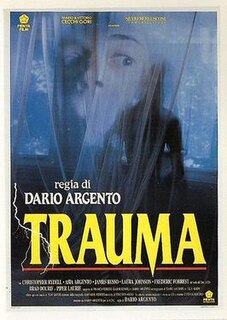
Trauma is a 1993 giallo horror film directed by Dario Argento and starring Asia Argento, Christopher Rydell, Piper Laurie, and Frederic Forrest.
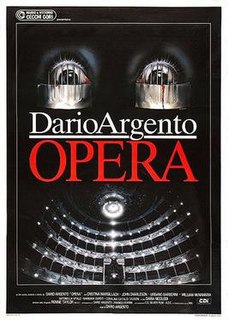
Opera is a 1987 Italian giallo film co-written and directed by Dario Argento, with music composed and performed by Brian Eno, Claudio Simonetti, and Bill Wyman. Starring Cristina Marsillach, Urbano Barberini, and Ian Charleson, the plot focuses on a young soprano (Marsillach) involved in a series of murders being committed inside an opera house by a masked assailant.
The soundtrack to the film Deep Red was mainly composed and performed by the Italian progressive rock band Goblin. Director Dario Argento had originally contacted jazz pianist and composer Giorgio Gaslini to score the film, but he was unhappy with his output, deeming it "awful". After failing to get Pink Floyd to write music for the film, Argento turned back to Italy and found Goblin. In the final score, only three of Gaslini's original themes were retained; however, in the film's original theatrical release, Gaslini was given full composer credit for the entire score, while Goblin were wrongly credited only as performers [i.e. "Music by Giorgio Gaslini, performed by Goblin"]. This was corrected in subsequent home video releases.
Ania Pieroni is a former Italian actress, known for The House by the Cemetery (1981), Tenebrae (1982) and Inferno (1980).
Giulia Marletta is an Italian-born film producer, television producer, director, and entertainment executive. She has been instrumental in establishing international financing for films in both the US and Europe. The films that she has preferred to produce have been director driven with complex and dark subject matter. During her career as a producer and executive producer, she has worked with directors including Dario Argento, David Lynch, Werner Herzog, and Al Pacino.
Simulakrum Lab is an Italian synthwave/retrowave music project created by composer and sound designer Paolo Prevosto.
1 2 "Dario Argento" (in Italian and English). Profondo Rosso. February 2006. Archived from the original on 6 May 2006. Retrieved 19 June 2007.
1 2 Editorial staff (17 May 2006). "Set pronto per Argento" (in Italian). Cinematografo. Archived from the original on 30 September 2007. Retrieved 19 June 2007.
↑ "Dario Argento" (in Italian and English). Profondo Rosso. 10 March 2006. Archived from the original on 6 May 2006. Retrieved 19 June 2007.
↑ "Dario Argento" (in Italian and English). Profondo Rosso. 11 April 2006. Archived from the original on 8 June 2007. Retrieved 19 June 2007.
This page is based on this Wikipedia article Text is available under the CC BY-SA 4.0 license; additional terms may apply. Images, videos and audio are available under their respective licenses.