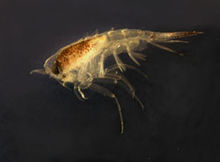
Amphipoda is an order of malacostracan crustaceans with no carapace and generally with laterally compressed bodies. Amphipods range in size from 1 to 340 millimetres and are mostly detritivores or scavengers. There are more than 9,900 amphipod species so far described. They are mostly marine animals, but are found in almost all aquatic environments. Some 1,900 species live in fresh water, and the order also includes terrestrial animals and sandhoppers such as Talitrus saltator.
Phronima is a genus of small, deep sea hyperiid amphipods of the family Phronimidae. It is found throughout the world's oceans, except in polar regions. Phronima species live in the pelagic zone of the deep ocean. Their bodies are semitransparent. Although commonly known as parasites, they are more technically correctly called parasitoids. Instead of constantly feeding on a live host, females attack salps, using their mouths and claws to eat the animal and hollow out its gelatinous shell. Phronima females then enter the barrel and lay their eggs inside, and then propels the barrel through the water as the larvae develop, providing them with fresh food and water.

Gammaridea is one of the suborders of the order Amphipoda, comprising small, shrimp-like crustaceans. Until recently, in a traditional classification, it encompassed about 7,275 (92%) of the 7,900 species of amphipods described by then, in approximately 1,000 genera, divided among around 125 families. That concept of Gammaridea included almost all freshwater amphipods, while most of the members still were marine.
Phliantidae is a family of isopod-like amphipod crustaceans chiefly from the southern hemisphere.
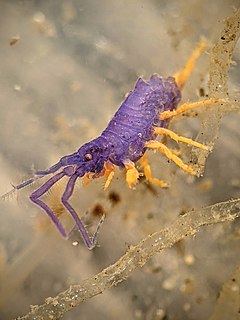
Podoceridae is a family of amphipods. It contains eight genera:

Oedicerotidae is a family of amphipods. It comprises the following genera:

Lysianassidae is a family of marine amphipods, containing the following genera:

Themisto gaudichaudii is an amphipod crustacean of the suborder Hyperiidea.
Chiltonia is a genus of amphipod crustaceans endemic to New Zealand. Four species are known, three of which live in fresh waters. They were first discovered by Charles Chilton in 1898 and the genus Chiltonia was erected the following year by T. R. R. Stebbing in Chilton's honour.

The Hyperiidae are a family of amphipods, containing these genera:

Phronima sedentaria is a species of amphipod crustaceans found in oceans at a depth of up to 1 km (0.6 mi). They are large in size relative to other members of the family Phronimidae. Individuals may be found inside barrel-like homes, created most commonly from the tunics of select species of tunicate, where they rear their young. P. sedentaria is known to employ multiple feeding strategies and other interesting behaviors, including daily vertical migration. The species is also known by the more common names “pram bug” and “barrel shrimp.”

Pontogeneiidae is a family of amphipod crustaceans, containing the following genera:

Nototropis falcatus is a species of amphipod crustacean. It is whitish in colour, with brown patches, and grows to a total length of around 7 mm (0.3 in). It lives on soft sediment such as fine sand at depths of 10 to 50 metres, from northern Norway to the west coast of Ireland, including the North Sea, and as far south as the southern Bay of Biscay.

Stegocephalidae is a little-studied family of amphipods belonging to the suborder Gammaridea.

Caprella mutica, commonly known as the Japanese skeleton shrimp, is a species of skeleton shrimp. They are relatively large caprellids, reaching a maximum length of 50 mm (2.0 in). They are sexually dimorphic, with the males usually being much larger than the females. They are characterized by their "hairy" first and second thoracic segments and the rows of spines on their bodies. Body color ranges from green to red to blue, depending on the environment. They are omnivorous highly adaptable opportunistic feeders. In turn, they provide a valuable food source for fish, crabs, and other larger predators. They are usually found in dense colonies attached to submerged man-made structures, floating seaweed, and other organisms.

Corophiidira is a parvorder of marine amphipod crustaceans in the infraorder Corophiida. In a previous classification, this taxon was treated as an infraorder and was then itself called Corophiida.
Paramoera walkeri is an amphipod of the genus Paramoera. It lives around Antarctica.

Themisto libellula is a marine amphipod of the family Hyperiidae. The species lives for 2 to 3 years, and grows up to 60 millimetres (2.4 in) over its lifetime. They are found in large quantities in Arctic water.

Eurythenes is a genus of marine amphipods in the family Eurytheneidae.