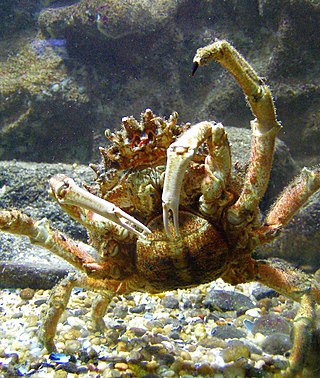
Maja is a genus of majid crabs erected by Jean-Baptiste Lamarck in 1801. It includes the following extant species:

Cancridae is a family of crabs. It comprises six extant genera, and ten exclusively fossil genera, in two subfamilies:

Xanthoidea is a superfamily of crabs, comprising seven families. Formerly, a number of other families were included in Xanthoidea, but many of these have since been removed to other superfamilies. These include Carpilioidea, Eriphioidea, Hexapodoidea, Pilumnoidea and Trapezioidea. Even in this reduced state, Xanthoidea remains one of the most species-rich superfamilies of crabs.
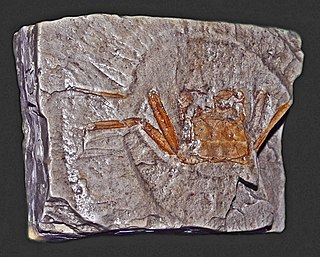
Retroplumidae is a family of heterotrematan crabs, placed in their own (monotypic) superfamily, Retroplumoidea.
Gecarcinucoidea is a superfamily of freshwater crabs. Its members have been grouped into families in various ways, with some authors recognizing families such as "Deckeniidae", "Sundathelphusidae", and "Parathelphusidae", but now only the family Gecarcinucidae is currently recognized.

Cheiragonidae is a small family of crabs, sometimes called helmet crabs, placed in its own superfamily, Cheriagonoidea. It comprises three extant species, Erimacrus isenbeckii, Telmessus acutidens and Telmessus cheiragonus, there are no yet evidences of Cheiragonidae in the fossil record. Many of these crabs were formerly treated as members of the Atelecyclidae.

Actumnus is a genus of crabs in the family Pilumnidae. Alongside the 28 extant species, it has a fossil record extending back into the Miocene.

Matutidae is a family of crabs, sometimes called moon crabs, adapted for swimming or digging. They differ from the swimming crabs of the family Portunidae in that all five pairs of legs are flattened, rather than just the last pair, as in Portunidae. Crabs in the Matutidae are aggressive predators.

Palicoidea is a superfamily of crabs, comprising the two families Crossotonotidae and Palicidae. Together, they contain 13 genera, including two genera in the Palicidae known only from fossils. The two families were previously treated as two subfamilies in a Palicidae of wider circumscription.

Planes is a genus of crabs in the family Grapsidae that currently comprises three extant species: Planes minutus, Planes marinus Rathbun, 1914, and Planes major (=cyaneus). A further fossil species is known from the Middle Miocene of the Caucasus.
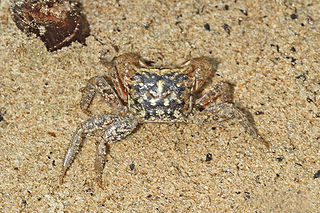
Metopograpsus is a genus of crabs, containing the following extant species:

Panopeus is a genus of crabs, containing these extant species:

Xantho is a genus of crabs in the family Xanthidae, containing five extant species, all restricted to the north-east Atlantic Ocean and Mediterranean Sea, although Xantho granulicarpis is not universally recognised as a separate species from Xantho hydrophilus:
Paraetisus globulus is a species of crab in the family Xanthidae, the only species in the genus Paraetisus. It was described in 1933 by Charles Melbourne Ward.

Polydectus cupulifer is a species of crab in the family Xanthidae, and the only species in the genus Polydectus. Together with the genus Lybia, it forms the subfamily Polydectinae. It is found in the Indo-Pacific, ranging from Madagascar and the Red Sea in the west to Japan, Hawaii and French Polynesia in the east. P. cupulifer is densely covered with setae (bristles), and frequently carries a sea anemone in each chela (claw).

Paraxanthias is a genus of crabs in the family Xanthidae, containing one exclusively fossil species and the following extant species:

Xanthias is a genus of crabs in the family Xanthidae, containing two exclusively fossil species and the following extant species:

Xanthodius is a genus of crabs in the family Xanthidae, containing one exclusively fossil species and the following species:

Zosimus is a genus of crabs in the family Xanthidae, containing the following species:

Symethis is a genus of crabs. It differs from other genera in the family Raninidae by the lack of ornamentation of the male first pleopods and by the reduced number of gills, and is therefore placed in a separate subfamily, Symethinae.


