
Agathis australis, or kauri, is a coniferous tree in the family Araucariaceae, found north of 38°S in the northern regions of New Zealand's North Island.

Cogenhoe is a village and former civil parish, now in the parish of Cogenhoe and Whiston, in the West Northamptonshire district, in the ceremonial county of Northamptonshire, England. The civil parish of Cogenhoe and Whiston had a population at the 2011 census of 1,436.

The giraffe weevil is a species of small weevil endemic to Madagascar. They are black-bodied and have bright red elytra covering their wings. Giraffe weevils are known for their elongated necks, with the males having necks 2 to 3 times the size of their female counterparts. There are several advantages to their elongated necks, including using them for combat, attracting mates, building nests, and acquiring resources. In the field of coleopterology, giraffe weevils are of interest because they exhibit sexual dimorphism. There are other beetle species that share the common name giraffe weevil, like the New Zealand giraffe weevil Lasiorhynchus barbicornis.

The New Zealand giraffe weevil, Lasiorhynchus barbicornis, is a straight-snouted weevil in the subfamily Brentinae, endemic to New Zealand. L. barbicornis is New Zealand's longest beetle, and shows extreme sexual dimorphism: males measure up to 90mm, and females 50mm, although there is an extreme range of body sizes in both sexes. In males, the elongated snout can be nearly as long as the body. Male giraffe weevils use this long rostrum to battle over females, although small males can avoid conflict and 'sneak' in to mate with females, sometimes under the noses of large males. The larval weevils tunnel into wood for at least two years before emerging, and live for only a few weeks as adults.

The Riodinini are one of the large tribes of metalmark butterflies. As numerous Riodinidae genera have not yet been unequivocally assigned to a tribe, the genus list is preliminary.
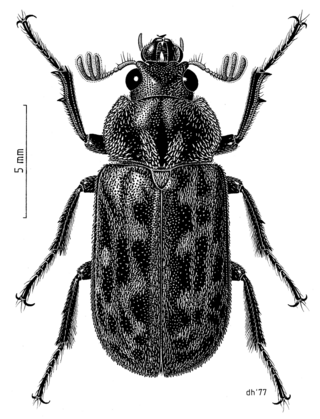
The New Zealand Arthropod Collection is a collection of terrestrial invertebrates held by Maanaki Whenua – Landcare Research in Auckland, New Zealand. It specialises in the taxonomy and identification of indigenous and exotic invertebrate species in New Zealand, and is one of New Zealand's Nationally Significant Collections and Databases.
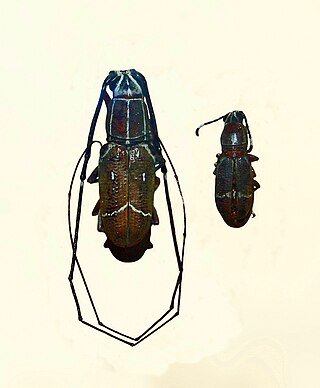
Xenocerus is a genus of beetles from the family Anthribidae, also known as fungus weevils.
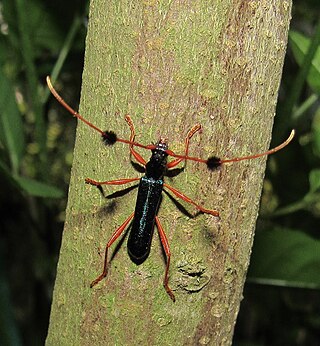
Compsocerus is a genus of typical longhorn beetles in the family Cerambycidae. There are about seven described species in Compsocerus, found in South America.

Batus is a genus of beetles in the family Cerambycidae, containing the following species:
Paromoeocerus is a genus of beetles in the family Cerambycidae, containing the following species:
Batus barbicornis is a species of beetle in the family Cerambycidae. It was described by Carl Linnaeus in 1764.
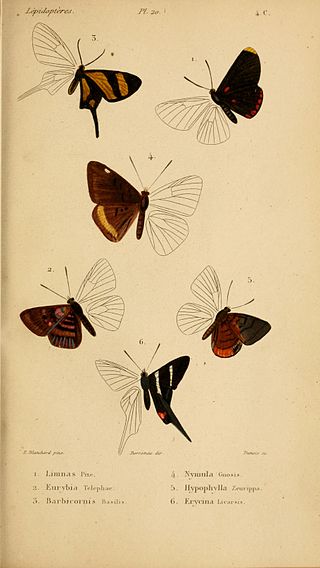
Barbicornis is a monotypic butterfly genus of the family Riodinidae with its single species Barbicornis basilis present in Paraguay, Brazil and Argentina.
Compsocerus barbicornis is a species of Long-Horned Beetle in the beetle family Cerambycidae. It is found in Brazil.
Paromoeocerus barbicornis is a species of beetle in the family Cerambycidae. It was described by Johan Christian Fabricius in 1792.
Mimonicarete barbicornis is a species of beetle in the family Cerambycidae, and the only species in the genus Mimonicarete. It was described by Breuning in 1957.
Bulborhodopis barbicornis is a species of beetle in the family Cerambycidae, and the only species in the genus Bulborhodopis. It was described by Breuning in 1948.
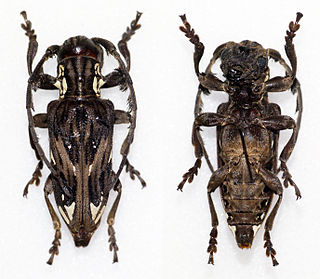
Mallonia is a genus of longhorn beetles of the subfamily Lamiinae, containing the following species:
Mallonia barbicornis is a species of beetle in the family Cerambycidae. It was described by Johan Christian Fabricius in 1798. It is known from Ghana, Benin, the Ivory Coast, and Guinea.

Magdalis is a genus of wedge-shaped bark weevils in the family Curculionidae. There are at least 20 described species in Magdalis.

Ornebius is a genus of crickets in the family Mogoplistidae and the tribe Arachnocephalini, erected by Félix Édouard Guérin-Méneville in 1844. Species may be called "common scaled crickets" and have widespread records of distribution, which are discontinuous ; they include: Africa, Asia, Australia, islands in the Indian and Pacific Oceans, and South America.


