
Zieria granulata, commonly known as the Illawarra zieria, hill zieria or hilly zieria, is a plant in the citrus family Rutaceae and is endemic to the Illawarra region of New South Wales. It is a tall, bushy shrub distinguished by the wart-like tubercles that cover the entire plant, its linear leaflets and small white, four-petalled flowers.

Hakea decurrens, commonly known as bushy needlewood, is a species of shrub or small tree in the family Proteaceae.

Zieria aspalathoides, commonly known as the whorled zieria, heath zieria, hairy zieria or heathy zieria, is a plant in the citrus family Rutaceae and is endemic to eastern Australia. It is a heath-like shrub with leaves that appear to be whorled and with pink flowers in groups of three, each with four petals and four stamens.

Dysoxylum rufum is a rainforest tree in the family Meliaceae, found in eastern Australia. It occurs on a variety of different soils and rainforest types. From as far south as Bulahdelah, New South Wales to the McIlwraith Range in far north eastern Australia. The specific epithet rufum refers to the rusty red of the leaf, fruit and flower hairs of this species.

Hakea laevipes is a shrub in the family Proteaceae. A widespread species found growing on coastal and tableland locations mainly in eastern New South Wales, with scattered populations in south-eastern Queensland.
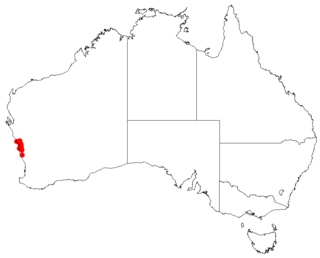
Hakea polyanthema is a shrub in the family Proteacea with small unpleasantly scented flowers in profusion in the leaf axils. It is endemic to Western Australia.
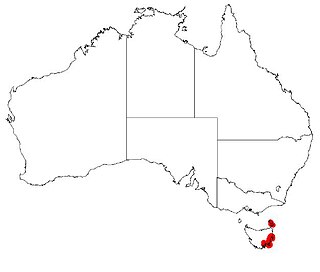
Hakea megadenia is a shrub or tree of the family Proteacea endemic to an area along the east coast of Tasmania and the Furneaux Island group off the coast of Tasmania.
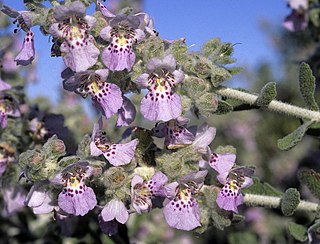
Quoya atriplicina, commonly known as saltbush foxglove, is a flowering plant in the mint family Lamiaceae and is endemic to Western Australia. It is a bushy shrub with its branches and leaves densely covered with a layer of hairs, giving them a greyish appearance. The leaves are broad-elliptic to almost circular in shape and the tube-shaped flowers are pink with purple spots inside.

Petrophile semifurcata is a species of flowering plant in the family Proteaceae and is endemic to an area near the west coast of Western Australia. It is an erect, bushy shrub with sharply-pointed, needle-shaped, sometimes lobed leaves and oval heads of silky-hairy, whitish, lemon-yellow or cream-coloured flowers.
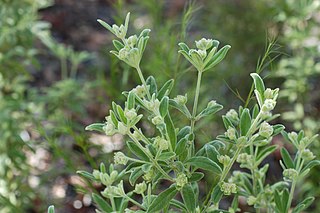
Zieria involucrata is a plant in the citrus family Rutaceae and is endemic to New South Wales. It is a sparse, erect shrub with mostly three-part leaves and groups of up to 21 small white flowers, the groups shorter than the leaves. It mostly occurs in the lower Blue Mountains, but is also known from other areas around Sydney.
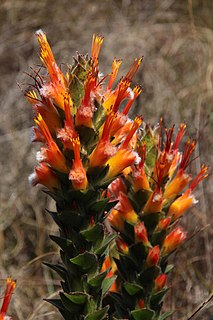
Mimetes capitulatus is an evergreen, upright, rounded shrub of about 2 m (7 ft) high, from the family Proteaceae. It has geyish green, lance- to egg-shaped leaves ending in a thickened tip. The flower heads and subtending leaves form a cylindric inflorescence, topped by ordinary, more or less upright leaves. Each primarily orange flowerhead contains 10–13 flowers with conspicuously scarlet styles, yellow under the narrow hourglass-like pollen presenter at its tip. Flowers can usually be found from mid-June till December, peaking in August. It is called conical pagoda in English and skraalstompie in Afrikaans.
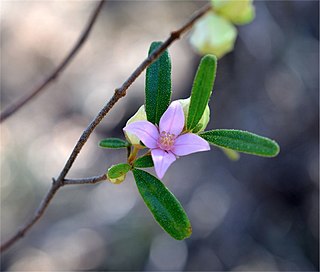
Boronia duiganiae is a plant in the citrus family Rutaceae and is endemic to mountain ranges in south-east Queensland, Australia. It is an erect shrub with many branches, leaves with one, three or five leaflets, and pink to white, four-petalled flowers.

Boronia odorata is a plant in the citrus family Rutaceae and is endemic to the central highlands of Queensland, Australia. It is an erect shrub with many branches, mostly simple leaves and pink to white, four-petalled flowers.
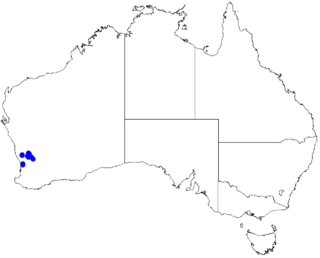
Boronia ericifolia, commonly known as Wongan Hills boronia, is a plant in the citrus family, Rutaceae and is endemic to the south-west of Western Australia. It is an erect, densely branched shrub with trifoliate leaves and pink, white or creamy yellow flowers with four petals and eight stamens only known from near Wongan Hills and Moora.
Olearia adenolasia, commonly known as woolly-glandular daisy-bush, is a species of flowering plant in the family Asteraceae. It is a small upright shrub with sticky leaves and blue-purple or white daisy flowers.
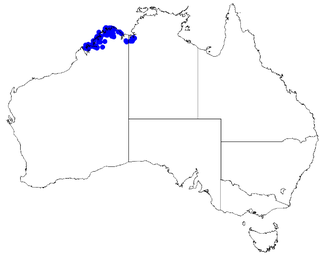
Boronia wilsonii is an erect shrub that is endemic to northern Australia. Its branches, leaves and backs of the flowers are densely covered with woolly hairs. The petals are white to pink or burgundy-coloured.

Scaevola parvifolia is an erect, many stemmed perennial in the family Goodeniaceae, which is native to Western Australia, the Northern Territory, Queensland and South Australia. It grows to a height of 0.6 m, and its blue-purple flowers may be seen from March to October.
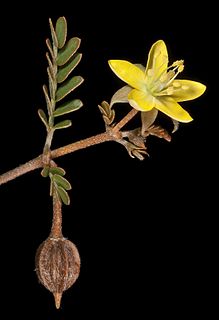
Tribulus macrocarpus is a species of flowering plant in the family Zygophyllaceae, which is found to the central north of Western Australia, and southern inland Northern Territory and northern South Australia.

Harpullia alata, common name -winged tulip or wing-leaved tulip, is a tree in the family Sapindaceae, endemic to eastern Australia, and found from Brisbane, Queensland to Grafton, New South Wales.

Harpullia leichhardtii is a tree in the family Sapindaceae, endemic to the Northern Territory.


