
Crambidae comprises the grass moth family of lepidopterans. They are variable in appearance, with the nominal subfamily Crambinae taking up closely folded postures on grass stems where they are inconspicuous, while other subfamilies include brightly coloured and patterned insects that rest in wing-spread attitudes.

Nematopogon robertella is a moth of the family Adelidae. It is found in Europe.

Mnesictena is a genus of snout moths in the subfamily Spilomelinae, where it is placed in the tribe Udeini. The genus was erected by the English entomologist Edward Meyrick in 1884. The currently known seven species are exclusively found on New Zealand and the associated Antipodes Islands and Chatham Islands.

Udea is a genus of snout moths in the subfamily Spilomelinae of the family Crambidae. The genus was erected by Achille Guenée in 1845. The currently known 216 species are present on all continents except Antarctica. About 41 species are native to Hawaii.
Udeoides is a genus of snout moths of the subfamily Spilomelinae in the family Crambidae. The genus was described by Koen Maes in 2006 and distinguished from the related genus Udea. All six species are distributed in the Afrotropical realm.
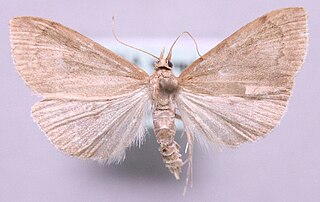
Udea accolalis is a species of moth in the family Crambidae described by Philipp Christoph Zeller in 1867. It is found in France, Switzerland, Italy, Austria, the Czech Republic, Slovakia, Hungary, Poland, Romania, Ukraine, Belarus, the Baltic region, Finland, Sweden and Russia.
Udea austriacalis is a species of moth in the family Crambidae. It is found from Spain, France, Switzerland, Italy, Austria, Romania, Bulgaria, Albania and Greece to Russia and China.
Udea cyanalis is a species of moth in the family Crambidae described by Jean Jacques Charles de La Harpe in 1855. It is found in Portugal, Spain, France, Germany, Switzerland, Austria, Italy, Bosnia and Herzegovina and Romania. It is also found in Russia and Hebei, China.
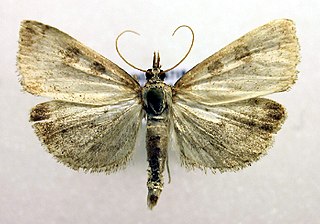
Udea elutalis is a species of moth in the family Crambidae. The species was first described by Michael Denis and Ignaz Schiffermüller in 1775. It is found in Spain, France, Germany, Switzerland, Austria, Italy, Slovakia, the Czech Republic, Poland, Romania, Estonia, Finland, Russia and Kazakhstan. It is also found in China.
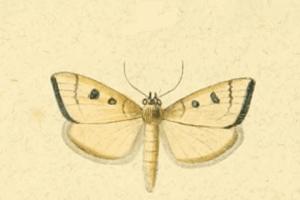
Udea fimbriatralis is a species of moth in the family Crambidae. It is found in Spain, France, Croatia, Bosnia and Herzegovina, Romania, Bulgaria, the Republic of Macedonia, Greece, Turkey and Russia.
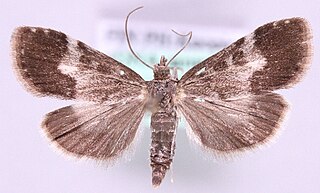
Udea hamalis is a species of moth in the family Crambidae described by Carl Peter Thunberg in 1788. It is found from Fennoscandia south to Switzerland and Ukraine and from France east to Russia.

Udea institalis is a species of moth in the family Crambidae. It is found in Spain, France, Italy, Greece, the Republic of Macedonia, Romania, Slovakia, Ukraine and Russia.

Udea itysalis is a moth in the family Crambidae. It was described by Francis Walker in 1859. It is found in North America, where it has been recorded from British Columbia to Quebec, south to Colorado, California, Nevada and Arizona. It has also been recorded from the Sayan Mountains in Russia.
Udea aenigmatica is a moth in the family Crambidae. It was described by Carl Heinrich in 1931. It is found in North America, where it has been recorded from Colorado.
Udea alaskalis is a moth in the family Crambidae. It was described by Arthur Gibson in 1920. It is a high Arctic species found in North America, where it has been recorded from Alaska. It is also found in Greenland and northern European Russia.
Udea brevipalpis is a moth in the family Crambidae. It was described by Eugene G. Munroe in 1966. It is found in North America, where it has been recorded from California, Colorado and Utah.
Udea indistinctalis is a moth in the family Crambidae. It was described by William Warren in 1892. It is found in North America, where it has been recorded from Alberta, Saskatchewan, Washington and California.
Udea radiosalis is a moth in the family Crambidae. It was described by Heinrich Benno Möschler in 1883. It is found in North America, where it has been recorded from Alberta, Arizona, California, Montana, Nevada, Newfoundland and Labrador and Utah.
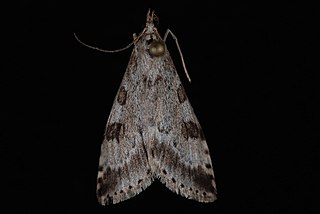
Udea washingtonalis, the Washington udea moth, is a moth in the family Crambidae. It was described by Augustus Radcliffe Grote in 1882. It is found in North America, where it has been recorded from Alaska, British Columbia, California, Montana and Washington.

Udeini is a tribe in the species-rich subfamily Spilomelinae in the pyraloid moth family Crambidae. The tribe was erected by Richard Mally, James E. Hayden, Christoph Neinhuis, Bjarte H. Jordal and Matthias Nuss in 2019.
